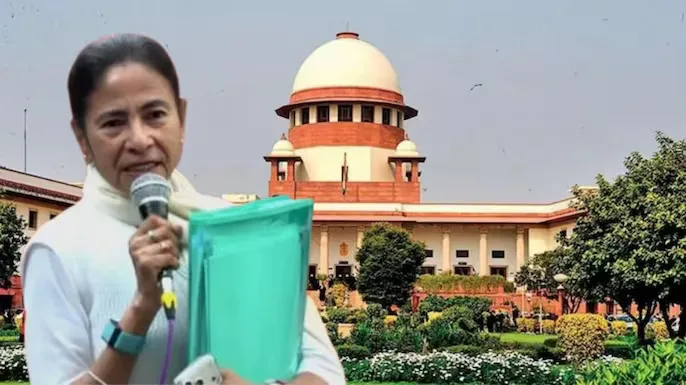
The Supreme Court on January 15 stayed all proceedings arising out of the FIR lodged by the West Bengal Police against officials of the Enforcement Directorate following the agency’s raids at the offices of Indian Political Action Committee (I-PAC) and the residence of its chief in Kolkata. The order came as a major relief for the central probe agency and a clear judicial intervention in an escalating confrontation between the Bengal government and central investigative authorities.
A bench comprising Justice Prashant Kumar Mishra and Justice Vipul Pancholi observed that judicial intervention was necessary to prevent a breakdown of the rule of law. “If we do not interfere, there will be lawlessness,” the bench remarked, indicating serious concern over the manner in which the probe agency’s functioning was allegedly obstructed during the raids.
Apart from staying the FIR, the apex court directed authorities to ensure that all CCTV footage related to the raids is preserved. This direction is seen as crucial, as it could provide objective evidence regarding the events that unfolded during the enforcement action, including the ED’s allegations of obstruction and removal of documents.
The matter has been listed for further hearing on February 3, when the court is expected to take up the broader issues surrounding the conduct of the raids, the counter-allegations by the state government, and the scope of central agencies operating in states ruled by opposition parties.
The controversy stems from ED raids conducted on January 8 at the Salt Lake office of I-PAC and the residence of its chief, Prashant Jain, in Kolkata. The searches were carried out in connection with an ongoing money laundering investigation linked to an alleged coal smuggling syndicate operating in eastern India.
According to the ED, the raids were obstructed by the local police and political functionaries. The agency has claimed that Chief Minister Mamata Banerjee herself entered the premises during the raid and took away “key and incriminating” documents that were part of the investigation.
Soon after the raids, the West Bengal Police registered an FIR against ED officials, accusing them of procedural lapses and misconduct. The move was sharply criticised by the central agency, which termed it an attempt to intimidate investigators and derail a sensitive probe.
Viewing the FIR as an unprecedented step against officers discharging their official duties under central law, the ED approached the Supreme Court seeking protection for its officials and a stay on the state police action.
In its petition before the apex court, the ED alleged repeated obstruction and non-cooperation by the West Bengal administration. The agency argued that given the direct involvement of the state executive, including the Chief Minister, an independent inquiry by the Central Bureau of Investigation (CBI) was necessary to ensure a fair and impartial probe.
The ED contended that allowing the state police to investigate central officers in such circumstances would set a dangerous precedent and severely undermine the autonomy of central investigative agencies.
Senior advocate Abhishek Singhvi, appearing on behalf of the West Bengal government, strongly opposed the ED’s plea for a stay and the demand for a CBI inquiry. Singhvi argued that the FIR was registered in accordance with law and that no agency or official was above legal scrutiny.
The state government has accused the ED of “overreach” and claimed that the raids were politically motivated, particularly as they took place just months ahead of the West Bengal Assembly elections. The Trinamool Congress has consistently denied allegations of obstruction and wrongdoing, asserting that the Chief Minister intervened only to protect constitutional rights and federal principles.
The timing of the raids has added a sharp political edge to the controversy. With Assembly elections on the horizon, the TMC has portrayed the ED action as part of a broader pattern of alleged misuse of central agencies against opposition-ruled states.
Mamata Banerjee, who has led the TMC to three consecutive Assembly victories since 2011, has repeatedly accused the Centre of attempting to destabilise her government through investigative agencies.
Before moving the Supreme Court, the ED had also approached the Calcutta High Court on January 9, seeking a CBI probe into the alleged seizure of documents by the Chief Minister during the raid at Prashant Jain’s residence. The agency claimed that incriminating material was forcibly taken from its custody with the assistance of the state police.
The Calcutta High Court adjourned the hearing on the ED’s plea earlier this week. In a related development, it disposed of a petition filed by the TMC seeking protection of its data, after the ED informed the court that it had not seized any material from I-PAC’s office or Jain’s residence during the raids.
Many view the Supreme Court’s intervention as a critical assertion of judicial oversight in disputes involving federal agencies and state governments. By staying the FIR and ordering preservation of evidence, the apex court has sought to prevent escalation while ensuring that facts can be objectively examined.
The observation on “lawlessness” has also been read as a strong signal that courts will not hesitate to step in if investigative processes are obstructed or politicised.
With the next hearing scheduled for February 3, the Supreme Court is expected to examine the larger constitutional and legal questions raised by the case, ranging from the powers and protection of central investigative agencies to the limits of state police action against central officers.