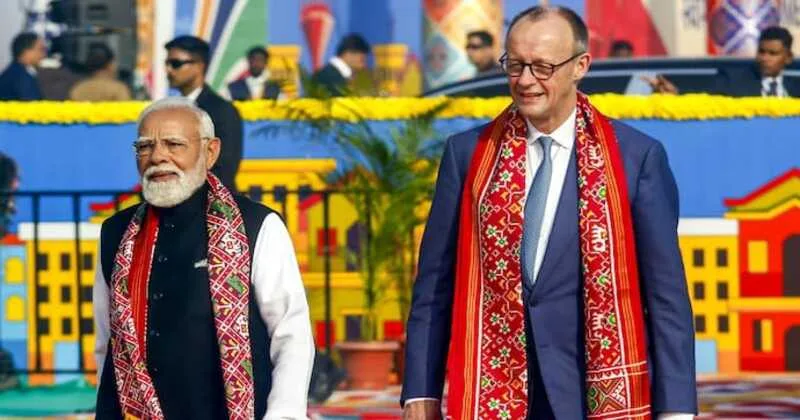
German Chancellor Friedrich Merkel’s visit to India has raised fresh expectations that a long-pending Free Trade Agreement (FTA) between India and the European Union could finally be concluded. The proposed agreement is being seen as a strategic opportunity for India to expand and diversify its trade routes at a time when global commerce is under strain due to the tariff policies of US President Donald Trump.
According to official indications, the agreement is expected to be signed by the end of this month. Merkel said that senior EU leaders would soon travel to India if the remaining terms are finalised. He made these remarks after holding detailed discussions with Prime Minister Narendra Modi during his visit.
The urgency behind India’s push for new trade partnerships has increased after the United States unilaterally imposed a steep 50 per cent tariff on Russian oil, while simultaneously demanding that India end its energy purchases from Russia. In response, the Indian government has accelerated efforts to secure access to alternative markets and reduce vulnerability to unilateral trade actions. India has already concluded trade agreements with the United Kingdom, Oman and New Zealand. Negotiations are also progressing with the Eurasian Economic Union, Mexico and Chile. At the same time, an India–US trade agreement remains under discussion, with talks continuing over sensitive issues such as agricultural and dairy imports.
Amid these developments, negotiations with the European Union have entered their final phase. Under the proposed agreement, the EU is seeking the removal of import duties on products such as automobiles, medical devices, wine and spirits. In exchange, Indian exports, including textiles, leather goods, pharmaceuticals, steel, petroleum products and electrical machinery, would gain duty-free access to all 27 EU member states. At present, the European Union imposes duties ranging from 12 to 16 per cent on Indian textile exports. The removal of these tariffs would significantly enhance the competitiveness of Indian textiles in European markets, allowing them to be sold at lower prices than those from rival exporting countries, including Bangladesh. Bilateral trade between India and the European Union reached an estimated €120 billion (approximately Rs 12.63 lakh crore) in 2024. Of this, Indian exports accounted for around ₹6.8 lakh crore, while imports from the EU stood at about Rs 5.4 lakh crore. Officials believe these figures could rise substantially once a comprehensive trade agreement comes into force.
Merkel’s visit is also notable for diplomatic reasons. India is the first Asian country he has visited since assuming office as Chancellor last year. Traditionally, European leaders have prioritised visits to China, but recent restrictions imposed by Beijing on the export of rare earth and critical metals have altered European calculations. Trade relations between China and several EU countries have deteriorated, and Merkel’s India visit is widely interpreted as signalling a shift in Europe’s strategic and economic focus.
The German Chancellor acknowledged that India cannot easily sever its long-standing ties with Moscow, particularly in the energy and defence sectors.
During the visit, India and Germany signed 19 memoranda of understanding covering areas such as trade, defence cooperation, semiconductors and advanced technologies. One particularly significant agreement relates to travel facilitation. Indian passport holders will now be allowed to transit through German airports without requiring a Schengen airport transit visa.
Until now, travellers flying from India to destinations such as New York via Frankfurt Airport were required to obtain a Type A transit visa, a process that involved a waiting period of around 15 days and a fee of approximately Rs 9,500. The new arrangement will eliminate these delays and costs, while also making Frankfurt, one of Europe’s major aviation hubs, a more convenient gateway for Indian travellers.
Merkel was accompanied by the chief executives of several leading German companies, many of whom met Prime Minister Modi during the visit. Modi stated that several of these firms are expected to make fresh investments in India, further strengthening economic ties between the two countries.