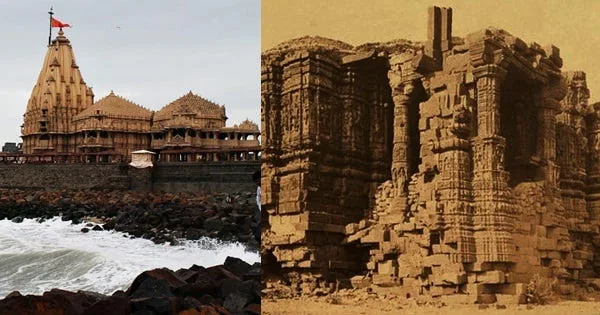
Somnath is often recalled through the narrow lens of invasion and destruction. The narrative usually begins and ends with Mahmud of Ghazni’s eleventh-century raid, reducing the mandir to a symbol of loss and trauma. But such a reading strips Somnath of its deeper historical meaning.
To understand Somnath fully, it must be viewed not in isolation, but as part of a wider coastal ecosystem that included Kutch, Bharuch, Khambhat, Surat, the Konkan shoreline, and later Goa. Together, these formed a chain of ports and cultural nodes that sustained India’s engagement with the oceans. When this chain weakened, India’s maritime dominance declined with it.
Somnath was not merely a place of worship. It was a financial nerve centre, a legal authority, and a gateway through which India interacted with global trade networks long before the modern world spoke of geopolitics.
India Before the Eleventh Century
Centuries before European empires took to the seas, India was already deeply embedded in maritime exchange. Far from being landlocked in outlook, the subcontinent maintained steady and sophisticated engagement with the Indian Ocean world.
Indian traders and sailors moved across the Arabian Sea to West Asia and Africa, and eastward to Southeast Asia and beyond. These journeys were not acts of conquest, but of commerce, culture, and religious exchange. Indian merchants settled abroad, Buddhist and Hindu monks travelled freely, and ideas flowed as smoothly as goods.
This reality is documented in the Periplus of the Erythraean Sea, a first-century Greek text that describes Indian ports and trade routes extending to Oman, Yemen, and the African coast. Such accounts confirm that Indian maritime trade was not marginal or episodic, but organised, regular, and trusted.
Navigation techniques, monsoon wind patterns, astronomy, and shipbuilding knowledge were deeply embedded in Indian coastal societies. The sea was not feared, it was understood.
Temples as Pillars of the Maritime Economy
One of the most overlooked dimensions of India’s maritime past is the economic role played by temples. Between the tenth and twelfth centuries, temples functioned as more than spiritual centres. They were institutions of finance, law, and social organisation.
Temples accumulated wealth through royal patronage and merchant donations. This wealth did not remain dormant. It was actively circulated through loans extended to merchant guilds undertaking overseas voyages. These voyages were risky, threatened by storms, piracy, and long-distance uncertainty. Temple treasuries provided the financial stability required to absorb losses and spread risk.
In return, successful traders contributed a portion of their profits back to the temple, reinforcing a cycle in which religion, economy, and maritime enterprise sustained each other. This system allowed Indian trade to flourish without the need for state-backed colonial empires.
Somnath and the Port of Prabhas Patan
Somnath’s power was closely tied to its geography. Located near the ancient port of Prabhas Patan, the temple stood on a coastline that had been active since Harappan times. Goods from the Roman world, West Asia, and Africa passed through this region, making it one of western India’s most significant maritime hubs.
The route linking Dwarka, Somnath, and Khambhat was not just commercial. It was also a pilgrimage corridor and cultural artery. Merchants, pilgrims, scholars, and sailors moved along this path, weaving economic exchange with civilisational continuity.
Somnath thus operated simultaneously as a religious shrine, a financial institution, and a legal authority that validated contracts and oaths. In practical terms, it anchored India’s western maritime world.
Merchant Guilds and Maritime Organisation
Indian oceanic trade was driven by powerful merchant guilds such as the Manigramam and the Ainnuruvar, known as the Five Hundred Lords. These were not informal associations. They operated with rules, contracts, collective responsibility, and even private security.
Guilds maintained fleets and guards to protect ships from piracy. They negotiated with local rulers and foreign ports, ensuring safety and continuity of trade. Temples like Somnath provided the institutional trust that underpinned these arrangements.
This decentralised yet robust system allowed India to dominate maritime commerce without large standing navies or overseas colonies.
The Ghazni Attack
When Mahmud of Ghazni attacked Somnath in the eleventh century, the impact went far beyond religious destruction. The temple’s wealth, reportedly immense, represented centuries of accumulated economic power tied directly to maritime trade.
The raid struck at the financial backbone of western India’s sea networks. The destruction of the Shivalinga symbolised the dismantling of an institution that supported trade, law, and trust. Notably, no mosque was built on the site, underscoring that the objective was plunder and disruption rather than religious conversion.
As Islamic empires expanded across West Asia, trade became a tool of imperial power. When India’s temple-centred maritime system proved resistant to control, its hubs became targets. Somnath was the first and most symbolic of these.
A Gradual Retreat from the Sea
The fall of Somnath damaged confidence as much as infrastructure. Over time, long sea voyages began to be viewed with suspicion. What later emerged as the social stigma of “kala pani” did not originate as theology, but as a psychological response to repeated maritime disruption.
This retreat was uneven. In the east, Rajendra Chola continued powerful naval campaigns, projecting Indian influence across Southeast Asia. Gujarat’s rulers also retained maritime awareness for centuries. India’s decline from the seas was slow and fragmented, not sudden.
Still, the balance had shifted.
The Ban Stambh at Somnath, an ancient pillar noting that no landmass obstructs the path to the South Pole, stands as evidence of India’s advanced geographical and astronomical understanding, knowledge that survived even as confidence faded.
As new powers rose along the western coast, political priorities changed. The Delhi Sultanate and later the Mughal Empire focused overwhelmingly on land-based control. Agriculture, forts, and cavalry defined power. The sea became peripheral.
Even at the height of Mughal authority, foreign sailors were relied upon to escort pilgrim ships to Mecca. Naval power was outsourced. India’s oceans slowly emptied of indigenous fleets.
When Vasco da Gama arrived in 1498, the Indian Ocean was no longer guarded by Indian maritime networks. European powers filled the vacuum, turning trade routes into instruments of domination.
Rebuilding Somnath, Reclaiming Memory
The reconstruction of Somnath in 1951 was not just an architectural act. It was an attempt to reconnect with a lost civilisational memory. Sardar Vallabhbhai Patel saw it as the restoration of national confidence, while others worried about its symbolism.
Yet rebuilding Somnath reaffirmed that history could not be erased entirely. The physical revival echoed a deeper truth, that India’s relationship with the sea had been interrupted, not destroyed.
India’s contemporary engagement with the Indo-Pacific is not a sudden strategic pivot. It is a return to a familiar space. Ancient trade routes, cultural ties, and maritime habits are being rediscovered and reinterpreted.
India’s naval modernisation, partnerships, and participation in frameworks like the QUAD reflect this continuity. When India speaks of a free, open, and inclusive Indo-Pacific, it echoes an ancient worldview in which the ocean was governed by trust, balance, and shared prosperity.
The recent recreation of ancient voyages, including traditional shipbuilding methods and routes from Gujarat to Oman, demonstrates that India’s maritime past was not myth, but lived reality.
Somnath marks the moment when India began to turn away from the sea. Its destruction weakened not just a temple, but an entire maritime ecosystem.
Today, as India reasserts its presence in the Indo-Pacific, it is completing a historical arc left unfinished for nearly a thousand years. What is being revived is not merely naval capability, but a civilisational instinct.