Long before the debate over secularism, civilisational identity and cultural restoration became central to India’s political discourse, one man stood firmly convinced that rebuilding the Somnath Temple was not merely about reconstructing stones, it was about restoring national confidence after centuries of invasions and humiliation.
That man was Kanhaiyalal Maneklal Munshi, better known as K.M. Munshi.
Today remembered as a prolific writer, lawyer, freedom fighter and founder of the Bharatiya Vidya Bhavan, Munshi played perhaps his most defining public role in leading the reconstruction of the Somnath Temple at Prabhas Patan in Gujarat after Independence.
His efforts eventually brought him into direct disagreement with Prime Minister Jawaharlal Nehru, who repeatedly expressed discomfort with the Indian state being associated with the rebuilding and consecration of the temple.
The debate, revived this week by Prime Minister Narendra Modi during the Somnath Amrut Mahotsav celebrations, once again opened a window into one of independent India’s earliest ideological confrontations, between secularism and civilisational restoration.
PM Modi recalls Nehru’s opposition
Addressing the gathering in Gujarat commemorating 75 years since the restored Somnath Temple’s inauguration, PM Modi said leaders associated with rebuilding the temple had faced opposition from Nehru.
“Sardar Vallabhbhai Patel and India’s first President Dr Rajendra Prasad made immense efforts to rebuild the Somnath temple, but they faced opposition from then Prime Minister Jawaharlal Nehru. No power in the world can make India bow down or force it to yield to pressure,” PM Modi said.
The remarks drew renewed attention to a series of letters written by Nehru between 1950 and 1951 to senior political leaders and officials including K.M. Munshi, Dr Rajendra Prasad, Jam Saheb of Nawanagar, Mridula Sarabhai, RR Diwakar and diplomat K.M. Panikkar.
In those letters, Nehru consistently argued that the Government of India should not associate itself with the reconstruction or inauguration of a religious structure.
🛕Do you know K.M. Munshi went against Jawaharlal Nehru for the reconstruction of Somnath Temple? Nehru wrote “I don’t like your trying to restore Somnath. It is Hindu revivalism”, Munshi replied “It is my faith in our past which has given me the strength to work in the present… pic.twitter.com/aJ9pihMAWL
— Rima Sarkar (@_RimaSarkar) May 11, 2026
“It is Hindu revivalism”: Nehru’s discomfort with Somnath
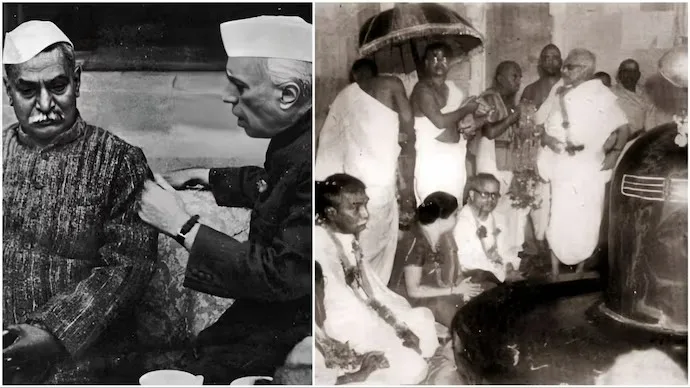
One of the earliest and most discussed exchanges occurred between Nehru and K.M. Munshi.
Nehru wrote to Munshi on July 20, 1950, “I have been feeling a little uncomfortable at your references to the rebuilding of the Somnath temple. As a Government, we cannot undertake the building of any religious edifices.”
He further added, “If once we begin doing so, we might be asked to favour a variety of religions. Also in the present economic condition of the country… any project for a large scale building of a temple seems rather out of place.”
According to accounts later documented by Munshi, Nehru also described the restoration effort as “Hindu revivalism,” a phrase that deeply reflected the ideological divide between the two leaders.
But Munshi was unmoved.
In a powerful response later published in his memoir Pilgrimage to Freedom, Munshi defended the reconstruction not as sectarian politics, but as a civilisational necessity.
“It is my faith in our past which has given me the strength to work in the present and look forward to our future.”
He wrote further, “I cannot value freedom if it deprives us of the Bhagavad Gita or uproots our millions from the faith with which they look upon our temples and thereby destroys the texture of our lives.”
Perhaps the most memorable line from his response captured the emotional and cultural significance he attached to Somnath, “I have been given the privilege of seeing my incessant dream of Somnath reconstruction come true.”
For Munshi, Somnath represented not merely a temple, but the endurance of a civilisation that had survived repeated invasions and destruction.
The temple that became a national symbol
The Somnath Temple occupies a deeply symbolic place in Indian history.
Located at Prabhas Patan in Gujarat, it is traditionally regarded as the first among the twelve Jyotirlingas of Lord Shiva. Over centuries, the temple became a target for repeated invasions and destruction, most famously by Mahmud of Ghazni in 1026 CE.
Its repeated desecration gradually transformed Somnath into a symbol of both civilisational trauma and resilience.
Even before Independence, Munshi had immersed himself in documenting the temple’s history. In 1940, he authored Jay Somnath in Gujarati, followed later by the landmark English work Somnath: The Shrine Eternal in 1952.
These works chronicled the temple’s ancient glory, invasions, destruction and eventual rebirth in independent India.
Sardar Patel’s promise and Munshi’s mission
The modern reconstruction movement began soon after Independence.
Following the integration of Junagadh into India in 1947, Sardar Vallabhbhai Patel visited Somnath on November 12, 1947 and publicly declared that rebuilding the temple would be a sacred duty.
Munshi, along with N.V. Gadgil and other leaders, became deeply involved in the project from its earliest stages.
After Patel’s death on December 15, 1950, the responsibility effectively fell upon Munshi, who was then serving as Union Minister for Food and Agriculture and chairman of the Somnath Temple Trust.
He supervised the clearing of ruins, architectural planning and construction work. The temple was rebuilt in the traditional Maru-Gurjara style by Sompura craftsmen and funded entirely through public contributions.
That aspect became particularly significant because it countered allegations that state funds were being used for religious purposes.
Rajendra Prasad’s decision despite opposition
One of Nehru’s biggest concerns emerged when India’s first President, Rajendra Prasad, agreed to attend the consecration ceremony.
Nehru feared the President’s participation would create the impression that the Indian state officially endorsed the religious event.
In a March 11, 1951 letter to C. Rajagopalachari, Nehru wrote, “I would have preferred if he had not associate himself in this way.”
But Rajendra Prasad chose to attend in his personal capacity and kept his commitment despite sustained objections.
On May 11, 1951, he performed the prana-pratishtha ceremony of the restored temple, marking the formal rebirth of Somnath.
For many supporters of the reconstruction movement, the moment symbolised the reclaiming of India’s civilisational confidence after centuries of historical upheaval.
Nehru’s fear: The international optics
Nehru’s objections were not limited to domestic politics alone.
A major controversy erupted when reports surfaced that Indian embassies abroad had been asked to collect water from rivers such as the Yangtze, Hoang Ho and Pearl River, along with soil and twigs from foreign regions, for rituals linked to the consecration ceremony.
Writing to diplomat K. M. Panikkar on April 17, 1951, Nehru described the entire development as “fantastic” and “embarrassing.”
In another strongly worded letter to the Jam Saheb dated April 22, 1951, Nehru warned that Pakistan was using the Somnath issue internationally to argue that India was abandoning secularism.
“Pakistan of course is taking great advantage of this to try to prove that we are not a secular State.”
He repeatedly clarified that the Government of India had “nothing to do with this matter” and questioned reports suggesting that the Saurashtra government might spend Rs 5 lakh on the installation ceremony.
Yet despite his reservations, the consecration proceeded.
Munshi’s legacy beyond politics
K.M. Munshi’s legacy today extends far beyond the Somnath Temple.
Born on December 30, 1887, Munshi was among the rare generation of leaders who combined intellectual depth, literary achievement, constitutional expertise and political activism.
Apart from his role in the freedom movement and Constitution-making process, he established the Bharatiya Vidya Bhavan in 1938 to preserve and promote Indian culture and education.
But for many, Somnath remains the defining symbol of his life’s work.
His writings and correspondence reveal a man convinced that political freedom without cultural continuity would leave India spiritually weakened.
Munshi’s determination represented a larger idea: that independent India could modernise without severing itself from its civilisational roots.
Debate that continues decades later
More than seven decades after the consecration of the restored Somnath Temple, the debate between Nehru’s interpretation of secularism and Munshi’s idea of cultural nationalism continues to shape Indian public discourse.
Irrespective of ideological positions, the reconstruction of Somnath remains one of the most consequential symbolic acts of post-Independence India, an event that transformed a ruined shrine into a national civilisational landmark.
And at the centre of that story stood K.M. Munshi, the man who refused to let Somnath remain only a memory of destruction.