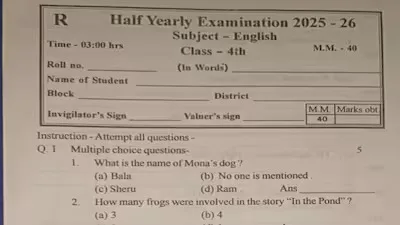
What began as a routine Class 4 English examination in government schools across Chhattisgarh has escalated into a major administrative and political issue, drawing sharp reactions from religious organisations, education officials, and district authorities. The controversy centres on a multiple-choice question in which “Ram” appeared as one of the options for a pet dog’s name.
The examination was conducted on January 6, and the question paper was distributed across several districts, including Balodabazar, Bhatapara, Mahasamund, Dhamtari, and Gariaband. Soon after the exam, images of the paper surfaced on social media and spread rapidly, triggering public outrage.
Hindu organisations objected strongly to the inclusion of “Ram” in the context of a dog’s name, stating that it hurt religious sentiments and amounted to disrespect towards a revered Hindu deity. As criticism mounted, the education department was forced to step in and order a formal inquiry into the matter.
According to officials, the controversial question was part of a simple vocabulary or comprehension exercise meant for primary school students. However, the choice of words in the multiple-choice options became the focal point of the dispute.
The paper was prepared under the Samagra Shiksha scheme, a centrally sponsored programme aimed at improving school education. Responsibility for coordinating the preparation of the paper lay with Sampada Bose, Assistant Project Coordinator, who had assigned the task to an expert committee comprising five teachers.
As per the findings of the inquiry, the option containing the word “Ram” was present in the final version of the question paper that was printed and distributed to schools.
Once the exam concluded, photographs of the question paper circulated widely on social media platforms, prompting sharp reactions from various Hindu groups. Protesters alleged that such content reflected insensitivity and demanded strict action against those responsible.
Facing growing pressure, the education department initiated an internal probe to determine how the contentious option had made its way into the examination paper and whether the lapse was deliberate or accidental.
A five-member inquiry committee was constituted by the Raipur District Education Officer (DEO) to examine records related to the preparation, moderation, printing, and distribution of the paper. The committee reviewed documents, interviewed officials, and sought written explanations from those involved.
The inquiry confirmed that the disputed option appeared in the version of the paper that was ultimately printed and handed out to students. It identified Shikha Soni, head teacher at Government Primary School, Nakti (Khapri) in Tilda, as the paper-setter, and Namrata Verma, a contractual assistant teacher at SEGES Higher Secondary School, Fafadih, Raipur, as the moderator.
Both teachers submitted written apologies and explanations to the department.
In her statement, Shikha Soni claimed that the inclusion of “Ram” was not intentional. She explained that she had originally intended to type the name “Ramu” as a common pet name but accidentally omitted the letter “U” while typing, resulting in “Ram” being printed.
She described the mistake as purely inadvertent and expressed regret for the oversight.
Moderator Namrata Verma, in her explanation, stated that she had retained the answer options as received from the paper-setter and failed to notice the error during the moderation process. She acknowledged her lapse and apologised for the mistake.
Following the preliminary findings, the education department suspended Shikha Soni, the head teacher who prepared the question paper. Officials said the suspension was necessary to ensure accountability and to send a clear message about adherence to sensitivity and diligence in academic work.
Action has also been initiated against moderator Namrata Verma. Officials indicated that disciplinary proceedings are underway and that she could face dismissal from service, given her contractual status.
The department stressed that examination material for young students must be prepared with utmost care and cultural sensitivity, particularly in a diverse and religiously sensitive society.
The controversy further widened into an administrative dispute over how the final version of the paper was printed and circulated. Sampada Bose, the Assistant Project Coordinator, stated that the PDFs she had shared were not meant for printing at that stage, raising questions about procedural lapses in the finalisation process.
Mahasamund District Education Officer Vijay Lahre claimed that the issue was detected during the half-yearly examination in his district and that immediate corrective steps were taken. According to him, the controversial option was removed, and alternative question papers were provided to students.
Lahre also suggested that the printed paper may have come from a different set due to a printing error.
Despite these explanations, the Directorate of Public Instruction (DPI), Raipur, has issued a show-cause notice to DEO Vijay Lahre, seeking clarification on why the lapse was not prevented at the district level and how the disputed paper was allowed to circulate.
The DPI has sought a detailed response on the monitoring mechanisms in place during the examination process and whether established protocols were followed.
Officials acknowledged that while the mistake may have originated as a clerical or typographical error, its impact was magnified due to religious sensitivities and the rapid spread of information online. The episode has reignited debate on quality control in government school examinations and the need for stricter oversight at every stage.
Education department sources said new guidelines may be issued to ensure multiple layers of scrutiny before question papers are finalised, printed, and distributed.
As of now, the suspended teacher remains under departmental action, while proceedings against the moderator and other officials are ongoing. The education department has assured that corrective measures are being taken to prevent similar incidents in the future.