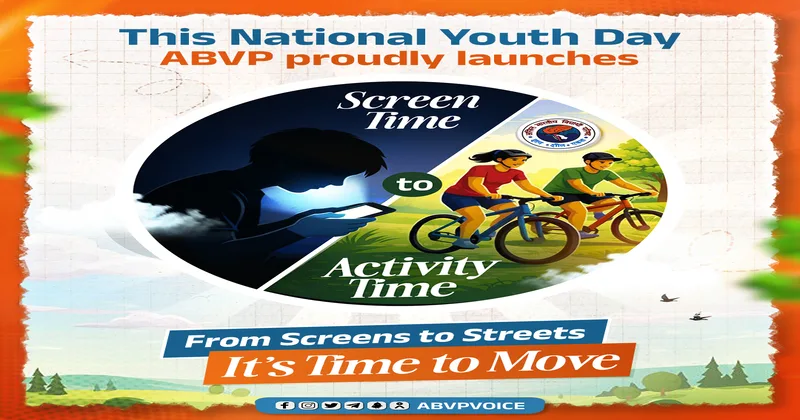
HYDERABAD: On the occasion of the 164th birth anniversary of Swami Vivekananda ji, the eternal source of inspiration for the youth, which is celebrated as ‘National Youth Day’, the Akhil Bharatiya Vidyarthi Parishad (ABVP) organised a series of programmes and activities across major educational campuses and city units throughout the country. Marking National Youth Day, ABVP launched its nationwide campaign, “Screen Time to Activity Time” through a seminar held at Hyderabad Central University. ABVP National General Secretary Dr. Virendra Singh Solanki extended his greetings to students on National Youth Day and called upon them to transform this campaign into a mass movement. This initiative is a meaningful effort to help youth overcome digital addiction and reconnect with nature, sports, and culture. In the upcoming days, ABVP will carry this forward as a transformative nationwide campaign.
ABVP firmly believes that only when young people convert their screen time into activity time can a healthy, alert, and capable nation be built. Today’s youth represent the digital era; however, excessive use of mobile phones and other digital devices is adversely affecting their health, time management, and social lives. Based on suggestions from students across the country, ABVP had earlier raised this issue with student representatives, teachers, and academicians from across India at its 71st National Conference held in Devbhoomi Uttarakhand. Continuing this effort, on the occasion of National Youth Day, the formal launch of the campaign was marked through the release of the campaign poster by ABVP’s National General Secretary at the seminar held at Hyderabad Central University. On this occasion, the elected President of the Hyderabad Central University Students’ Union, Siva Palepu, along with all other Students’ Union office-bearers, were also present.
Through this campaign, ABVP seeks to convey to the youth that progress should not be limited to technology alone but must also be humane and creative. Under this initiative, youth will be encouraged to adopt a healthy and socially connected lifestyle through calls such as ‘Screen Time to Green Time,’ ‘Screen Time to Fun Time,’ ‘Screen Time to Play Time,’ and ‘Meal Without Reel.’ At present, an average student spends more than 8–9 hours daily on technological devices, which is having a negative impact on their social and intellectual development, with many students slipping into depression at a young age. Through its units nationwide, ABVP will organise programmes and encourage students to reduce their screen time and increase their activity time.
Addressing the seminar at Hyderabad Central University, ABVP National General Secretary Dr. Virendra Singh Solanki extended National Youth Day greetings to the citizens of the nation and, while launching the ‘Screen Time to Activity Time’ campaign, stated, “Today’s youth are the largest consumers of technology in the era of the information revolution. The fact that the average screen time of young people has reached 8 to 9 hours is a matter of serious concern. It is not only restricting their physical energy but also distancing them from society and nature. As a result, even young people are increasingly suffering from various physical and mental ailments. ABVP’s ‘Screen Time to Activity Time’ campaign should not be seen merely as a programme, but as a mass movement for cultural and health awareness. Only when students step out of the virtual world and experience the greenery of playgrounds, the spirit of sports competition, and the satisfaction of social service can their true intellectual, mental, and social development take place. Through various programmes across the nation, ABVP will urge all students to reduce their daily screen time by at least 30 minutes and invest that time in nature and creative activities, so that technology does not become an obstacle to their holistic development. On the 164th birth anniversary of Swami Vivekananda ji, this nationwide campaign is being launched, and we have complete faith that it will reconnect India’s youth with their roots, nature, and society.”