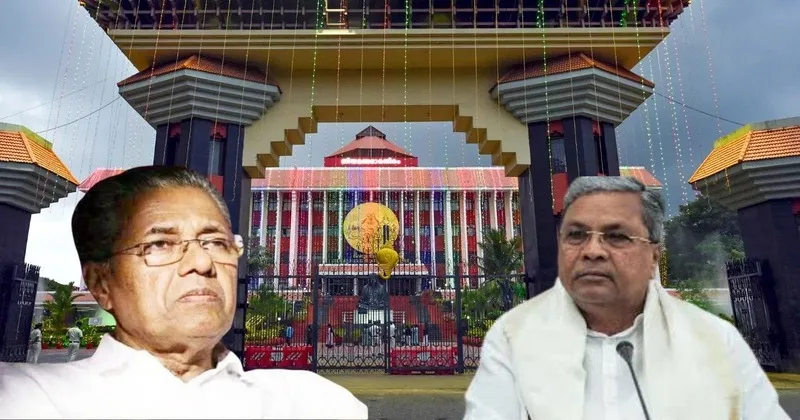
BENGALURU: Karnataka Chief Minister Siddaramaiah strongly opposed the proposed Malayalam Language Bill 2025 being pursued by the Kerala government, warning that its implementation would severely impact Kannada-speaking communities, particularly in the border district of Kasaragod. Urging Kerala Chief Minister Pinarayi Vijayan to immediately withdraw the Bill, Siddaramaiah said any attempt to impose a language on linguistic minorities would amount to an assault on constitutional guarantees of linguistic freedom.
In a detailed post on X, Siddaramaiah said the Kerala government’s proposal to make Malayalam a compulsory first language in Kannada-medium schools was deeply concerning and ran counter to the spirit of India’s Constitution. He asserted that if the Bill were enforced without considering the interests of Kannada-speaking residents of Kasaragod, the Karnataka government would stand firmly with them and extend all possible support to protect their linguistic rights.
ಕೇರಳದ ಕನ್ನಡ ಮಾಧ್ಯಮ ಶಾಲೆಗಳಲ್ಲಿ ಪ್ರಥಮ ಭಾಷೆಯಾಗಿ ಮಲಯಾಳಂ ಕಲಿಕೆಯನ್ನು ಕಡ್ಡಾಯಗೊಳಿಸುವ ಕೇರಳ ಸರ್ಕಾರದ ಪ್ರಸ್ತಾಪಿತ ಮಲೆಯಾಳಿ ಭಾಷಾ ಮಸೂದೆ-2025 ಸಂವಿಧಾನ ಖಾತರಿ ಮಾಡಿರುವ ಭಾಷಾ ಸ್ವಾತಂತ್ರ್ಯದ ಮೇಲಿನ ಪ್ರಹಾರವಾಗಿದೆ ಎಂದು ಹೇಳಲು ವಿಷಾಧಿಸುತ್ತೇನೆ.
ಇಂತಹದ್ದೊಂದು ಕಾನೂನು ಜಾರಿಗೆ ಬಂದರೆ ಕೇರಳದ ಗಡಿಜಿಲ್ಲೆಗಳಲ್ಲಿ ಮುಖ್ಯವಾಗಿ… pic.twitter.com/4LNY2Dk10D
— Siddaramaiah (@siddaramaiah) January 8, 2026
Calling the proposed legislation an attack on constitutional values, Siddaramaiah expressed “deep regret” over what he described as an unexpected move by the Communist-led Kerala government. He said enforcing Malayalam as the compulsory first language in Kannada-medium schools would deprive Kannada-speaking students of their fundamental right to learn in their mother tongue. Such a move, he said, would directly undermine the linguistic freedom guaranteed by the Constitution and marginalise language minorities living in Kerala’s border districts, especially Kasaragod.
“Kasaragod may be administratively part of Kerala today, but emotionally and culturally it remains deeply connected to Karnataka,” Siddaramaiah said. He emphasised that the people of Kasaragod are closely connected to the Kannada language, culture, and literature, and are no less Kannada than those living within Karnataka’s borders. Protecting their interests, he asserted, is a moral and constitutional responsibility of his government.
The Chief Minister underlined that India’s unity is rooted in its diversity and that every citizen has the right to education in their mother tongue. Any attempt to dilute this right, he warned, would weaken the very idea of pluralism that defines the nation. He added that linguistic identity is not merely about communication, but about dignity, self-respect and cultural continuity.
Siddaramaiah urged Pinarayi Vijayan to reconsider and withdraw the Malayalam Language Bill 2025, stating that for linguistic minorities, language is an inseparable part of their identity. He noted that scientific studies have consistently shown that children grasp concepts more effectively when educated in their mother tongue. Imposing a different language at the foundational level, he cautioned, would not only hamper learning but also push an independent language toward gradual decline.
Highlighting the ground realities in Kasaragod, Siddaramaiah noted that generations of residents have been educated in Kannada-medium schools and continue to use Kannada in their daily lives. He cited the collective opinion of Kannada-speaking communities in the district, stating that nearly 70 per cent of students in Kasaragod prefer Kannada as their language of instruction. “No language stands in opposition to another,” he said, adding that India is a cradle of multiple languages, cultures and religions, and any move that disturbs this balance is dangerous.
Referring to constitutional provisions, Siddaramaiah said the protection of minority rights, including linguistic rights, is clearly enshrined in the Constitution. Articles 29 and 30 guarantee citizens the right to preserve their language, script and culture, and to establish and administer educational institutions of their choice. Article 350(A) ensures the right to primary education in one’s mother tongue, while Article 350(B) provides safeguards for linguistic minorities. In this context, he asserted, no government has the authority to curtail the linguistic freedom of minorities.