I was two days short of 18, a first-year Delhi University student, when our professor burst into our class and announced the demolition of the disputed structure (in Ayodhya) on that day of December 6, 1992. And there was total silence. The only Muslim student in our class was part of my group of 6 friends. I remember I couldn’t bear to look at her. I was wondering what she would be feeling – bad, scared, helpless. She lived in Nizamuddin East, a predominantly Muslim, elite neighbourhood, and our professor was concerned about her safety and how she would get home. I remember her sitting up straight and reassuring the professor in a firm, resilient tone, saying that educated people lived in her area and that there was nothing to worry about. And that she would reach home safe.
Then the professor asked the inevitable question to the whole class; do you people feel what happened was right. I remember most of us saying no, except one girl who said it was totally justified because the mosque had been built there after breaking Ramji’s temple. While some mumbled a muted yeah, most of us just glared at her and looked away again, thinking of the feelings of our Muslim friend sitting next to us.
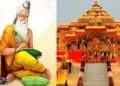
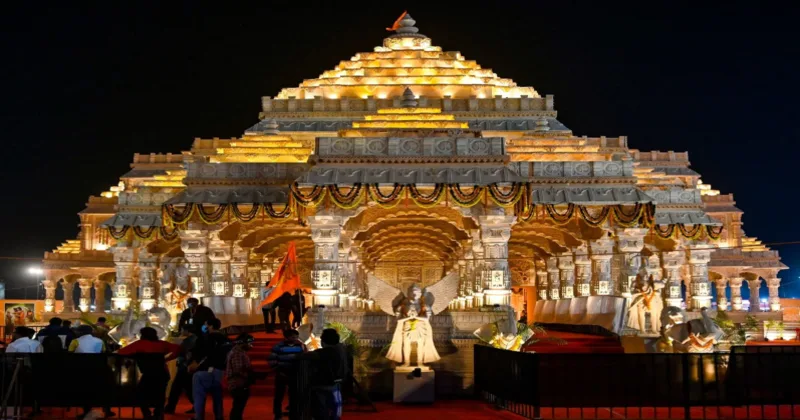
Cut to the Pran Prarthistha of the Ram Mandir in January 2024 and the Dhwajarohan on 25-11-25, so much has changed. I remember breaking down in tears when I saw the Pran Prathistha on TV. The flag flying above the temple signified a moment of quiet healing for a wound that had been searing for almost 500 years. As I watched our Prime Minister’s hands shake as he offered a silent prayer after hoisting the flag atop the temple’s Shikhara, I was reminded of that December morning of 1992.
How things have changed in my life. From an atheist, then an agnostic, almost someone embarrassed for being Hindu, to a confident, proud Hindu woman today. How did this transition happen?
At 18, on that fateful day in December, I was totally unaware of my own history. My thoughts churned from what I read or watched in state-controlled media and from what I had read in my school-prescribed NCERT books. My idea of India was essentially an ancient, conservative, superstitious land with weak kings and even weaker moral fibre, and therefore ruled by foreign powers for 1000 years. The religion of the land had too many things ailing it – sati (although abolished), child marriage (also illegal then), and the biggest bane – untouchability a result of the rigid caste system. With so many things stacked against my own religion, no wonder my faith was low. As a child or a young adult, I didn’t feel any kind of pride in being a Hindu!
It’s only thanks to the Internet and my self-driven passion that I started exploring history. Suddenly, all these side characters of my history books, Shivaji Maharaj (referred to as someone adept at Guerrilla Warfare), Maharana Pratap, Ranjit Singh, began emerging as valiant kings who fought for their faith, culture, prestige, land and freedom. I realised Swaraj wasn’t an ask of Gandhiji; Shivaji had spoken of Hindvi Swaraj much earlier. I read and understood the life of the Sikh Gurus who bore the most extreme kind of torture to preserve the Sanatan faith.
As I read more, my lovely image of the Mughal rulers began to crack. I could now see the chopped-up hands of the labourers who built the beautiful monument to love. I could see the pious emperor Aurangzeb, who sustained himself via stitching prayer caps and didn’t take any money from the vaults of the empire, was actually one of the most cruel and insane tyrants whose favourite pastime was breaking temples and converting people on the point of the sword.
As I read about Takshila and Nalanda, I realised these were the Cambridge and Harvard of the ancient world. The fact that the invaders took months to burn every book in Nalanda’s extremely well-stocked library made my jaw drop in wonder at the sheer number it must have housed, especially at a time when everything was handwritten!
The image of the Europeans who had ‘civilised the natives’, given them trains and modern education too, began to fade as I read about Macaulay, the Goa inquisitions, and the artificially created Bengal Famine, in which millions perished.
As I began exploring my religion, I realised that the reason it has existed for over 7000 years, at least, has been because of its inclusivity and because it has never been shy of changing or evolving. I understood that ‘Shashtrath’, debate had been its modus operandi, not dictat or commandments as found in other dominant religions. Sure, over time, as with anything, certain corruptions crept in, but no one’s head was cut off for opposing the system. Hinduism, more aptly, Sanatan Dharm, has always been a work in progress and will remain so.
There have always been naysayers within the fold. In fact, atheism is an accepted practice within Hinduism, as is the concept of “Isht Dev”, a personal god. There is not one single book, or one head of religion or a particular way to practice one’s faith. This sets it apart from all other faiths. In fact, all the above can qualify you as an apostate in the Abrahamic religions!
Yes, there are certain set guidelines that are acceptable by all when they come together in a group, but on your own, this is the only faith where one can actually live by the credo ‘you do you’! And this builds within you respect and pride for a system that existed before the dawn of recorded history.
In a way, this period between 1992 and 2025 has been my journey to understand what my nation and my Hindu faith have endured over the centuries. It amazes me to think how resilient we have been as a people, surviving these surging storms over centuries, yet emerging confident, strong, and proud! And that’s why I wait eagerly to visit the Ram Temple one day, because it is now so intrinsically part of my identity as a Hindu and a resident of this ever-existing and ever-changing ancient land.