Washington: US President Donald Trump has issued a stern warning to Venezuela’s new interim leader, Delcy Rodriguez, saying she could face consequences more severe than those meted out to her predecessor, Nicolas Maduro. In an interview with The Atlantic, Trump said Rodríguez would “pay a heavy price” if she failed to act in line with Washington’s expectations. Maduro, he added, is currently being held in a federal prison in New York on drug trafficking charges, a development Trump cited as evidence of the costs of defying the United States.
Trump has outlined a vision to rebuild Venezuela by leveraging its vast oil reserves. After Maduro’s arrest, celebratory scenes were reported among segments of the Venezuelan diaspora in the United States. Many expatriates attended a banquet at Mar-a-Lago, where they publicly thanked Trump for what they described as a restoration of freedom. The event was also attended by prominent businessman Elon Musk. While critics accuse Trump of intervening in Venezuela primarily to gain access to oil resources, supporters argue that his actions have helped dismantle an authoritarian system and opened a path to recovery.
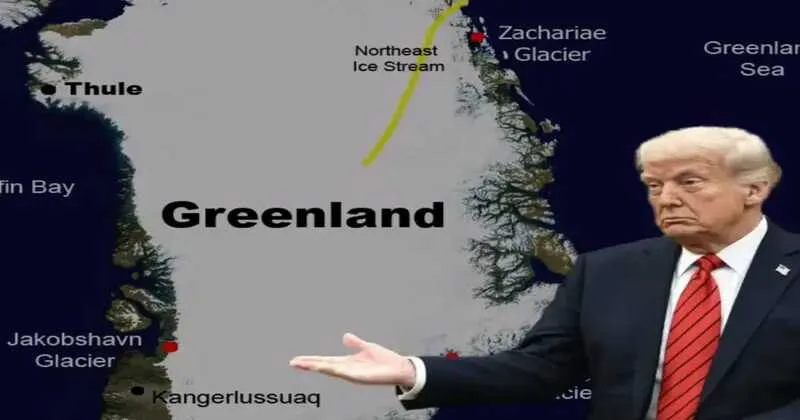
Following the political transition in Venezuela, Trump also turned attention to Greenland, a Danish territory that has long featured in strategic discussions in Washington. He argued that Greenland is vital to US national security, claiming that Russian and Chinese vessels are increasingly active in the surrounding Arctic waters. His remarks sparked controversy after supporters shared social media posts suggesting that Greenland could soon become part of the United States. Denmark swiftly rejected the idea, with Prime Minister Mette Frederiksen stating that Greenland is not for sale and that Trump’s threats and pressure must stop.
Greenland, the world’s largest island, is an autonomous region within the Kingdom of Denmark. Located between the Arctic and Atlantic Oceans and geographically adjacent to North America, about 80 per cent of the island is covered by ice, leaving much of it uninhabited. The population numbers roughly 56,000, predominantly Inuit, and fishing remains the backbone of the local economy.
In recent years, Greenland has attracted global attention for both its strategic military value and its potential mineral wealth. Beneath its ice sheets are believed to be significant deposits of rare minerals, including gold, diamonds and uranium. The territory is also considered crucial for Arctic defence and early-warning systems, making it strategically important to the United States. For these reasons, Washington has repeatedly expressed interest in acquiring Greenland, proposals that have been firmly rejected by both Denmark and Greenland’s own government.
Although geographically part of North America, Greenland is culturally and politically closer to Europe, particularly Denmark and Norway. It has its own parliament and administration, while Copenhagen retains responsibility for foreign policy and defence. Recent US expressions of interest in purchasing the island have once again brought Greenland into the international spotlight, underscoring its growing importance in global geopolitics due to rare minerals, oil and natural gas reserves.