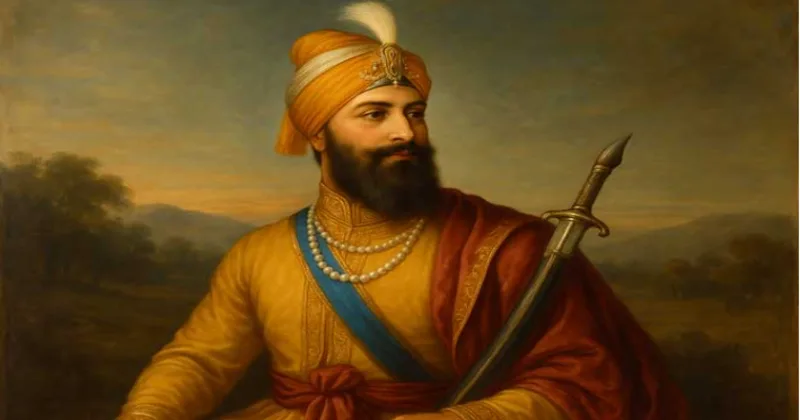
History occasionally produces figures who do not merely respond to their time but reorder the moral grammar of civilisation itself. Guru Gobind Singh was one such figure. He was not only a spiritual leader but also a warrior resisting tyranny. He was his era’s greatest soldier-philosopher—a thinker who carried ethics into action, and a warrior who placed power under the authority of conscience. His enduring relevance lies not in ritual remembrance, but in the moral framework he offered to humanity: Shubh Karman—righteous duty, fearlessly performed.
Guru Gobind Singh, son of Guru Tegh Bahadur, was born on 22 December 1666 at Patna Sahib, in present-day Bihar. At the age of nine, he was compelled to assume profound spiritual and historical responsibility when his father was executed by the Mughal state for defending the freedom of conscience of a persecuted Hindus. He thus became the tenth Guru at an age when most are scarcely aware of the burdens of the world. His greatest and most transformative contribution would later take institutional form in the Khalsa—a disciplined community of equals committed to righteous duty, moral courage, and resistance to injustice.
This early encounter with authority, sacrifice, and moral choice decisively shaped Guru Gobind Singh’s philosophy of righteousness as Duty – shubh Karman.
What Is Shubh Karman?
For Guru Gobind Singh, shubh karman does not mean good intentions, emotional virtue, or successful outcomes. It signifies righteousness as duty that must be performed unfailingly —action that is morally legitimate, undertaken without fear or greed, governed by ethical restraint, and performed even when it entails personal loss or sacrifice.
An action qualifies as Shubh only when it meets four tests: it is rooted in justice and truth; it arises from necessity rather than desire or anger; it respects moral limits even under provocation; and it is embraced without attachment to survival, reward, or recognition. Righteousness, in this sense, is absolute in principle but contextual in expression. Values do not change, but the form of action adapts to circumstance. Silence may be righteous at one moment, resistance at another; persuasion in one era, force in another. What never changes is the moral compass.
This ethic decisively rejects both passivity and fanaticism. Inaction in the face of injustice is abdication of duty ; action driven by rage or revenge is moral corruption. Shubh Karman charts a demanding middle path—where courage is mandatory, but restraint is sacred.
Beyond Karma: A Civilisational Advance
While Indian thought has long emphasised karma as duty, Guru Gobind Singh advances it into the domain of collective moral responsibility. He shifts the focus from the individual soul’s inner struggle to the ethical crisis of society itself. His concern is not merely how a person attains liberation, but how a civilisation preserves dignity when injustice becomes organised and coercive.
In this framework, righteousness is not judged by metaphysical detachment alone, but by fearlessness under pressure. The question is not only whether one acts without attachment, but whether one acts at all when doing right becomes dangerous. This is karma stripped of comfort and demanded as individual and collective duty.
Life as the Practice of Shubh Karman
Guru Gobind Singh did not leave this ethic in abstraction. He lived it under the harshest historical conditions, turning his life into its most persuasive commentary.
From childhood, he lived under the shadow of persecution and broken promises. Leadership did not come to him as an inheritance alone, but as a moral compulsion. He could have chosen withdrawal, compromise, or quiet survival. Instead, he accepted responsibility, fully aware of its cost. This was shubh karman in its first lived form: choosing duty when retreat was possible.
He institutionalised righteous duty through the creation of the Khalsa in 1699. The Khalsa was neither a religious militia nor a priestly hierarchy. It was a moral commonwealth—egalitarian, disciplined, and bound by shubh karman. By dismantling lineage, caste privilege, and dynastic authority, Guru Gobind Singh universalised righteousness as duty.
He considered raising of the sword a shubh karman, a call of righteous duty in the face of tyranny and persecution, after exhaustion of peaceful remedies. Force was introduced not as identity assertion, but as moral duty. Even then, it was governed by restraint—no cruelty, no hatred of the defeated, no sanctification of excess. Power remained subordinate to ethics.
He absorbed unimaginable personal loss without surrendering moral clarity. The martyrdom of his sons and family did not produce indiscriminate vengeance or ethical collapse. Instead, it revealed the depth of his philosophy: suffering does not license injustice; grief does not excuse rage. To abandon one’s values under pain would be the ultimate failure of shubh karman.
He confronted imperial power with truth rather than flattery in the Zafarnama. This was not a threat letter, but a moral indictment—calling out deceit, oath-breaking, and ethical illegitimacy. He did not reject authority; he demanded that authority answer to conscience.
Finally, he rejected personal or dynastic legacy by installing the Guru Granth Sahib as the eternal Guru. In doing so, he ended personality cults and placed ethical text, collective memory, and conscience above individuals. It was the final act of righteous duty: duty over dynasty, principle over power.
Life as the Battlefield of Duty
When Guru Gobind Singh speaks of the battlefield, he is not glorifying perpetual war. He is defining life itself as a field of duty. Most moral battles are not fought with swords. They are fought in institutions, professions, courts, markets, communities, and within the self. The cost today is often reputation, livelihood, or isolation—not always life. The test, however, remains unchanged: whether one stands firm when righteousness demands courage.
In this sense, Guru Gobind Singh universalised ethics. His philosophy applies wherever injustice seeks compliance and wherever fear tempts silence.
From Individual to Planetary Order
The true power of shubh karman lies in its scalability. It is not merely a personal virtue; it is a governing principle.
For the individual, it means integrity over convenience and duty over desire.
For society, it means protecting the vulnerable.
For the state, it means exercising power with restraint, enforcing law without vendetta, and securing order without oppression.
For the market, it means wealth creation without exploitation, profit without deception, and innovation without moral blindness.
A world guided by shubh karman will not be conflict-free, but it will be conflict-with-conscience. Peace arises not from the absence of power, but from the presence of ethics at every level of human action.
A Message to Humanity
Guru Gobind Singh’s message to humanity is austere but liberating: the prime purpose of human life lies in righteous duty. Rights without responsibility decay into entitlement. Faith without courage collapses into ritual.
He reminds us that neutrality in the face of injustice is not tolerance; it is moral failure. And that the highest spirituality is not withdrawal from the world, but disciplined, fearless action within it.
In an age paralysed by greed and terror , Guru Gobind Singh offers a civilisational correction: righteousness is human duty, and it must be performed without fear. That is shubh karman. And that, even today, is humanity’s hardest—and highest—calling.