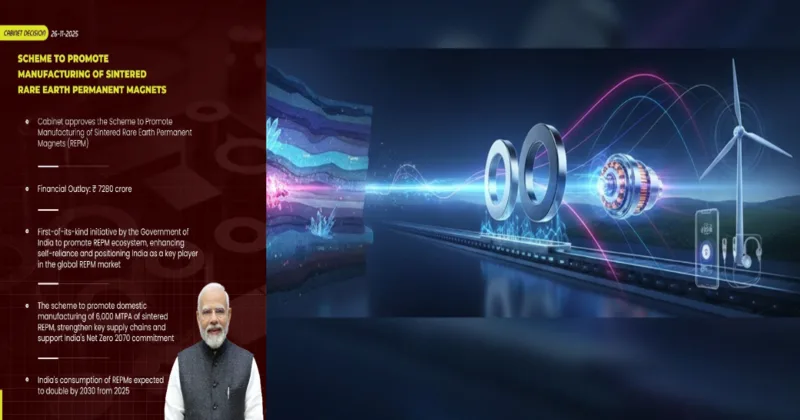
NEW DELHI: The Government of India has approved the Scheme for the Promotion of Manufacture of Rare Earth Permanent Magnets (REPM) with a total expenditure of ₹7,280 crore a major intervention in strategic area of future manufacturing.
The Scheme aims to set up a total of 6,000 MTPA of Integrated REPM production capacity in the country that involves the entire value chain ranging from Rare-Earth Oxides production to the production of the final Permanent Magnets.
This particular project has been conceptualized with the intention of enhancing Indian self-reliance in regard to an essential industrial input necessary for electric vehicles, renewable energy infrastructure, electronics, aerospace or defence sectors as well. With the purpose of reducing imports, improving supply chain resilience and positioning India as a credible participant in the global REPM value chain alongside Aatmanirbhar Bharat, Strategic Independence, Net-Zero 2070 targets or other National Strategic Schemes as an end-to-end manufacturing ecosystem.
What is Rare Earth Permanent Magnets and Their Strategic Importance
Rare Earth Permanent Magnets or REPMs, represent the class of permanent magnets that has the highest strength, as they can provide high magnetic strength and stability in compact sizes. Their properties include high efficiency, compactness and precision, make them vital for applications involving advanced technologies. REPMs find use in:
• Electric car motors
• Wind turbine generators
• Consumer and Industrial Electronics
• Aerospace and defense systems
• Precision sensors and actuators
These performance benefits help to ensure that modern engineering systems are more compact, lightweight more powerful and reliable. The growing importance of a stable source of high-performance magnets to a more domestically-manufactured, clean-energy, mobility, electronics and military industry is becoming even more relevant to a growing Indian economy.
India’s Rare Earth Resource Base: Strength With Integration
The country has a considerable natural inventory of rare earth minerals like monazite, containing a high amount of rare earth oxides (REO). It is gauged that the total monazite ore found in the country is about 13.15 million tonnes, containing 7.23 million tonnes of rare earth oxides. The deposits of rare earth minerals are found in the coastal beach sands, teri/red sands and alluviational inland deposits in various states like Andhra Pradesh, Odisha, Tamil Nadu, Kerala, West Bengal, Jharkhand, Gujarat and Maharashtra.
In addition to its coastal deposits, in situ resources consists of 1.29 million tonnes of REO in hard rock regions of Gujarat and Rajasthan have also been found. Another supporting factor for its resources is that in order to increase its resources, the Geological Survey of India (GSI) has added 482.6 million tonnes of rare earth ore resources to its existing pool through its systematically undertaken exploration efforts. This data reveals a healthy upstream supply of resources for India that can sustain downstream industries related to rare earths such as everlasting magnets.
A historic first for India’s high-tech manufacturing!
The Union Cabinet has approved a scheme to establish India's first integrated ecosystem for manufacturing Sintered Rare Earth Permanent Magnets (REPM), which are essential components in electric vehicles, wind turbines,…
— Narendra Modi (@narendramodi) November 26, 2025
Domestic Demand and Import Phenomenon
Data from official trade statistics reveals that from 2022-23 to 2024-25, China was an important supplier of essential permanent magnets to India. Import reliance on China varied between 59.6 per cent and 81.3 per cent in value and between 84.8 per cent and 90.4 per cent in volume. This highlights the degree to which the country’s production sector has been exposed to probable disruptions due to dependencies on one key supplier.
On the other hand, the forward demand trend indicates that the domestic demand is expected to grow. The demand for REPM in India is expected to double by the year 2030, due to an increase in the use of electric vehicles, a higher capacity of renewable energy, electronics manufactured in the country and the strategic sectors requirements. The expected rise in the demand side of the industry, which necessitates the establishment of an integrated manufacturing facility in the country.
Design and Structure of the REPM Manufacturing Scheme
The approved plan provides a holistic framework for end-to-end REPM production in the Indian context with a greater emphasis on capacity building and competitiveness.
The proposed plan seeks to develop a total of 6,000 MTPA of integrated REPM production capacity based on the overall value chain, starting from oxide feedstock handling to the production of REPM. The capacity allocation would be done by a competitive bidding process on a global basis among a maximum of five beneficiaries with a maximum allocation of 1,200 MTPA of capacity to each beneficiary.
The financial structure of the project covers:
• Rs 6,450 crore allocated as sales linked incentives for production of REPMs to be paid over five years
• Rs. 750 crores are allocated as a capital subsidy for the development of advanced integrated manufacturing facilities
The proposal involves a seven-year implementation period, inclusive of a two year gestation period to establish infrastructure, followed by five years during which disbursement of incentives is directly tied to the number of REPMs sold. These plans are structured to promote stability in the initial stages of production while offering an incentive for continued production and development amid periods where no incentives are received.
Alignment with National Industrial and Sustainability Goals
The proposed development of a REPM manufacturing facility in India fits well with a number of Indian national interests. Rare earth magnets are a vital component of efficient motors and wind power generation and other clean energy technologies, thus being immediately relevant to the Indian energy roadmap and Net Zero 2070 vision.
REPMs are also applied to defense and aerospace sectors, where it is imperative to have guaranteed access to key parts. The development of IC contributes to security and helps to localize, thereby making it less susceptible to disruptions from other countries.
The initiative also aligns with the overall emphasis of the Government on enhancing the value chains of critical minerals, specifically under the National Critical Minerals Mission (NCMM), whose intent is to ensure better availability, processing and use of mineral resources that are required by high technology applications.
The National Critical Minerals Mission and Value Chain Integration
The REPM manufacturing scheme is another measure that fits perfectly within this paradigm. It ensures a high downstream manufacturing capability based on the upstream mineral availability. All these programs have a significant impact on self-reliance, the adoption of clean energy, mobility and a strong defense manufacturing base.
There have been some policy developments that have contributed to this ecosystem. The Mines & Minerals (Development & Regulation) Act, 1957 (MMDR Act), which regulates mineral development, has been amended by the MMDR Amendment Act 2023. The above mentioned policy developments were made to provide a strong foundation to the critical & deep seated mineral ecosystem in India by:
• The inclusion of private participation in the entire process of exploration for minerals
• Empowering the Government to auction mineral concessions
• Establishment of a new exploration license system
Such initiatives promote investment and access to raw materials required for the manufacturing of REPM and boost the effectiveness of implementing the policy.
Global Supply Chains and India’s Strategic Positioning
It has been observed that global supply chains for rare earth materials and permanent magnets have periodically been disrupted and the importance of secure and diversified sourcing has become more pronounced. India has taken steps on both domestic reforms and international partnerships to firm up supply security.
It has signed bilateral agreements with major mineral rich countries like Australia, Argentina, Zambia, Peru, Zimbabwe, Mozambique, Malawi and Cote d’Ivoire. India also engages in trilaterals and multilaterals like the MSP, IPEF and iCET that work for resilient and transparent critical mineral supply chains.
Role of KABIL in Securing Overseas Resources
Khanij Bidesh India Limited or KABIL, which has assured the supplies of strategic minerals from overseas sources. KABIL is a joint venture between National Aluminium Company Limited, Hindustan Copper Limited and Mineral Exploration & Consultancy Limited of the Ministry of Mines.
Its mandate will be to identify, explore, acquire and develop mineral assets abroad that will ensure supplies of critical and strategic minerals such as lithium and cobalt, among others from partnerships in countries such as Argentina. This is important for strengthening the domestic value chain in clean energy, electronic mobility, electronics and defense as well as strengthening the Make in India initiative.
Laying the Foundation for Strategic Manufacturing
This scheme represents a structured effort to build national capability in Rare Earth Permanent Magnets, a strategically critical advanced material. In its focus on supporting integrated production, incentivizing scale and efficiency while aligning reforms in mining and critical minerals policy, the scheme sets out important ways to enhance the competitiveness of India while addressing certain strategic vulnerabilities.
Backed by an outlay of Rs 7,280 crore, a capacity target of 6,000 MTPA and a carefully sequenced implementation framework, the initiative positions well to help drive energy transition goals deeper, increased industrial capacity and contributor value to the wider vision of Aatmanirbhar Bharat and Viksit Bharat @2047.