Beneath the Waves: How India’s S-5 is quietly rewriting nuclear deterrence in the indo-pacific
August 23, 2026
  • Read Ecopy
  • Circulation
  • Advertise
  • Careers
  • About Us
  • Contact Us
Android AppiPhone AppArattai
Organiser
  • ‌
  • Bharat
    • Assam
    • Bihar
    • Chhattisgarh
    • Jharkhand
    • Maharashtra
    • View All States
  • World
    • Asia
    • Europe
    • North America
    • South America
    • Africa
    • Australia
  • Editorial
  • International
  • Opinion
  • RSS @ 100
  • More
    • Op Sindoor
    • Analysis
    • Sports
    • Defence
    • Politics
    • Business
    • Economy
    • Culture
    • Special Report
    • Sci & Tech
    • Entertainment
    • G20
    • Azadi Ka Amrit Mahotsav
    • Vocal4Local
    • Web Stories
    • Education
    • Employment
    • Books
    • Interviews
    • Travel
    • Law
    • Health
    • Obituary
  • Subscribe
    • Subscribe Print Edition
    • Subscribe Ecopy
    • Read Ecopy
  • ‌
  • Bharat
    • Assam
    • Bihar
    • Chhattisgarh
    • Jharkhand
    • Maharashtra
    • View All States
  • World
    • Asia
    • Europe
    • North America
    • South America
    • Africa
    • Australia
  • Editorial
  • International
  • Opinion
  • RSS @ 100
  • More
    • Op Sindoor
    • Analysis
    • Sports
    • Defence
    • Politics
    • Business
    • Economy
    • Culture
    • Special Report
    • Sci & Tech
    • Entertainment
    • G20
    • Azadi Ka Amrit Mahotsav
    • Vocal4Local
    • Web Stories
    • Education
    • Employment
    • Books
    • Interviews
    • Travel
    • Law
    • Health
    • Obituary
  • Subscribe
    • Subscribe Print Edition
    • Subscribe Ecopy
    • Read Ecopy
Organiser
  • Home
  • Bharat
  • World
  • Operation Sindoor
  • Editorial
  • Analysis
  • Opinion
  • Culture
  • Defence
  • International Edition
  • RSS @ 100
  • Magazine
  • Read Ecopy
Home Bharat

Beneath the Waves: How India’s S-5 is quietly rewriting nuclear deterrence in the indo-pacific

In the silent depths of the Indian Ocean, a strategic revolution is taking shape. With the S-5 class SSBN, India is preparing to reshape nuclear deterrence in Asia—quietly, decisively, and for decades to come

WEBDESKWEBDESK
Jan 2, 2026, 06:00 pm IST
inBharat, Defence
Follow on Google News
Representative image

Representative image

Facebook
Twitter
WhatsAppTelegramEmail

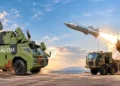
New Delhi: In the closing days of 2025, India’s naval-industrial ecosystem grew louder: construction had quietly begun on the S-5 class nuclear ballistic missile submarine. If accurate, the move marks the most consequential evolution of India’s sea-based deterrent since INS Arihant first went to sea. The S-5 is not an incremental upgrade, it represents a generational shift in scale, reach, and strategic intent, with implications that extend well beyond the Indian Ocean.

🇮🇳 The Titan Rises: India Begins Building its Deadliest Predator, the S-5.

The rumors were true. As of late December 2025, India has quietly commenced the construction of its most ambitious naval project to date—the S-5 Class Nuclear Ballistic Missile Submarine.

This isn't just… pic.twitter.com/cOV2GxQEm6

— The Sacred Scroll (@SacredScroll) January 1, 2026

The most striking feature of the S-5 is its size. While the Arihant class displaces roughly 6,000 tonnes submerged, the S-5 is projected at around 13,500 tonnes, more than double. This leap isn’t about prestige. Displacement translates into endurance, acoustic quieting, crew habitability for longer patrols, and, crucially, payload capacity. In practical terms, it allows India to field a submarine designed for sustained blue-water operations, capable of remaining submerged for months while retaining high readiness.

This scale places the S-5 in the same league as the world’s premier SSBNs, signaling that India’s undersea deterrent is maturing from a regional posture to a globally relevant one.

Also Read: Rajasthan: Tonk police seize 150 kg of ammonium nitrate, 200 explosive cartridges from car; Two men arrested

The heart of the S-5’s deterrent value lies in its missiles. The Arihant and Arighaat were optimized for regional deterrence; the S-5 aims higher. Reports suggest a jump from four launch tubes to as many as 12–16 vertical launch tubes, designed to carry the K-6 submarine-launched ballistic missile.

With a projected range of 6,000 to 8,000 kilometers or more, and MIRV capability, the K-6 transforms India’s second-strike calculus. From patrol areas in the Bay of Bengal, an S-5 could hold at risk targets across Asia and beyond, without ever approaching contested chokepoints. That ability credible retaliation from secure bastions, is the cornerstone of survivable nuclear deterrence.

Powering this leap is a new pressurized water reactor reportedly rated at 190 MW or higher. Earlier Indian SSBNs prioritized stealth but faced limitations in sustained high-speed transit. The S-5’s reactor is expected to close that gap, enabling faster repositioning across the Indian Ocean while maintaining low acoustic signatures.

Speed, in this context, is not about chasing adversaries; it’s about survivability. The ability to relocate unpredictably complicates adversary tracking and enhances the submarine’s chances of evading hunter-killer forces, turning the SSBN into what strategists prize most: a ghost.

Strategically, the timing matters. Beginning construction in the mid-2020s sends a clear signal before the next decade unfolds. It underscores that India’s security horizon is not confined to the Himalayas and that the Indian Ocean will not become anyone’s uncontested backyard.

For New Delhi, the S-5 reinforces the third leg of the nuclear triad at a time of intensifying great-power competition in the Indo-Pacific. Sea-based deterrents are the most survivable, and thus the most stabilizing, component of a nuclear posture. By strengthening this leg, India reduces incentives for escalation during crises on land.

If two hulls are indeed under construction at Visakhapatnam, induction timelines around 2030–2032 appear plausible, with additional boats following in the mid-2030s. That trajectory would enable Continuous At-Sea Deterrence, ensuring at least one SSBN is always on patrol.

The broader shift is conceptual. India’s long-stated doctrine of “minimum credible deterrence” appears to be evolving toward assured retaliation backed by robust survivability. The S-5 does not make conflict more likely; it makes catastrophic miscalculation less so. In rising silently beneath the waves, the S-5 signals that India has entered a new strategic era, one defined not by noise or spectacle, but by quiet confidence and enduring deterrence.

 

Topics: Defense AnalysisIndo-PacificIndian OceanNuclear DeterrenceMilitary TechnologyIndia NavyS-5 Submarine
Share
Tweet
SendShareSend
✮ Subscribe Organiser YouTube Channel. ✮
✮ Join Organiser's WhatsApp channel for Nationalist views beyond the news. ✮
Previous News

US lawmakers vouches bail for Umar Khalid; An attempt to destabilise regime & breach judicial sovereignty in India?

Next News

Indore Water Contamination: ‘Cleanest City’ becomes a death trap as 10 die due to toxic water

Related News

Japanese Defence Minister Shinjiro Koizumi holds bilateral talks with PM Modi and Defence Minister Rajnath Singh

India-Japan ink pact for Indo-Pacific security; Affirms co-production of advanced military tech under Make-in-India

India’s Defence Sector Rise: Self-reliance, indigenous military tech powering strategic edge & national security

INS Nipun inducted into Indian Navy

INS Nipun Commissioned: India’s indigenous submarine rescue capability gets a major boost

DRDO's seven flagship programmes reflect India's expanding indigenous defence ecosystem and its drive towards strategic self-reliance

DRDO lists seven indigenous defence technologies that place India among the world’s advanced military powers

The Indian Ocean remains the enduring foundation of the India-US strategic partnership, according to Italy's ISPI

China Isn’t the Real Driver: Indian Ocean keeps India-US strategic partnership strong, says report

Great Nicobar is emerging as a strategic gateway that strengthens India's maritime reach while increasing pressure on China's Malacca Dilemma

Great Nicobar Project to boost India’s Indo-Pacific leverage, deepen China’s Malacca Dilemma: Report

Load More

Latest News

CGHS wellness centre to remain open

Fact Check: Health Ministry says wellness centres not closing for NEET-PG exam duty, check official update

Beyond the familiar festivities, Onam carries a layered Hindu civilisational memory shaped by Bhagwan Vamana, Mahabali, sacred texts and centuries of tradition.

Onam’s Forgotten Roots: How a Hindu civilisational tradition was recast in modern Keralam’s political narratives

AIAPGET 2026 Disrupted in Jaipur; NTA Issues Notice to Eduquity (This image is generated by AI)

AIAPGET 2026: NTA suspends Eduquity after power failure disrupts exam at Jaipur centre; Show-cause notice served

MEA exposes Telangana CM Revanth Reddy real agenda of Telangana CM Revanth Reddy's visit to US. Stops him from visiting US

MEA exposes Telangana CM Revanth Reddy’s anti-Bharat agenda masked as ‘State Development’

(Left to Right) Congress MP and former Punjab chief minister Charanjit Singh Channi, Late former Congress leader Sajjan Kumar, Deepender Hooda

‘Mind your tongue’: Channi Vs Hooda clash over ‘role model’ praise for 1984 anti-Sikh riots perpetrator Sajjan Kumar

EAM Jaishankar(File Photo)

EAM Jaishankar decodes geopolitical reality with 3Cs; Outlines 4Ds as strategic solutions to fortify national security

Pakistan PM Shehbaz Sharif and Former PM Imran Khan

Pakistan: Contempt plea filed against PM Shehbaz Sharif & 2 ministers for defying Supreme Court order on Imran Khan

PM Modi’s Free Online Coaching Mission: A tool for digital inclusion and social mobility

Karnataka: Textbook crisis deepens as private school students forced to depend on photocopies months into academic year

Assam Cybercrime Shock: Rafiqul Alam, Chinese hacker nexus looted Rs 1,071 cr; Rs 16 crore routed to China via crypto

Load More
  • Privacy
  • Terms
  • Cookie Policy
  • Refund and Cancellation
  • Delivery and Shipping

© Bharat Prakashan (Delhi) Limited.
Tech-enabled by Ananthapuri Technologies

  • Home
  • Search Organiser
  • Bharat
    • Assam
    • Bihar
    • Chhattisgarh
    • Jharkhand
    • Maharashtra
    • View All States
  • World
    • Asia
    • Africa
    • North America
    • South America
    • Europe
    • Australia
  • Editorial
  • Operation Sindoor
  • Opinion
  • Analysis
  • Defence
  • Culture
  • Sports
  • Business
  • RSS @ 100
  • Entertainment
  • More ..
    • Sci & Tech
    • Vocal4Local
    • Special Report
    • Education
    • Employment
    • Books
    • Interviews
    • Travel
    • Health
    • Politics
    • Law
    • Economy
    • Obituary
  • Subscribe Magazine
  • Read Ecopy
  • Advertise
  • Circulation
  • Careers
  • About Us
  • Contact Us
  • Policies & Terms
    • Privacy Policy
    • Cookie Policy
    • Refund and Cancellation
    • Terms of Use

© Bharat Prakashan (Delhi) Limited.
Tech-enabled by Ananthapuri Technologies