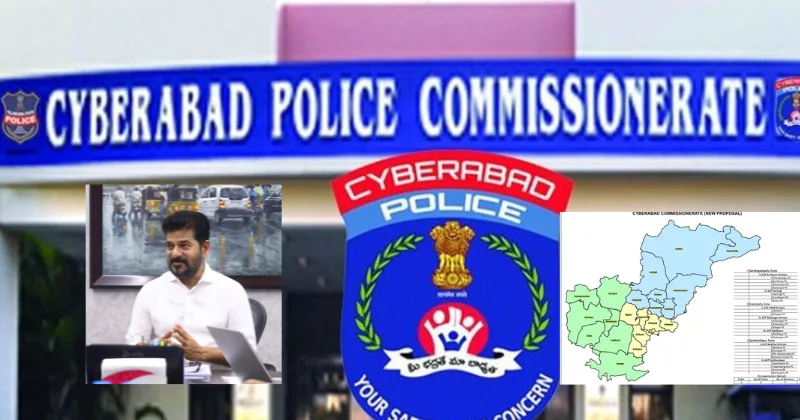
The Telangana government announced a reorganisation of the existing police commissionerate system in Hyderabad and its surrounding regions, creating a fourth commissionerate for what it describes as the upcoming “future city”.
Under the new arrangement, the existing Hyderabad and Cyberabad commissionerates will continue with the same names, while the Rachakonda commissionerate has been renamed as Malkajgiri. The Yadadri Bhuvanagiri district, which earlier fell under Rachakonda, has been removed from the commissionerate’s jurisdiction.
According to the government order dated on December 29, the restructuring is linked to the recent expansion and reorganisation of the Greater Hyderabad Municipal Corporation (GHMC) and long-term urban development plans.
Proposed Cyberabad Police Commissionerate pic.twitter.com/ojkvFYiXKo
— Jacob Ross (@JacobBhoompag) December 30, 2025
Officials said the move aims to improve public services, strengthen law and order, and enhance crime control in rapidly expanding urban and peri-urban areas.
Key administrative and institutional locations — including the Assembly, Secretariat, Begumpet, Shamshabad Airport and the proposed High Court complex at Budvel — will now fall under the Hyderabad Commissionerate.
Reorganisation of Police Commissionerates
Decision to establish four Police Commissionerates
Four Police Commissionerates
The existing three commissionerates have been reorganised, and the following four Police Commissionerates have been established:
•Hyderabad
•Cyberabad…— Jacob Ross (@JacobBhoompag) December 29, 2025
The IT corridors such as Gachibowli, the Financial District, Nanakramguda, Madhapur and Raidurg, along with industrial clusters including Patancheru, Genome Valley, RC Puram and Ameenpur, will continue under the Cyberabad Commissionerate.
The newly renamed Malkajgiri Commissionerate will cover areas such as Keesara, Shamirpet, Quthbullapur and Kompally.
Meanwhile, Yadadri Bhuvanagiri will function as a separate police unit, with a Superintendent of Police to be appointed exclusively for the district.
Citing the “rapid development” of the future city, the government has also created a new commissionerate covering Chevella, Moinabad, Shankarpally, Maheshwaram and Ibrahimpatnam.
Orders were issued appointing police commissioners for the four commissionerates and an SP for Yadadri Bhuvanagiri district. Sudheer Babu, who was serving as Commissioner of Police, Rachakonda, has been transferred as Commissioner of Police, Future City. Cyberabad Commissioner Avinash Mohanty has been posted as Commissioner of Police, Malkajgiri. M. Ramesh, Inspector General of Police (Provisioning and Logistics), has been appointed Commissioner of Police, Cyberabad. V.C. Sajjanar will continue as Commissioner of Police, Hyderabad.
The government stated that the decision aligns with a broader administrative strategy in which the state has been divided into three zones for focused development. As part of this exercise, the GHMC area has been reorganised into 12 zones, 60 circles and 300 wards, prompting corresponding changes in other departments, including the police.
However, the repeated administrative restructuring by the Congress-led government has drawn scepticism. Critics point out that several of these moves appear driven more by political signalling than by a clear assessment of ground realities.
After attempts such as the Musi rejuvenation project and the much-touted future city initiative failed to show tangible outcomes, the reorganisation of GHMC limits followed now by the redrawing of police commissionerates is being seen as another effort to assert long-term political presence in Hyderabad.
For the Congress government and Chief Minister Revanth Reddy, the administrative reshuffles are projected as governance reforms. Yet, on the ground, questions remain over whether these changes will translate into better policing and urban management, or whether they are part of a continuing pattern of symbolic decisions by the Congress government led by CM Revanth Reddy.