Leader of propaganda and his foreign echo chambers: How Rahul Gandhi amplifies anti-India narratives from Germany
June 7, 2026
  • Read Ecopy
  • Circulation
  • Advertise
  • Careers
  • About Us
  • Contact Us
Android AppiPhone AppArattai
Organiser
  • ‌
  • Bharat
    • Assam
    • Bihar
    • Chhattisgarh
    • Jharkhand
    • Maharashtra
    • View All States
  • World
    • Asia
    • Europe
    • North America
    • South America
    • Africa
    • Australia
  • Editorial
  • International
  • Opinion
  • RSS @ 100
  • More
    • Op Sindoor
    • Analysis
    • Sports
    • Defence
    • Politics
    • Business
    • Economy
    • Culture
    • Special Report
    • Sci & Tech
    • Entertainment
    • G20
    • Azadi Ka Amrit Mahotsav
    • Vocal4Local
    • Web Stories
    • Education
    • Employment
    • Books
    • Interviews
    • Travel
    • Law
    • Health
    • Obituary
  • Subscribe
    • Subscribe Print Edition
    • Subscribe Ecopy
    • Read Ecopy
  • ‌
  • Bharat
    • Assam
    • Bihar
    • Chhattisgarh
    • Jharkhand
    • Maharashtra
    • View All States
  • World
    • Asia
    • Europe
    • North America
    • South America
    • Africa
    • Australia
  • Editorial
  • International
  • Opinion
  • RSS @ 100
  • More
    • Op Sindoor
    • Analysis
    • Sports
    • Defence
    • Politics
    • Business
    • Economy
    • Culture
    • Special Report
    • Sci & Tech
    • Entertainment
    • G20
    • Azadi Ka Amrit Mahotsav
    • Vocal4Local
    • Web Stories
    • Education
    • Employment
    • Books
    • Interviews
    • Travel
    • Law
    • Health
    • Obituary
  • Subscribe
    • Subscribe Print Edition
    • Subscribe Ecopy
    • Read Ecopy
Organiser
  • Home
  • Bharat
  • World
  • Operation Sindoor
  • Editorial
  • Analysis
  • Opinion
  • Culture
  • Defence
  • International Edition
  • RSS @ 100
  • Magazine
  • Read Ecopy
Home Politics

Leader of propaganda and his foreign echo chambers: How Rahul Gandhi amplifies anti-India narratives from Germany

Rahul Gandhi’s repeated foreign engagements, especially in Germany, reveal a troubling pattern where India’s internal political narratives are internationalised under the garb of “democracy” and “institutional concern.” From Deutsche Welle to various political foundations, a deeper ideological ecosystem emerges, one in which the Leader of Propaganda appears more comfortable exporting narratives than contesting them at home

Shashank Kumar DwivediShashank Kumar Dwivedi
Dec 31, 2025, 06:30 pm IST
in Politics, Bharat
Follow on Google News
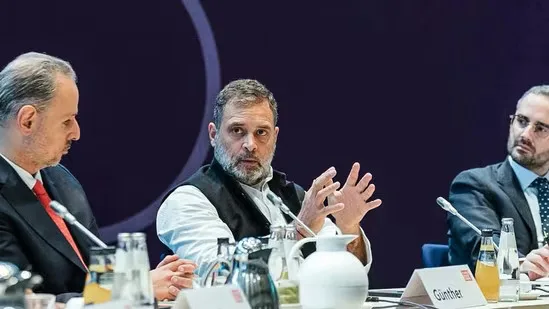
Lok Sabha LoP Rahul Gandhi during a dialogue (Representative image)

Lok Sabha LoP Rahul Gandhi during a dialogue (Representative image)

FacebookTwitterWhatsAppTelegramEmail

When an Indian court convicted Congress leader Rahul Gandhi in a criminal defamation case in 2023, the episode should have remained what it legally was: a purely domestic judicial process. The complainant was Indian, the law was Indian, and the court was Indian. Yet the political aftershocks travelled far beyond India’s borders, most notably to Germany.

The German Foreign Ministry’s statement that it was “monitoring the situation” and hoped judicial independence would not be compromised was striking, not for its content but for its audacity. Why would Germany feel compelled to comment on an internal Indian legal matter involving a sitting politician? More importantly, why did Rahul Gandhi and his ecosystem appear to welcome, even amplify, such external scrutiny?

This was not an isolated diplomatic remark. It was a window into a far more complex and coordinated ideological engagement, one that uses media, NGOs, academic platforms, and “democracy discourse” to shape narratives about India. At the centre of this ecosystem stands Rahul Gandhi, increasingly resembling less a national opposition leader and more a Leader of Propaganda, exporting selective narratives about India to foreign audiences.

Germany: The quiet architect of narrative influence

When discussions of foreign interference in India arise, attention usually turns to the United States, CIA, USAID, or the so-called “deep state.” In that din, Germany often escapes scrutiny. Yet if one examines the Hindi-Urdu media space, the NGO sector, and academic networks, Germany’s footprint is both deep and systematic.

Deutsche Welle (DW News), Germany’s state-funded international broadcaster, is the most visible arm of this influence. DW’s Hindi-Urdu service, which completed six decades in India in 2024, has consistently pushed narratives portraying India as “out of control,” especially during COVID-19, questioned the legitimacy of Indian institutions, described security forces in Kashmir as “occupying forces,” and regularly platformed voices hostile to India’s civilisational and political identity.

The BBC’s influence in India can be explained by colonial history. Germany has no such historical baggage. DW’s sustained presence is therefore not accidental, it is strategic. Germany’s soft power operates quietly, embedding itself deeply rather than making loud interventions.

From post-war guilt to moral superiority

Post-World War II Germany reinvented itself. Militarism was replaced with commerce, and later, with moral authority. What began as atonement for Nazi crimes gradually transformed into a self-appointed role as a global moral arbiter, defining democracy, human rights, and acceptable political behaviour.

This moral rebranding now borders on moral bullying. Countries like India, which do not seek Western validation of their democratic credentials, naturally become targets. Germany’s approach differs from America’s overt interventions; it is subtler, more institutional, and often more effective. NGOs, academic fellowships, research funding, media narratives, these are the new tools of influence.

It is in this ideological landscape that Rahul Gandhi’s repeated foreign engagements must be viewed. His lecture at the Hertie School of Governance in Berlin was not a benign academic exercise. The Hertie School is funded by the Hertie Foundation, an institution rooted in Germany’s post-Nazi “atonement economy.” Under the banner of strengthening democracy, such institutions actively engage in shaping political narratives in other countries.

When Rahul Gandhi speaks on these platforms about “institutional capture” or warns of impending civil conflict in India, he is not merely expressing dissent. He is exporting a narrative, one that aligns neatly with Germany’s normative power agenda.

For a politician who claims to represent India’s democratic opposition, Rahul Gandhi appears remarkably uninterested in fighting ideological battles within India’s democratic framework. Instead, he seeks validation abroad, amplifying internal political disagreements into global talking points. This is why the label Leader of Propaganda fits so uncomfortably well.

Germany’s stiftung model and India’s red lines

Germany’s political foundations, Stiftungen, are unique. They are state-funded, party-linked institutions that operate globally to “teach democracy.” In India, their activities have increasingly drawn scrutiny from the Ministry of Home Affairs, leading to stricter enforcement of FCRA norms and the cancellation of licences of several NGOs.

Apart from NGOs, the Friedrich Ebert Stiftung (linked to the SPD) and the Heinrich Boll Stiftung (linked to the Greens) have also been accused of pushing agendas that conflict with India’s development priorities, from opposing infrastructure projects to questioning internal security measures.

Germany’s recently articulated “Feminist Foreign Policy” has further complicated matters. Statements on Kashmir echoing Pakistan’s positions, framing Manipur violence along religious lines, and public comments on arrests of Indian leaders cross diplomatic red lines. These are not isolated remarks; they are part of an ideological framework that places “human rights” above national sovereignty, conveniently defined by Berlin.

Germany has also emerged as a safe haven for India-critical digital influencers. Its strong free-speech and privacy laws shield individuals from Indian legal processes. Influencers like Dhruv Rathee, whose reach expanded significantly ahead of Indian elections, have found comfort in this ecosystem, later appearing prominently on international platforms like the BBC and sympathetic Indian media.

Publications linked to German media programmes, further amplify these narratives. The result is a sophisticated information-war front that adapts seamlessly to the digital age.

Question of loyalty and leadership

India today stands on the brink of becoming one of the world’s top three economies. Its civilisational confidence is returning. For sections of Europe’s political elite, including Germany’s, this rise is unsettling. India is no longer content being lectured.

In this context, Rahul Gandhi’s role is deeply troubling. Instead of challenging the government through domestic political mobilisation, policy alternatives, and parliamentary debate, he appears more invested in feeding international audiences a bleak picture of India. Opposition is not treachery but exporting narratives that weaken India’s institutional credibility certainly raises questions of political responsibility.

The real battle today is not at borders but within narratives, institutions, and minds. As Germany sharpens its normative power and Rahul Gandhi continues his foreign lectures, Indian voters must ask: is this leadership or is it propaganda?

For a nation that has fought hard for sovereignty, the answer matters.
Topics: Leader of PropagandaDeutsche WelleDW NewsGermanyRahul Gandhi
ShareTweetSendShareSend
✮ Subscribe Organiser YouTube Channel. ✮
✮ Join Organiser's WhatsApp channel for Nationalist views beyond the news. ✮
Previous News

The Shiva Multiverse

Next News

Times Apart: Why January 1 Isn’t Scientific — and Bharatiya New Year Is

Related News

Rahul, Kharge and Jairam vs. India's Great Nicobar Vision (This is an AI generated image)

Great Nicobar Project: Why Congress is opposing Modi government’s strategic mega plan

Uttar Pradesh Congress chief Ajay Rai (Left) and Prime Minister Narendra Modi (Right)

Uttar Pradesh: FIR lodged against Congress state President Ajay Rai over alleged ‘derogatory’ remarks against PM Modi

TN CM Joseph Vijay; late LTTE chief Prabhakaran, Congress leader Rahul Gandhi, former PM Rajiv Gandhi (Left to Right)

Tamil Nadu: Congress pays tribute to Rajiv Gandhi as ally CM Joseph Vijay glorifies LTTE Chief Prabhakaran

(Left) Tamil Nadu CM Joseph Vijay (Right) Keralam’s chief minister designate V.D. Satheeshan

Keralam: Satheeshan swearing-in set to become I.N.D.I Alliance’s show of strength on May 18

Senior Congress leader and Congress Working Committee member Ramesh Chennithala

Keralam Congress: Satheeshan named CM; Ramesh Chennithala fumes; K.C. Venugopal disappointed

Opposition Under Fire for Politicising PM Modi’s Fuel Conservation Appeal

Global Energy Uncertainty: PM Modi appeals for fuel conservation appeal; Opposition’s anti-India narrative exposed

Load More

Latest News

West Bengal Set for Bullet Train Project, Says Railways Minister

Massive Rail Boost for West Bengal: Bullet train, 60 new metro rakes and Rs 14,205 crore allocation announced

Uttar Pradesh Chief Minister Yogi Adityanath reviewing meeting for upcoming Tourist Circuit

UP Charts New Tourism Vision: From Chhatrapati Shivaji Maharaj Museum to Vindhyachal Circuit

Visuals from the site of protest in Jantar Mantar

From ‘Azadi’ slogans to disrespect of national flag: Inside the Cockroach Janta Party protest at Jantar Mantar

Chairman of the Rastriya Swatantra Party of Nepal Rabi Lamichhane meets PM Modi in New Delhi

From the China Card to Development Diplomacy: Nepal opens a new chapter in its political reset with India

'Stand Up for Abhishek': Expelled TMC MLA Claims Party Was Asked to Applaud Mamata's Nephew After Crushing Election Defeat

West Bengal: Expelled TMC MLA Ritabrata claims party was asked to applaud Mamata’s nephew after crushing defeat

Forced to Remove the “Faith”: How Hindu students are targeted at exam centres

A representative image generated using AI

Gujarat: Parsi woman Married to a Muslim man cremated with Hindu rites after VHP’s intervention

She showed the "Made in Pakistan" label attached to the bedsheet

Made in Pakistan bedsheet sold at Pune religious fair? Viral video triggers investigation

India's first Prime Minister Jawahar Lal Nehru and India's current Prime Minister Narendra Modi

From ‘Ship to Mouth’ under Nehru to free rations for 80 crore under Modi: Inside India’s food security revolution

Picture from the site of protest

22 million followers, a few hundred on ground: Cockroach Janta Party faces its first reality check at Jantar Mantar

Load More
  • Privacy
  • Terms
  • Cookie Policy
  • Refund and Cancellation
  • Delivery and Shipping

© Bharat Prakashan (Delhi) Limited.
Tech-enabled by Ananthapuri Technologies

  • Home
  • Search Organiser
  • Bharat
    • Assam
    • Bihar
    • Chhattisgarh
    • Jharkhand
    • Maharashtra
    • View All States
  • World
    • Asia
    • Africa
    • North America
    • South America
    • Europe
    • Australia
  • Editorial
  • Operation Sindoor
  • Opinion
  • Analysis
  • Defence
  • Culture
  • Sports
  • Business
  • RSS @ 100
  • Entertainment
  • More ..
    • Sci & Tech
    • Vocal4Local
    • Special Report
    • Education
    • Employment
    • Books
    • Interviews
    • Travel
    • Health
    • Politics
    • Law
    • Economy
    • Obituary
  • Subscribe Magazine
  • Read Ecopy
  • Advertise
  • Circulation
  • Careers
  • About Us
  • Contact Us
  • Policies & Terms
    • Privacy Policy
    • Cookie Policy
    • Refund and Cancellation
    • Terms of Use

© Bharat Prakashan (Delhi) Limited.
Tech-enabled by Ananthapuri Technologies