In the contemporary Bharatiya ethos, there exists a pervasive duality. On one hand, there is the Gregorian date used for official documentation, passports, and daily administrative transactions; on the other, there is the Bharatiya Tithi (lunar day), which governs cultural, religious, and agrarian life. As one exclaims “Happy New Year” amidst fireworks at the stroke of midnight on December 31, the mind inevitably confronts a fundamental question: Have the planetary positions shifted? Has there been a discernible transition in the seasons? What precisely has altered in nature at this midnight hour? The objective answer is no, nothing.
Conversely, when Gudhi Padwa or Ugadi is celebrated, nature undergoes a fundamental transformation. Deciduous trees bear new foliage, the Rabi crops are harvested, and the Sun’s celestial position shifts. Yet, due to entrenched colonial narratives, we have been conditioned to perceive the change of year on January 1 as “scientific” and “secular,” while labeling the Bharatiya system of timekeeping as “religious” or “archaic.” Let us deconstruct this misconception using scientific evidence.
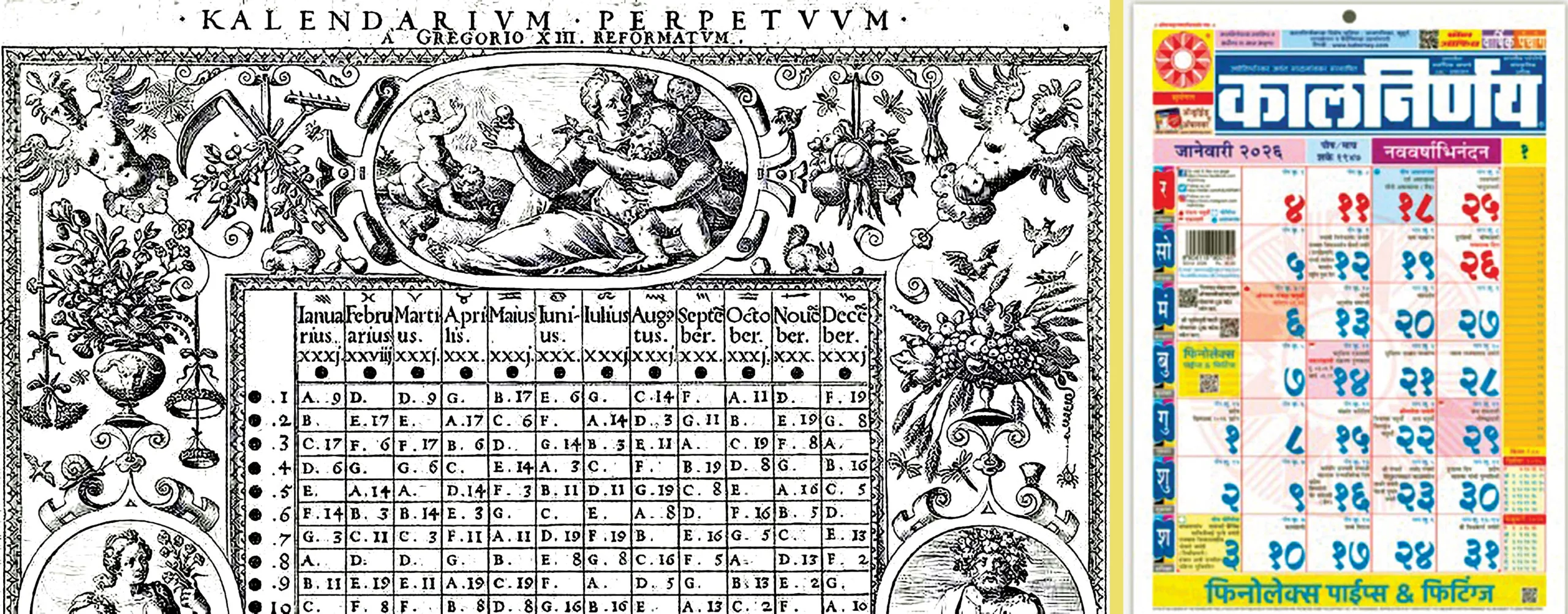
The Gregorian calendar, currently the global standard for civil administration, is not derived from scientific observation but is a construct designed for Roman political convenience and ecclesiastical requirements.
In science, any measurement requires a logical ‘Zero Point.’ The Gregorian calendar commences on January 1. No significant astronomical event occurs in the Earth’s orbit on this date. It is neither an Equinox nor a Solstice. This date was selected purely for Roman administrative convenience. Prior to the era of Julius Caesar, the year commenced in March (which is why the etymology of September (7), October (8), November (9), and December (10) was originally accurate). This logic was discarded to impose January 1.
The primary objective of the Gregorian calendar was not the accurate measurement of time, but the fixation of the date of Easter. In 325 CE, the Church adopted the Julian calendar. However, it was so flawed that it accumulated an error of one day every century. By 1582, this discrepancy had grown to ten days, causing Easter to drift into the wrong season. To rectify this, Pope Gregory XIII summarily excised ten days from the calendar in 1582; October 4 was immediately followed by October 15. A system that must delete days to correct its own structural flaws can hardly be classified as scientific.
The terms AD (Anno Domini – In the Year of the Lord) and BC (Before Christ), in a calendar often touted as ‘secular,’ are inherently religious. Furthermore, there is no historical evidence regarding the exact birth date of Jesus Christ. In the 6th century, Dionysius Exiguus established a hypothetical ‘Year Zero’ for Easter calculations. Thus, the global timeline is anchored to an event lacking historical verification. The distribution of days across Gregorian months is highly capricious. Why do some months have 30 days and others 31? Why does February have 28 or 29? There is no astronomical justification. This stems from the vanity of Roman Emperors. Julius Caesar’s month (July) had 31 days; consequently, Augustus Caesar demanded that his namesake month (August) also possess 31 days. To accommodate this, days were subtracted from February. It is a structure built on human ego, not cosmic order.
Bharatiya Luni-Solar System
Bharatiya sages and mathematicians perceived time not just as linear but as cyclical. They achieved a sophisticated synchronisation of the motions of two primary celestial bodies: the Sun and the Moon. In the Gregorian system, a ‘day’ represents only the Earth’s axial rotation (24 hours), whereas in the Bharatiya system, the micro-unit is the Tithi (Lunar Day). A Tithi is completed when the Moon advances 12° (degrees) ahead of the Sun in the sky. This is a prime example of Relative Motion. Consequently, the duration of a Tithi is not fixed like a mechanical clock (varying between approximately 21 to 26 hours).
Harmonising Solar and Lunar Cycles
A purely lunar year consists of 354 days, while the solar year is roughly 365.25 days. This creates a discrepancy of 11 days annually. If uncorrected, festivals would drift across seasons. Bharatiya mathematicians devised an advanced method of the Adhik Maas (Intercalary Month).
Every three years (approx 11×3=33 days), an extra month is added to bridge this gap. A lunar month in which the Sun does not transit from one Zodiac sign to another (Sankranti) is designated as the Adhik Maas. This mathematical intervention ensures eco-alignment; Diwali always occurs at the onset of winter,
and Holi during the spring.
Monsoon, Agriculture, and Nirayan System
For an agrarian civilisation like Bharat, a ‘year’ is not merely a count of days but a forecast of the monsoon. Here lies the true efficacy of the Bharatiya system. The Western (Sayana) is based on the Tropical year. It focuses on seasons but ignores the backdrop of stars. Due to the axial precession of the Earth, the position of stars changes in the Tropical year. The Bharatiya (Nirayan) is based on the Sidereal year. It measures the Sun’s position relative to fixed stars (Nakshatras) in the galaxy.
The word ‘Varsha‘ (Year) in Bharatiya languages is derived from ‘Varsha‘ (Rain). Monsoon winds are governed by Global Circulation and the Coriolis Force. The Coriolis Force is an inertial force related to the Earth’s rotation relative to the fixed stars. Therefore, to predict the monsoon accurately, the Nirayan system (Sun’s position among stars) is scientifically superior to the Sayana system (Sun’s position relative to Earth). Even today, while meteorological departments often falter based on calendar dates, farmers rely on observations like “The onset of Mrig Nakshatra” or “Rohini rains,” which prove remarkably accurate. This is because Bharatiya Nakshatras are directly linked to the cosmic forces controlling the monsoon.
The New Year: A Cosmic Celebration
Why is the Bharatiya New Year (Chaitra Shukla Pratipada) superior to December 31?Astronomical Convergence: The commencement of the Bharatiya New Year is not arbitrary. It is based on a specific celestial confluence — The Sun: Enters the constellation of Aries (Vernal Equinox – equal day and night); The Moon: The first lunar day (Pratipada) follows the end of the Amavasya; The Earth: It begins with rise of the Sun (the natural start of the diurnal cycle). The Gregorian New Year begins at midnight, in darkness. The Bharatiya New Year begins at sunrise, symbolising the journey ‘From Darkness to Light’ (Tamaso Ma Jyotirgamaya).
Chaitra and the Festival of Creation: The month of ‘Chaitra’ derives from the Chitra Nakshatra. During this period, spring is in full bloom. Nature sheds the old to make way for new foliage. It is nature’s ‘birthday.’ Conversely, on December 31, the Northern Hemisphere is in the grip of winter, and nature is dormant. celebrating a ‘new’ year during a period of stasis is scientifically dissonant. The Bharatiya New Year aligns with the season of regeneration. Mathematical Precision: The length of the Bharatiya Sidereal Year is 365 days, 6 hours, 9 minutes, and 9.5 seconds. The Gregorian year is 365 days, 5 hours, and 48 minutes. The Bharatiya calculation aligns more precisely with the actual motion of the cosmos. Calculations posited by mathematicians like Aryabhatta and Bhaskaracharya millennia ago align almost perfectly with modern satellite data.
A calendar is not just a tool for viewing dates; it shapes the cognitive framework of a society. The Colonial Hangover: We were educated to believe that ‘Western’ equates to ‘Advanced.’ Consequently, we prioritised December 31 over millennia of tradition. This is symptomatic of a deep-seated inferiority complex. We subconsciously accept European time as the ‘Standard’ and our own as ‘Secondary.’
The Mask of Secularism: Many argue that the Bharatiya Panchang is ‘Hindu’ while the Gregorian is ‘Secular.’ However, as demonstrated, the Gregorian calendar is constructed entirely around Christian exigencies (Easter). In contrast, the Bharatiya Panchang is based on planetary movements. Planets do not belong to a religion. Amavasya, Poornima, or Solstices are astronomical events, not religious ones. Therefore, the true Universal Calendar is the Bharatiya one.
Bharatiya Luni-Solar timekeeping system and the New Year based upon it are not matters of emotional or religious belief, but are grounded in rigorous scientific truth
It is evident that the Bharatiya Luni-Solar timekeeping system and the New Year based upon it are not matters of emotional or religious belief, but are grounded in rigorous scientific truth. The New Year on January 1 is part of a system replete with flaws, arbitrariness, and historical errors. In contrast, the Bharatiya New Year (Gudhi Padwa/Ugadi) is astronomically accurate, mathematically advanced, ecologically consistent, and logical.
The young generation must understand that being ‘Modern’ does not mean severing ties with one’s roots, but rather comprehending the science embedded within one’s traditions. When you raise the Gudhi on Gudhi Padwa, you are not merely performing a ritual; you are saluting the magnificent Cosmic Dance of the Sun and Moon upon which our existence depends. Partying on December 31 may be a personal choice, but treating it as the ‘New Year’ is scientifically illiterate.