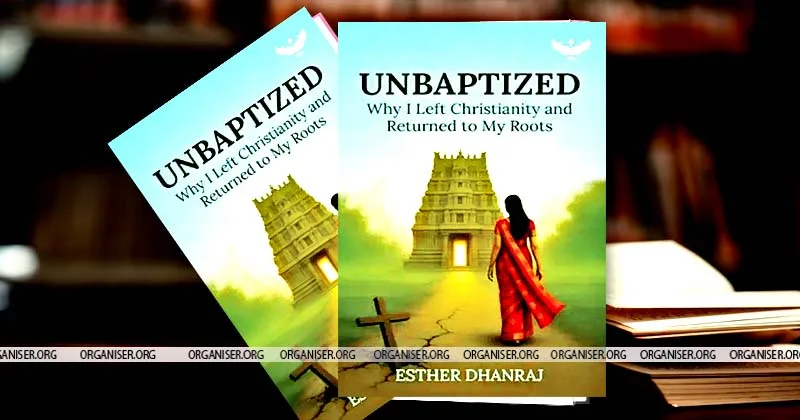
Publisher: Garuda Prakashan, Pages: 316, MRP: Rs 549.00
I first heard of an academic pursuit in religious studies called “apologia” while listening to Esther Dhanraj’s podcast with Rajiv Malhotra. I found it strange that one needed to be armed with arguments to protect a religion from attacks by critics. Apologetics involves three to four years of very costly formal training and requires academic rigour and hard work.
When I read the details of what goes into this Master’s degree in Divinity in Esther Dhanraj’s book ‘Unbaptized: Why I Left Christianity and Returned to My Roots,’ I also felt a sense of respect for a religious order that creates a phalanx of defence, knowing that its stories contain many inconsistencies and myths, carefully woven and curated by a large number of scholars and religious zealots over time to establish what is called the Church today.
As you read about the trials and tribulations of a deeply dedicated seeker like Esther as she undergoes this soul-searing exercise, you wonder whether she is a lone scholar who rebelled, or whether there could be more. She informs us that there are many who, after spending their lifetimes (far longer than the years she spent in her temporary house of faith), at a certain stage realised that they were propagating and defending a faith that was a violence to their mind and soul. It is only faith that makes many stay back. It becomes painfully clear that the purpose of apologetics was more to protect the reputation of scripture at any cost. She finds that even the martyrdom myth is a tool the Church uses to conquer cultures in the name of love. And when local resistance rises, whether through lawful pushback or community self-defence, it is spun as persecution.
To be a Hindu is to recognise that the danger is not only from outside but also festers within; that the assault may come from without, but the collapse begins within
As you read the book, you understand the troubled state of mind of many converts from Hindu dharma who cannot surrender their ancient faith and rational thinking, and therefore cannot die in peace. With deep anguish, she shares the disturbing stories of her own family. She has dedicated an entire chapter to the heart-wrenching story of her father and mother, who could not bear the rift within the family, among relatives, and the forced abandonment of his past beliefs. During his last days of inner trauma, he asks her, “Am I going to Hindu hell for forsaking my dharma? Or Christian hell for doubting the faith I professed for twenty-five years?” […] “They told us Christianity would prevent all illnesses and problems. They said it was a shield. If they had said that Christians had to suffer more, no Hindu would ever convert. Not one.”
This brings me to Chapters 2 and 3. They are fascinating and, at the same time, deeply hurt you, as they lay bare the process of harvesting and fishing for the troubled souls. The entire process involves breaking down spiritual barriers one by one—disbelief in one’s own God, raising well-rehearsed questions, and creating cracks in the target’s belief. It is a relentless exercise, sometimes carried out by more than one person, handing over the task to the next when the “sheep” wanders into another area. Every vulnerable Hindu should read this part.
The awakening of consciousness and intellect that Esther confronted made her realise how difficult it is to come out of the hole into which she had been sucked. As she discovers the hollowness of the simple-looking religion, she does not know where to go. The anchor that stabilised her life is no more, and there is nothing else to hold on to. Esther coins a new term, “Extianity,” to describe the emotional and intellectual turmoil of this transitional phase. While there are plenty of resources available to herd the sheep into Christianity, no guide is easily available for someone who seeks ‘ghar wapsi’—to rescue a person suspended midair like the proverbial “Trishanku.” An “Extian” is someone who has exited the Christian framework after deliberate intellectual and spiritual enquiry. During this dark period, she notes how agents of the Church blame the convert for her failures but give credit to God for her successes; and she realises that the theory of karma is far more logical.
Her search led her back to Sanatan Dharma. It was her own struggle and her own discovery that brought her back to her roots, and she felt emotionally anchored again. She observes that each conversion in her family followed a crisis, and into those sacred wounds walked the evangelist—cloaked in compassion but armed with an agenda. She wonders why a fellow Hindu did not enter a troubled Hindu’s life before the missionary did.
With her deep academic understanding of the Church, Christianity, the Bible, and its fables and myths dressed up as history, and having lived the faith honestly for nearly two decades, she is well equipped to provide a critique of the institutional weaknesses of Sanatani society. She notes that Christianity succeeded not because of superior truth, but because of superior organisation and emotional manipulation. What we need is adaptation—to present dharma in formats that people already recognise and trust. Sanatan Dharma just needs a stronger voice. She gives the example of the Joshua Project, which is targeted, data-driven, and grassroots-driven, and underlines that Hindu society too needs to adopt such strategies without losing its essence.
She finds that evangelism in Bharat is far more tactical and transactional, rooted not in philosophy but in pragmatism; it enters through social services—free education, healthcare, food aid, disaster relief, social activism, or employment opportunities. “It’s spiritual human trafficking, dressed up in hymns and hallelujahs,” she writes. Her last chapter, “Am I a Hindu?”, is not about her. It is about every Hindu. It is a series of questions and reflections that every Hindu should ponder to rethink whether we are Hindus in the true sense and what is expected of us as Hindus. I will quote just one paragraph to give you an idea of her earnestness—
To be a Hindu is to recognise that the danger is not only from outside but also festers within; that the assault may come from without, but the collapse begins within in the form of: (a) our own indifference, which eats away at us like termites in sacred wood; (b) our laziness to learn; (c) our hesitation to speak; (d) our quiet shame in rituals we no longer understand; (e) the outsourcing of our children’s minds to systems that ridicule us; and (f) our eagerness to exchange timeless wisdom for Western approval, becoming master compartmentalizers. […] We perform rituals for prosperity but do not invest a rupee in the institutions that protect our civilisational memory. We build houses on soil we refuse to defend. We type away angry comments on keyboards but lift not a finger to fund a think tank. We do not show up in courts. We barely show up at satsangs.
To summarise, this book shares the searing pain of a convert who goes through self-realisation, leading to a long period of troubled life and, finally, a rediscovery of her roots. The book is a stunning commentary on illogical and mythicised Churchianity and the cunning games of evangelists. It is not just a harsh criticism of the lack of social support structures in Hindu society, but also one that offers antidotes—easy-to-adopt solutions that can be implemented at the local as well as the larger level. This book is a must-read for all Hindus who may have realised their mistake. They can correct it; it is never too late.