The demographic change and infiltration issue of Assam is a grim reality. For decades, the State has been quietly transformed by two relentless forces: large-scale infiltration from neighbouring Bangladesh and a rapid population surge among Bangladeshi-origin Muslims, commonly referred to as Miya-Muslims. The consequences of this unchecked demographic shift are now starkly visible across the map. Nearly twelve districts, once the homeland of indigenous tribal communities and native Assamese people, have today turned into Miya-Muslim majority areas. The alarm bells, it must be said, were rung nearly half a century ago. In 1979, in what was arguably the first mass movement of its kind in independent India, the All Assam Students Union (AASU) launched the historic Assam Agitation — a six-year-long struggle that shook the political establishment and ultimately culminated in the signing of the Assam Accord. But the Accord, for all its promise, could not hold back the tide. Kumud Phukan from Morigaon district who participated in the Assam agitation as a young student said that the accord was used by the Government to safeguard the infiltrators.
The Illegal Migrants (Determination by Tribunals) Act, 1981 (IMDT) was introduced to make the detection and deportation complicated. The Congress Government intentionally safeguarded their votebanks and pushed Assam into an alarming stage of demographic change. The infiltration continued, the demographics continued to shift, and today, Assam finds itself confronting a crisis that the agitation of 1979 had warned about — only now, the warning has become a lived reality for the indigenous people of the land.
The recently announced high-powered committee by the union home ministry to study demographic change across the country by infiltration and other unnatural causes has been welcomed by all sections of the society in states. Yet, perhaps the most troubling aspect of this crisis is not the infiltration itself, it is the silence around it. The slow, steady erosion of Assam’s demographic fabric has largely gone unnoticed, or worse, been deliberately overlooked. Mainstream media, by and large, has either failed to shine an adequate light on the issue or chosen to look the other way. The left-liberal and opposition political parties have actively suppressed the demographic change, not out of ignorance, but out of calculated political interest, using minority vote banks as electoral currency while the indigenous people of Assam pay the price. The result is a danger that has been allowed to fester in the shadows. Much like termites hollowing out a structure from within — invisible until the collapse is imminent.
The infiltration of Bangladeshi nationals and Rohingyas has been silently consuming vast tracts of Bharat’s landscape silently in the past few decades. Like in some districts of Assam the damage has already crossed the point of no return. Districts like Dhubri and Barpeta, once thriving centres of Assamese culture and indigenous life, now stand as grim testimony to what happens when a nation fails to protect its own borders and its own people. The termites, it appears, have been at work for a very long time. And the house is already showing cracks. Nanda Pathak from Barpeta said that the intensity of their aggression is so high and rapid that places like Chenga, Mondia have now become almost 100 per cent Miya-Muslim areas. Satra land and Government land were encroached and huge villages were established to claim authority.
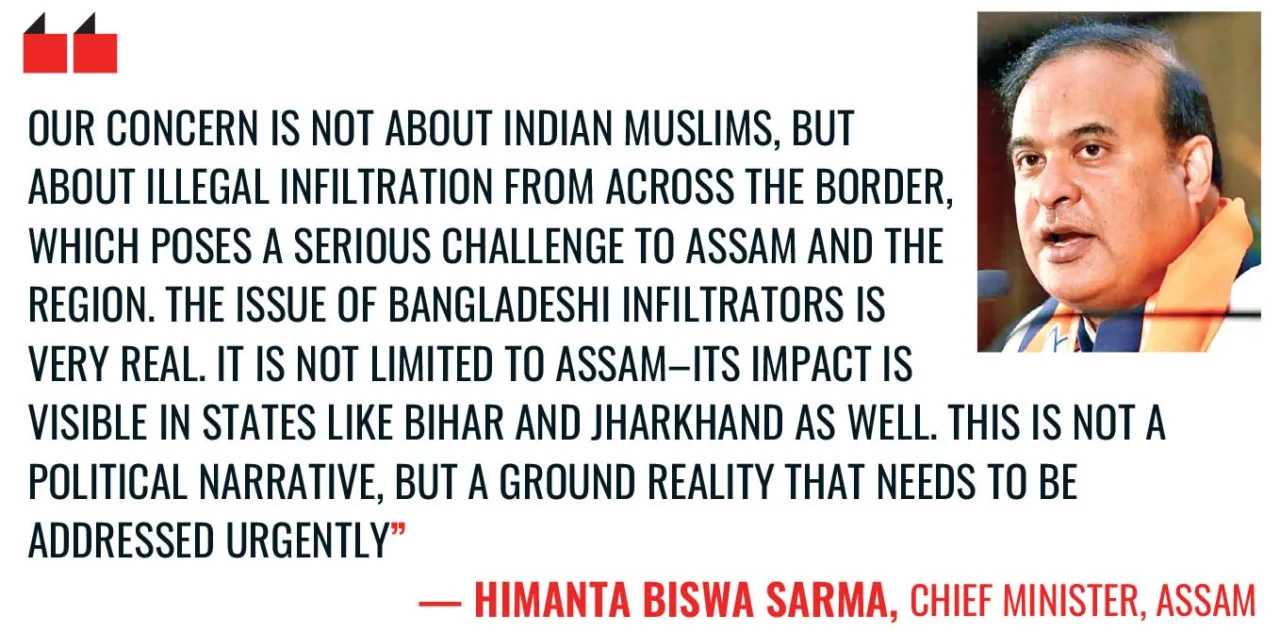
Lauding Home Ministry’s decision, Assam Chief Minister Himanta Biswa Sarma asserted, “Assam has long been facing the challenge of demographic change. This initiative will prove crucial to protecting our cultural heritage, tribal communities, and the rights of indigenous peoples. We are confident that this committee will play a major role in securing India’s future.”
The Statistical Reality
If we analyse the huge demographic change in 7 Muslim majority districts of Assam between 1991 to 2011 based on census reports, the dangerous picture of drastically decreasing Hindu population and growth of Muslim population would shock anyone concerned on the issue.
In 1991 census, the Hindu population of Barpeta district was 5,57,929. Sadly it has declined to 4,92,996 in the 2011 census. In contrast, the Muslim population in the district, according to 1991, was 7,76,943 which increased to 11,98,036. Likewise in Dhubri district, Hindu population was 3,82,817 according to the 1991 census and increased by over 5000 to 3,88,380. But in the same period, the Muslim population of the district increased from 9,38,789 (in 1991 census) to 15,53,023 (in 2011 census). Similarly in Darrang district, the Hindu population as per 1991 census was 7,86,332 and it drastically decreased more than half of the population to 3,27,322, while the Muslim population rose from 4,15,332 in 1991 to 5,97,392 in 2011. In Bongaigaon district, Hindu population was 5,16,830 in 1991 and it decreased to 3,59,145 in 2011. Whereas the Muslim population increased from 2,64,393 in 1991 to 3,71,033 in 2011.
In the middle Assam district of Morigaon and Nagaon, the Muslim population growth is even higher. In Mirigaon, Muslim population was 2,89,835 in 1991 and it increased to 5,03,257 making it another Muslim majority district.
In neighbouring Nagaon district, the Muslim population increased from 8,93,322 in 1991 to 15,63,203 much higher than the Hindu population. In these 7 districts of Assam (Barpeta, Dhubri, Bongaigaon, Goalpara, Darrang, Morigaon and Nagaon) between 1991 to 2011, the Hindu population decreased from 38,38,791 to 35,92,819, whereas the Muslim population rose from 39,13,920 to 63,65,873. The decrease of Hindu population was 6.41 per cent and increase of Muslim population was 62.65 per cent.
The population growth analysis in ‘Revenue Circle’ wisely shows a more detailed picture of the danger of demographic change taking place in Assam in the last several decades. In Kolgasia revenue circle in Barpeta district, the Hindu population in 1991 was 3,186 which further decreased to 1,391 persons against a Muslim population of 1,94,456 making the area a total Muslim area of the district. Similarly, in Baghbor revenue circle of the district, the Hindu population decreased to 10,789 in 2011 against a Muslim population of 2,94,993. In Dolgaon revenue circle of Darrang district, the Hindu population remained 53 thousand between 1991 to 2011 whereas Muslim population increased from 1,54,179 to 4,18,012. Pranjal Baruah from Darrang district explains that in his district, Hindu population started evicting the villages five decades ago where Muslim population increased due to infiltration and population blast. As a result, the Muslim population got a lot of area for expansion. The Hindu community was confined to town and semi urban areas while Muslim population grew in riverine and village areas. Most of the Hindu population shifted to cities and towns due to the aggression of Miya-Muslims which resulted in a sharp fall of Hindu population. In just two decades, the Hindu population of Darrang became less than half from over 7.50 lakh to less than 3.50 lakh people. This is due to a very low population growth amongst Hindu and mass exodus from villages.
Along with these seven, South Salmara Mankachar district bordering Bangladesh has a population of 95.19 per cent Muslims. Against 5,55,114 Muslims, there are only 26,162 Hindu population. Similarly, Hailakandi in Barak Valkey has also become a Muslim majority district. Hailakandi is one of the three districts in Southern Assam’s Barak Valkey region bordering Bangladesh, with a 60.31 per cent Muslim population. The process of 2027 census has already begun across the country. People here in Assam are fearing some shocking Muslim population growth in the last one and a half decades. It has been anticipated that the Muslim population might go near 40 per cent seeing the official growth in the last few decades.