Bangladesh is at a critical juncture, navigating a complex path. Its path was defined by significant economic progress which has occurred from 2004 till 2024. However, intense political volatility witnessed at present is coupled with acute vulnerability to climate change in view of its unique geographical location. Its future direction hinges on the ability of its interim government and the upcoming democratically elected government to restore political stability, address economic inequality and social discontent and foster resilient, sustainable development.
Economic trajectory: Growth and challenges
Over the past decades, Bangladesh has made a remarkable transformation from one of the poorest nations at its inception in 1971 to a lower-middle-income country and one of the world’s fastest-growing economies. This progress has been largely driven by the ready-made garment (RMG) industry, remittances from citizens abroad and agricultural resilience. The country has been a major global apparel supplier and its manufacturing sector has been expanding beyond textiles into areas like pharmaceuticals, ceramics and shipbuilding.
However, the economy faces considerable headwinds lately. Ongoing political unrest and labour issues have affected the crucial garment sector, threatening international demand and manufacturing units are shifting out of the country. Inflation, declining foreign exchange reserves and a bleak & uncertain economic situation poses immediate challenges to the interim government. The economy has long been characterized by a traditional structure and an over-reliance on a few key exports. Diversification and modernization are essential for sustained, inclusive economic growth.
Political landscape: Navigating instability
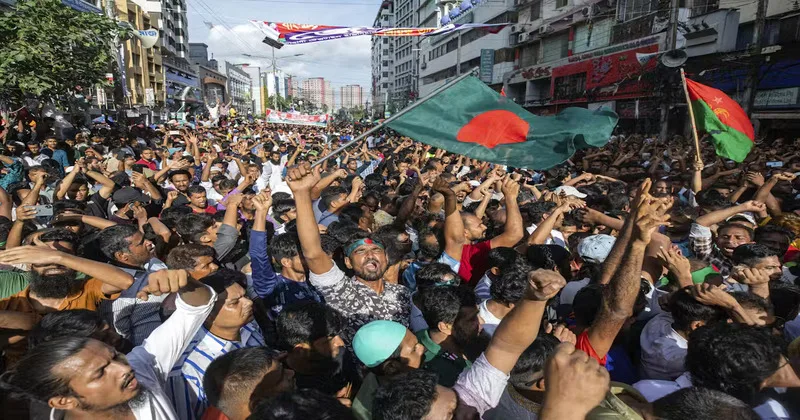
The political scene in Bangladesh has historically been volatile, marked by periods of military rule and intense partisan political rivalry. The 2024 student-led uprising that toppled the previous government led to the establishment of an interim government under the Chief Adviser Muhammad Yunus. This new administration faces immense pressure to provide stability and a clear path to the announced 2026 parliamentary elections.
Restoring Order: The country has experienced significant unrest, including violence against minorities and the targeting of media offices and the historical sites. Restoring public order and ensuring the safety of all citizens should be a top priority but in reality, it doesn’t seem to be so.
Addressing Grievances: The protests—genuine, engineered or orchestrated highlighted deep public anger over corruption, economic inequalities and a political system dominated by patronage. The government’s ability to address these root causes of public dissatisfaction will be crucial for long-term stability.
Regional Relations: Political changes have also stirred regional dynamics, particularly with neighbouring India, leading to increased anti-India sentiment among some groups despite robust trade links. Managing these complex diplomatic relationships will be important for regional stability.
Climate and Environment: An existential threat
Geographically, Bangladesh is a low-lying, riverine delta, making it one of the most vulnerable countries in the world to climate change. Rising sea levels, more extreme weather events (cyclones, typhoons, tsunamis and floods) and changing conditions in the upstream river deltas pose an existential threat to its vast population and agricultural land.
Though the country has developed certain disaster recovery capabilities and is working on long-term strategies like the Bangladesh Delta Plan 2100 to combat these challenges, its future is inextricably linked to the global efforts to combat climate change and its own ability to adapt and build resilience.
Social and human development
Despite its challenges, Bangladesh has made significant strides in human development, including reducing population growth and improving health and education indices, with a particular focus on women’s empowerment particularly under the Sheikh Hasina regime. The nation’s path forward requires continuous investment in its people to harness its demographic dividend effectively.
Bangladesh is heading towards a future of uncertainty. Despite its immense economic potential, it has not been able to develop a stable, sustainable socio-political identity since its inception 54 years ago. In fact, the way its population is conducting itself at present puts its polity and economy to significant risk. A country must have a clear-cut vision—short term, medium term and long term. If the political and military elite show such vulnerability to foreign interference in its internal affairs, the country’s future is rendered bleak and uncertain.
Ultimately, where Bangladesh heads will depend on the collective efforts of its people and leaders to navigate political complexity, foster sustainable economic growth and build resilience against the unavoidable impacts of climate change. But what is being witnessed at present is throwing up a very pessimistic picture. There are palpable efforts by the Yunus government to postpone or prevent the elections scheduled on February 12, 2026. The military sems to be politically divided—one section aligned with Jamat-e-Islami party coloured by religious fundamentalism and bigotry and the other section aligned with either Awami League or BNP.
Bangladesh is the lost child of mother India or Bharat. It is the alienated and politically separated sister of our West Bengal and this political separation was the result of colonial machinations dating back to 1905. There appears to be no reason on earth for the people in West Bengal and Bangladesh who have common language, culture and traditions to exist as separate countries or parts thereof. They were artificially divided by intrigues of history and they are bound to organically unite and coalesce into one nation sooner than later. But we only desire and wish that this natural transition occurs without war, bloodshed and destruction. Let it come through ideological correction of the masses, drawing from the innate elements of Sanatan dharma which is the common cultural denominator of the two peoples.