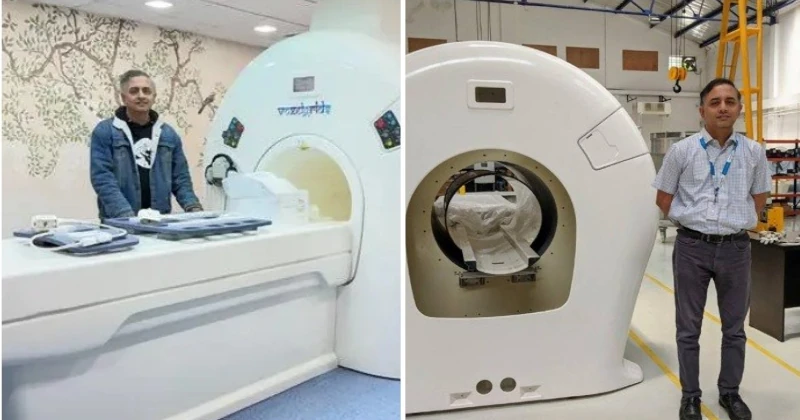
Bengaluru-based startup VoxelGrids, backed by Zoho Corporation, has successfully developed and deployed the country’s first fully indigenous 1.5 Tesla Magnetic Resonance Imaging (MRI) scanner, marking a decisive step toward reducing India’s reliance on imported diagnostic equipment.
According to media, the advanced MRI system was officially unveiled on December 25, 2025, capping nearly 12 years of research and development led by VoxelGrids founder Arjun Arunachalam. The scanner is now operational at the Chandrapur Cancer Care Foundation near Nagpur, where it is being used for patient diagnostics making it the first clinical installation of an entirely homegrown 1.5T MRI system in India.
India currently depends heavily on multinational medical imaging giants such as Siemens and GE Healthcare for MRI systems. VoxelGrids’ breakthrough challenges this dominance by delivering a high-performance scanner built entirely within the country, aligned with the government’s Aatmanirbhar Bharat vision.
At the heart of the innovation is a helium-free “dry magnet” design, a major departure from conventional MRI machines that rely on liquid helium a scarce, costly, and logistically challenging resource. By eliminating helium, VoxelGrids has reduced manufacturing costs by nearly 40 per cent, while also making the system lighter, more energy-efficient, and compact.
Traditional MRI machines typically weigh around 6 tonnes, whereas the VoxelGrids scanner weighs just 2–3 tonnes, allowing for easier installation in smaller hospitals and opening the door to mobile MRI units for rural and semi-urban regions.
Beyond cost savings, the indigenous scanner has been engineered to suit India’s on-ground realities. The system consumes less power, is resilient to electrical fluctuations, and is designed to function reliably even in regions with unstable power infrastructure a major challenge for advanced medical equipment in many parts of the country.
VoxelGrids has also introduced a pay-per-use business model, significantly lowering the upfront investment required by hospitals and diagnostic centres. This model could prove transformative for smaller healthcare institutions that currently cannot afford MRI facilities.
Industry data underscores the urgency of such innovation. India has only about 5,000 MRI scanners, translating to roughly 3.5 machines per million people far below global averages. This limited availability often results in long waiting periods and restricted access, particularly outside major cities.
VoxelGrids aims to bridge this gap by making MRI technology more affordable and widely available, enabling earlier diagnosis and improved patient outcomes across the country.
The project has received substantial support from both the private sector and the government. Zoho Corporation, a key backer of VoxelGrids, hailed the achievement as a milestone for indigenous innovation.
Commenting on the development, Zoho CEO Shailesh Kumar Davey said, “We congratulate VoxelGrids on their first successful clinical installation, marking a step forward for indigenous medical tech in India. Zoho’s investment in VoxelGrids underscores our commitment to nurturing deep-tech innovation for mission-critical sectors.”
The MRI scanner was developed under the National Biopharma Mission, with significant financial support from the government. Of the Rs 17 crore spent on development, Rs 12 crore was provided by the Biotechnology Industry Research Assistance Council (BIRAC) under the Department of Biotechnology (DBT), according to a 2023 government press release.