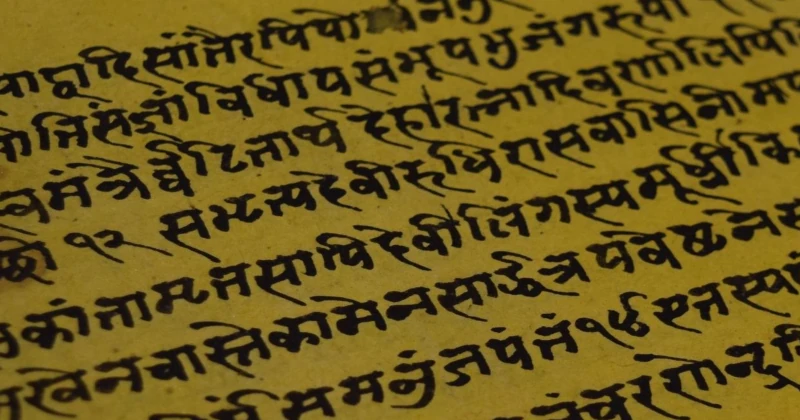
NEW DELHI: For decades, Sanskrit has routinely been labelled a “dead language” in academic and popular discourse. Yet emerging linguistic analysis and renewed scholarly interest are forcing a serious re-evaluation of that claim. By conservative estimates, Sanskrit contains over 10 million words a figure that dwarfs most modern languages and exposes the limitations of conventional word-count comparisons.
The DEAD language Sanskrit has 10 million words by conservative estimates.
If you coined 1,000 new words every year, you'd need 10,000 years to match it. English? 170,000 words. Mandarin? Around 370,000.
A linguistic architecture built across millennia, encoding knowledge… pic.twitter.com/h06FVph6en
— GemsOfINDOLOGY (@GemsOfINDOLOGY) December 25, 2025
To put this in perspective, even if a language coined 1,000 new words every year, it would take 10,000 years to reach Sanskrit’s scale. English, often considered one of the world’s most expansive languages, contains roughly 170,000 words in active use, while Mandarin Chinese is estimated at around 370,000. Sanskrit’s magnitude is not merely numerical it is structural.
Linguists point out that Sanskrit’s true strength lies in its architectural design, formalised over 2,500 years ago by the grammarian Pānini. His grammatical system does not treat words as static units but as outcomes of a highly precise generative process. Almost every verbal or nominal root in Sanskrit can systematically produce verbs, nouns, adjectives, participles, compounds, and specialised technical terms with mathematical accuracy.
Unlike many modern languages, Sanskrit does not expand linearly. It grows combinatorially. Its rules of sandhi (phonetic transformation) and samāsa (compounding) allow the creation of long, information-dense words that can compress what would otherwise require full sentences in English or Mandarin. As a result, the very concept of “word count” becomes inadequate when applied to Sanskrit.
This generative capability made Sanskrit uniquely suited to encode complex knowledge systems ranging from philosophy, mathematics, astronomy, medicine, and logic to poetics and metaphysics long before the advent of modern computational thinking. Scholars argue that Sanskrit functions less like a spoken vernacular frozen in time and more like a linguistic operating system, designed for precision, abstraction, and infinite extensibility.
Far from being obsolete, Sanskrit’s rule-based grammar has drawn interest from fields such as artificial intelligence, computational linguistics, and knowledge representation. Researchers note that its clarity of syntax and semantic predictability make it remarkably compatible with algorithmic modelling.
(This story is based on a twitter thread by GemsOfINDOLOGY)