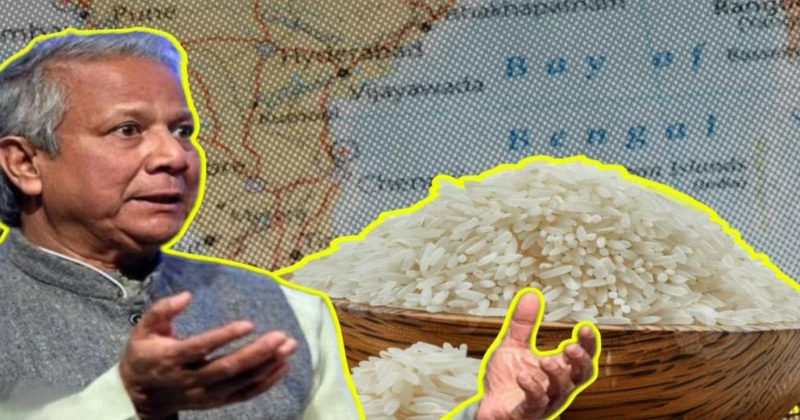
A major setback appears to be looming for the Bangladesh government led by Muhammad Yunus, which has increasingly aligned itself with Pakistan in an overtly anti-India posture. A section of Indian rice traders has now approached the Centre, urging it to impose a ban on rice exports to Bangladesh in view of the deteriorating political and security environment.
The demand comes amid heightened tensions following an attack on the Indian High Commission office in Chittagong in recent days.
Traders argue that continuing exports under such circumstances exposes Indian commercial interests to serious risks. They also point out that Bangladesh has recently imposed restrictions on jute exports to India, further straining bilateral trade relations.
Despite these developments, the Yunus government formally requested India just a day ago to allow the import of rice to meet domestic shortages. The Centre has not yet indicated whether it will accede to this request. Parallel to this, there is also a growing chorus demanding that India reconsider the supply of electricity to Bangladesh. Earlier, the Adani Group had suspended power supply to Bangladesh for several months after dues were not cleared on time.
Indian rice plays a crucial role in Bangladesh’s food security. Access to Indian rice provides significant economic relief, as it is both cheaper and of higher quality compared to supplies from several other exporting nations. For the current financial year 2025–26, Bangladesh plans to import a total of 900,000 tonnes of rice to stabilise prices and maintain buffer stocks.
Out of this total, around 200,000 tonnes are to be sourced from countries such as Myanmar, Vietnam and Pakistan under government-to-government agreements. The remaining quantity is procured through international tenders floated by private traders. Indian exporters typically submit the lowest bids in these tenders, making them highly competitive. While Pakistan quotes around $395 per tonne, Indian bids are approximately $40 lower.
Indian traders also emphasise that only a small fraction of India’s overall rice exports is destined for Bangladesh. India enjoys extensive markets across Africa and other regions, where demand for Indian rice remains strong. Globally, Indian rice commands a favourable position due to its consistent quality and competitive pricing. Currently, Indian rice is priced at about $351 per tonne, compared to $395 from Pakistan, $360 from Vietnam and $430 from Thailand.
In this backdrop, traders are questioning whether India should continue supplying rice to a country facing economic distress while adopting what they describe as an anti-national stance. So far, the central government has not issued an official response.
Bangladesh’s vulnerability is not limited to food imports. The country remains heavily dependent on India for electricity. Adani Power alone supplies around 1,500 megawatts of electricity daily. Other Indian suppliers include NTPC, PTC India Limited, and Semcorp Energy India Limited. Analysts warn that a coordinated withdrawal by these suppliers could trigger a severe energy crisis in Bangladesh.