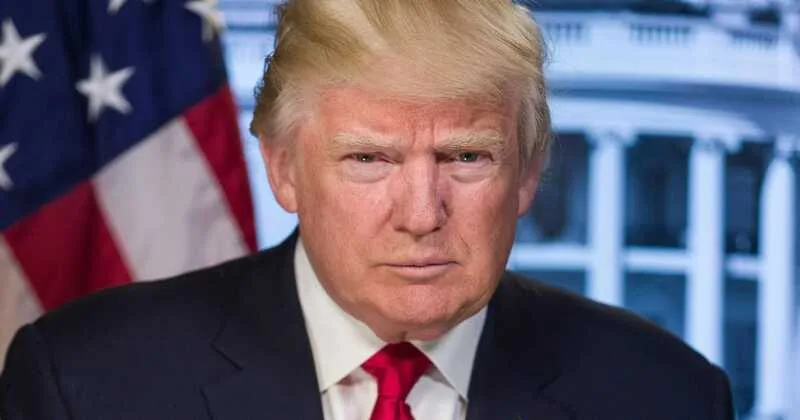
US President Donald Trump on Thursday (December 25) night declared that American forces had carried out a “powerful and deadly” strike against Islamic State terrorists operating in Nigeria, citing attacks on Christians as the primary trigger for the action.
In a statement posted on his Truth Social platform, Trump said the operation targeted ISIS elements in northwest Nigeria who, according to him, had been “viciously killing, primarily, innocent Christians” at levels unseen for decades.
“Tonight, at my direction as Commander in Chief, the United States launched a powerful and deadly strike against ISIS terrorist scum in northwest Nigeria,” Trump wrote, using characteristically strong language to underline his stance against radical Islamist groups.
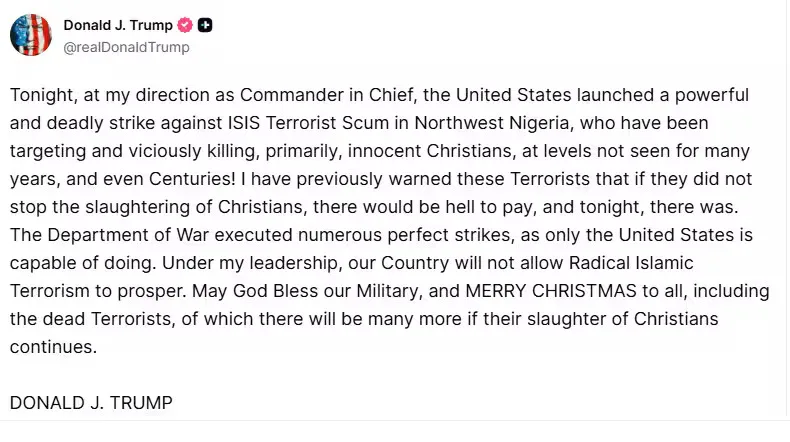
Trump said the strike followed earlier warnings issued by his administration to extremist groups operating in Nigeria. He claimed the militants had ignored those warnings, forcing the United States to act militarily.
“I have previously warned these terrorists that if they did not stop the slaughtering of Christians, there would be hell to pay, and tonight, there was,” he said.
The President credited what he referred to as the “Department of War” for executing what he described as “numerous perfect strikes,” asserting that such operations demonstrated US military superiority.
“Under my leadership, our country will not allow Radical Islamic Terrorism to prosper,” Trump added.
In a post that combined seasonal messaging with a warning, Trump indicated that further US military action could follow if attacks on Christians continued.
“May God bless our military, and Merry Christmas to all, including the dead terrorists, of which there will be many more if their slaughter of Christians continues,” he wrote, drawing immediate attention for the tone and timing of the statement.
The US Africa Command (AFRICOM) later confirmed the operation, stating that the strikes were conducted on December 25, 2025, in Sokoto State, in coordination with Nigerian authorities.
“At the direction of the President of the United States and the Secretary of War, and in coordination with Nigerian authorities, U.S. Africa Command conducted strikes against ISIS terrorists in Nigeria,” AFRICOM said in a statement.
US Defence Secretary Pete Hegseth expressed gratitude to the Nigerian government for its cooperation, highlighting intelligence sharing and operational coordination.
Nigeria’s Ministry of Foreign Affairs acknowledged cooperation with the United States, saying it involved intelligence exchange and strategic coordination carried out in line with international law and respect for sovereignty.
“Terrorist violence in any form, whether directed at Christians, Muslims or other communities, remains an affront to Nigeria’s values and to international peace and security,” the ministry said, stressing that extremist violence in the country affects multiple religious communities.
Nigerian officials have consistently maintained that jihadist groups such as ISIS and Boko Haram target both Christians and Muslims, particularly in the country’s northern and central regions.
For months, Trump has openly accused the Nigerian government of failing to protect Christians, repeatedly warning of direct US action if the killings continued.
In a statement last month, Trump said that if Nigeria failed to act, the United States could halt aid and even intervene militarily. He had ordered the US Defence Department to prepare for possible action, warning that America could enter Nigeria “guns-a-blazing” to eliminate terrorist groups.
Despite Nigeria’s objections, the United States recently designated the country as a “country of particular concern” under the International Religious Freedom Act. The US State Department also announced visa restrictions on Nigerian individuals and their family members accused of involvement in mass killings and violence against Christians.
The US strike marks a significant escalation in Washington’s direct military involvement against ISIS in West Africa and underscores the Trump administration’s emphasis on religious freedom as a component of its counterterrorism policy.