

The killing of Islamist leader Osman Hadi in Bangladesh by unknown gunmen, followed by his sister’s assertion that Bangladesh is engaged in a “200-year war,” offers a rare and unfiltered window into the ideological worldview that animates large sections of Bangladeshi Muslim politics. The allegation by Osman Hadi’s brother, who has publicly accused Bangladesh’s unelected head Muhammad Yunus of complicity in the killing, further underscores the depth of internal ideological contestation within the Bangladeshi Islamist ecosystem. These developments cannot be dismissed as isolated political events or factional violence. They are manifestations of a much older and deeper civilisational conflict—one that predates both Pakistan and Bangladesh and finds its earliest organised expression in the figure of Titumir.
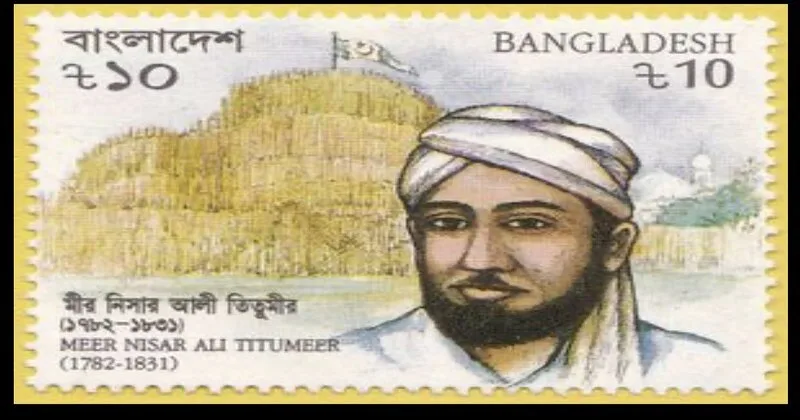
While Titumir remains largely unknown to most Bhartiyas, he is revered among Bangladeshi Muslims. He is not merely remembered as a rebel but is actively projected as a proto-nationalist and freedom fighter by the muslims in Bangladesh. This elevation is neither accidental nor historically honest. It is the product of manufactured Islamist political consciousness through sustained ideological conditioning, a process in which religious violence directed against Sanatan civilisational society has been retrospectively sanitised and recast as resistance.
Titumir was born in 1782 in the 24 Parganas region of Adi Banga (West Bengal), a deeply Sanatan civilisational space in eastern Bharat. Influenced by his mother, he became a Hafiz at a young age. His early adulthood, however, reflected instability and violence rather than piety. Over time, he moved from being a farmer to leading a dacoit gang, then becoming a wrestler, and later serving as a lathial—an armed enforcer—for a Hindu zamindar. This trajectory eventually brought him into conflict with the colonial-imperial rule of the East India Company, leading to his imprisonment.
Titumir’s decisive ideological transformation occurred only after his release. In 1822–23, he travelled to Mecca for the Hajj, where he encountered Syed Ahmad Barelvi. This encounter marked his induction into the Wahabi ideological universe. Wahabism rejected syncretism, Sanatan civilisational practices embedded within Indian Islam, and plural coexistence, seeking instead to purge Islam of all influences deemed haram and restore an imagined pristine past. In the Bhartiya civilisational context, this represented a deliberate rupture from centuries of Sanatan–Islamic civilisational syncretism that had allowed coexistence within the Bhartiya Up-mahadweep.
Under Wahabi influence, Syed Ahmad Barelvi declared Bharat to be Dar-ul-Harb, not merely because of colonial-imperial rule by the East India Company, but because Sanatan civilisational authority—social, cultural, and political—continued to structure everyday life. Muslims, he argued, had strayed from “true Islam” and were therefore religiously obligated to wage jihad against kafir rule to re-establish Dar-ul-Islam. Titumir was dispatched back to Bengal with a clear mandate: mobilise the Muslim peasantry for jihad.
Upon his return, Titumir immediately began implementing this mission. He targeted Hindu zamindars, particularly Krishnadeva Rai of Purha, accusing him of religious bias and illegal taxation of Muslims. No credible historical evidence supports these allegations. What is evident is Titumir’s strategic use of grievance narratives to mobilise support. The Sanatan-led zamindari order was deliberately recast as a civilisational oppressor, allowing jihadist mobilisation to masquerade as social justice. This narrative framework would later be adopted wholesale by Marxist historiography, creating a durable ideological bridge between Islamist violence and left-wing academic legitimisation.
Drawing upon his experience as a lathial, Titumir organised a mujahid force trained in the use of lathis and indigenous weapons. This period marks one of the earliest instances in eastern Bharat where Islamist mobilisation was fused with proto-class rhetoric—an ideological precursor to later Islamist-Left convergence. While Marxism had not yet entered Bengal, the conceptual groundwork for portraying Sanatan civilisational society as feudal and oppressive had already been laid.
As his influence expanded, Titumir acquired a Robin Hood–like image among Muslim peasants. This romanticisation, however, obscures the true nature of his movement. Titumir launched an explicitly Islamic revivalist campaign aimed at dismantling Sanatan civilisational continuity in Bengal and replacing it with a Sharia-governed Islamic order. He reportedly assembled an army of approximately 15,000 men and constructed a fortified bamboo stronghold near Barasat, known as the Bansher Kella. From this base, he declared independence from both Sanatan zamindars and the East India Company, framing his rebellion explicitly as jihad against kafir authority.
The East India Company responded decisively in 1831. A British force under Lieutenant Colonel Stewart—comprising cavalry, native infantry, and artillery—destroyed the bamboo fort. Titumir was killed, and the rebellion collapsed militarily. Ideologically, however, it endured.
In one of the most consequential acts of historical distortion, Marxist and Islamist historians later rebranded Titumir’s jihad as the “first war of independence.” This claim collapses under scrutiny. Titumir did not fight for national freedom or civilisational pluralism. His objective was to impose Islamic rule. His movement relied on coercion, forced conversions, and the abduction of Hindu women, many of whom were forcibly married to his followers. To describe such a campaign as a freedom struggle is to hollow out the very meaning of freedom.
Though short-lived, Titumir’s jihad exerted a profound ideological influence. It fed directly into the mindset that animated large sections of Muslim participation in the 1857 uprising. For many of these participants, 1857 was not a national war of independence but a jihad to reclaim lost Islamic political supremacy and restore Mughal-Islamic authority over Bharat. The colonial authorities recognised this distinction clearly. In the aftermath of 1857, they marginalised Muslim elites and increasingly relied on Sanatan-rooted communities, particularly Bengali Hindus, for administration and governance.
Colonial modern education fostered the emergence of a Sanatan-rooted Bengali middle class that absorbed ideas of democracy and political representation while remaining anchored in civilisational identity. The rise of Hindutva-led nationalism in Bengal alarmed the British, prompting them to shift the imperial capital from Calcutta to Delhi and intensify divide-and-rule strategies. The 1905 partition of Bengal became the most consequential outcome of this policy.
The partition marked the first successful political rupture of a Bhartiya civilisational space on the basis of Islamic majoritarianism. Wealthy Muslim elites, deeply resentful of Sanatan dominance in the zamindari system, welcomed the division. Leaders such as Nawab Salimullah of Dhaka embraced the partition, reviving Titumir-like narratives that portrayed Bhartiya society as inherently oppressive. The division was framed as liberation from Hindu rule rather than as colonial manipulation.
This partition provided the ideological blueprint for Pakistan. British policies further entrenched religious identity as a political category through the introduction of separate electorates in 1909, institutionalising communal division across the Bhartiya Up-mahadweep.
The long-term consequences were catastrophic. While the violence of 1946–47 and the genocide of Hindu communities in East Pakistan in 1971 require separate examination, post-1971 Bangladesh’s ideological direction was decisively shaped by Ziaur Rahman. Following the assassination of Sheikh Mujibur Rahman, Ziaur Rahman re-Islamised Bangladesh’s political narrative with the backing of Jamaat-e-Islami and tacit Pakistani support. He erased the decisive role of the Indian Army in Bangladesh’s liberation, recasting 1971 as a victory achieved solely by the Mukti Bahini.
Under his leadership, Bangladesh shifted from being anti-Pakistan to increasingly pro-Pakistan, pro-Islamic, and aligned with Western strategic interests. Beneath these political shifts lay a deeper ideological current. Resentment towards Sanatan-civilisational Bharat runs far deeper in the Bangladeshi Islamist psyche than in Pakistan. A persistent belief exists that Bharat “stole” Muslim lands, particularly West Bengal and Assam. This belief echoes Titumir’s vision of an Islamic “Greater Bengal” encompassing large parts of eastern Bharat, including the Northeast.
Within this framework, the idea of a “200-year war” is neither rhetorical nor symbolic. It reflects a long-standing Islamist project aimed at reversing Sanatan civilisational continuity in eastern Bharat. The killing of figures such as Osman Hadi and the narratives constructed around them are contemporary manifestations of this unresolved ideological ambition.
The irony is stark. Titumir was ranked eleventh in the BBC’s poll of the “Greatest Bengali of All Time.” This recognition highlights how global and regional narratives have normalised Islamist violence when it aligns with anti-Sanatan and anti-Bharatiya sentiment.
What is unfolding in Bangladesh today is not episodic instability. It is the persistence of a two-century-old Islamist project aimed at dismantling Sanatan civilisational continuity in eastern Bharat, sustained through manufactured Islamist political consciousness through sustained ideological conditioning. Recognising this continuum is essential not only for understanding Bangladesh’s internal trajectory but also for safeguarding Bharat’s civilisational, cultural, and national security interests in the decades ahead.