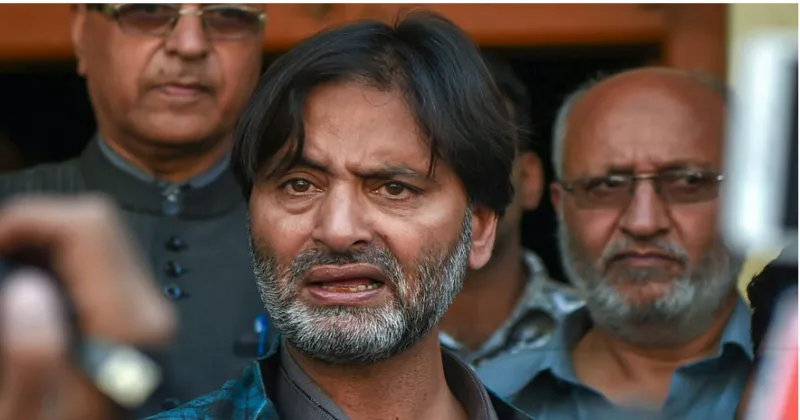
NEW DELHI: The Delhi High Court on December 23 rejected the appeals filed by Kashmiri separatist leaders Masarat Alam Bhat, Shabir Ahmed Shah, Nayeem Ahmad Khan, businessman Zahoor Ahmad Shah Watali and others against the trial court order framing charges against them in a terror funding case under the Unlawful Activities Prevention Act (UAPA).
For the uninitiated, Masarat Alam is a terrorist who played a leading role in arson during the 2010 summer unrest in the Kashmir Valley. Some years later, when Mufti Mohammad Sayeed became CM of J&K with the BJP’s help, one of his government’s first orders was to release Masarat Alam. However, the order had to be rescinded following strong opposition from the BJP, PDP’s junior partner in the coalition government.
A Division Bench of Justices Vivek Chaudhary and Manoj Jain also rejected the appeals filed by Hizbul Mujahideen Chief Syed Salahuddin’s sons Shahid Yousuf and Syed Ahmad Shakeel.
The Bench said that since the appeals were against the order on charge, they are not maintainable in view of Section 21 of the National Investigation Agency (NIA) Act. Section 21 of the NIA Act provides that interlocutory orders of the Special NIA Court are not appealable.
The court held that an order of the NIA court framing charges against the accused is an interlocutory order, and any challenge to it is barred by Section 21 of the NIA Act. This is a significant enunciation of a legal point which may arise in courts repeatedly.
“An Order framing charge, as against final order, is an interlocutory order, as it does not decide any proceeding finally and the term “intermediate order” is a concept of revisional jurisdiction, which cannot be applied while interpreting the term “appeal” both on facts and law. A conjoint reading of Section 21, other sections and purpose of the NIA Act shows that the term “order” in Section 21(1) refers to a final order and not an interlocutory or intermediate order,” the Delhi High Court ruled.
The Special NIA Court had, in March 2022, charged the appellants with offences under the UAPA over allegations of funding terror. Special Judge Praveen Singh had said that the accused had the common object of secession and they were in close association to terrorist organisations under the “guiding hand and funding of Pakistani establishment”.
Notably, in the same case, the Court had also charged Lashkar-e-Taiba (LeT) founder Hafiz Saeed and Hizbul Mujahideen chief Syed Salahuddin, as well as Jammu Kashmir Liberation Front Founder Yasin Malik. While Saeed and Salahuddin are stated to be in Pakistan, Malik pleaded guilty in the case and was awarded a life sentence. The NIA’s appeal seeking death penalty for him is pending before the Delhi High Court. Yasin Malik is serving his term in Tihar jail in Delhi.
On Tuesday, in its judgment, the court also rejected the appeals filed by several other persons in different terror cases.
This includes Javed Ali, Alemla Jamir, Masasong Ao, Abdur Rehman, Md Waqar Lone, Rajkumar, Rouf Ahmad Bhat, Mateen Ahmad Bhat, Haris Nisar Langoo, Manan Dar, Hanan Gulzar Dar, Zamin Adil Bhat and Arsalan Feroze Ahenger.
Senior Advocates Nitya Ramakrishnan and Tanveer Ahmed Mir with others, appeared for the appellants in the cases. On the other hand, Senior Advocates Sidharth Luthra and Gautam Narayan, Special Public Prosecutor (SPP) Akshai Malik with some other advocates appeared for NIA.
Meanwhile, a special NIA court in Budgam district of J&K on Tuesday ordered the attachment of more than 1.5 kanals of land belonging to US-based Kashmiri separatist lobbyist Ghulam Nabi Fai. He was declared an absconder in a terror-related case many years ago and was known to host separatists and secessionists from Kashmir and Pakistan on a regular basis in the US. At one time, he was a very well-known face in the international media who did lobbying in the power corridors of the US.
Judge Yahya Firdous passed the order after hearing from the Assistant Public Prosecutor Mohammad Iqbal Rather. An application for attachment of Dr Fai’s property under Section 83 of the Criminal Procedure Code (CPC), corresponding to Section 85 of the BNSS. In its seven-page order, the court directed the District Collector of Budgam to attach the immovable property of Dr Fai comprising two properties. One property comprised one kanal and two marlas, while the second one, located at the village Chattabugh, comprised 11 marlas.
The court further ordered that before attachment, the DC must ensure the involvement of revenue authorities to properly identify and demarcate the land. It also directed the Senior Superintendent of Police, Budgam, to provide necessary assistance to the collector, if required.