The decision by Donald Trump, President of the United States, to impose a sharp 50 per cent double tariff on Indian goods has strained trade relations between India and the US. The Trump administration believed that such a steep tariff would severely disrupt India’s export-driven sectors and pressure New Delhi into accepting American trade demands. However, India has responded with confidence, signalling that it will not be destabilised by unilateral tariff measures, even at the cost of displeasing Washington. Instead of yielding, India has accelerated its efforts to diversify trade partnerships and strengthen economic ties with other major economies. After concluding a Free Trade Agreement (FTA) with Oman, India has now reached a comprehensive trade agreement with New Zealand, reinforcing its strategy of expanding global market access while reducing dependence on the US.
Taking advantage of the ongoing Trump-led tariff war, India has revived several stalled trade negotiations that had remained dormant for years. Notably, a US trade delegation visited India shortly after Russian President Vladimir Putin held talks with Prime Minister Narendra Modi in New Delhi. Despite this renewed engagement, the Indian government has firmly rejected several US demands, particularly the push to open India’s sensitive agricultural market to American products. The Centre made it clear that India’s position on agriculture and market access is non-negotiable, and that the decision now rests with Washington. If the US is willing to accommodate India’s concerns, a bilateral trade deal could be announced by March, according to official sources. Piyush Goyal, the Union Commerce Minister, has publicly stated that an India–US trade agreement is “very close,” although significant differences remain.
While discussions with the US continue, India’s exporters are benefiting from newly secured markets through agreements with countries such as Oman and New Zealand, offering broader access and reduced trade risk.
India–New Zealand Trade Agreement
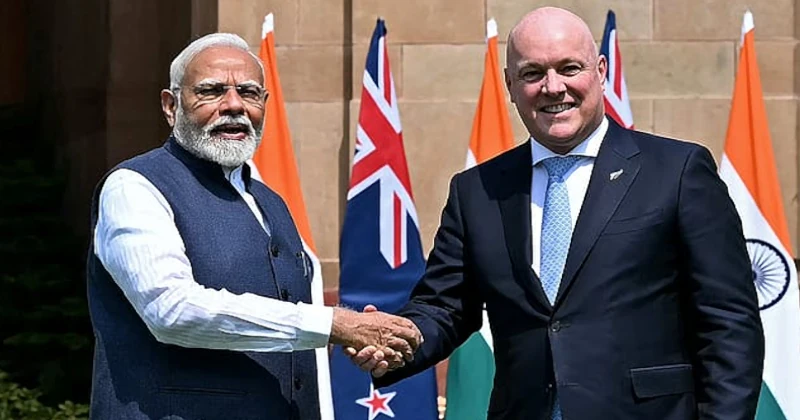
The newly concluded agreement between India and New Zealand aims to double bilateral trade within the next five years. Under the terms of the deal, all Indian exports to New Zealand will be duty-free, providing a major boost to Indian manufacturers and exporters across multiple sectors. On the import side, 95 per cent of goods entering India from New Zealand will be exempt from customs duties. From the very first day of implementation, 57 per cent of products will receive duty-free access, with this figure expected to rise to 82 per cent once the agreement is fully implemented. In addition, New Zealand has committed to investing $20 billion (approximately Rs 1.7 lakh crore) in India over the next 15 years, significantly strengthening long-term economic cooperation.
During the 2024–25 financial year, bilateral trade between the two countries stood at $1.3 billion (around Rs 11,600 crore). India’s exports accounted for $711 million (Rs 6,300 crore), while imports from New Zealand were valued at $587 million (Rs 5,200 crore).
India primarily imports wool, iron, steel, aluminium, fruits, nuts, wood pulp, and paper from New Zealand. In return, India exports pharmaceutical products, machinery, rare metals, textiles, and vehicles. To safeguard domestic farmers and traders, imports of milk and dairy products, coffee, onions, sugar, spices, edible oil, and rubber have been excluded from the agreement. Beyond goods, the agreement also strengthens cooperation in services, tourism, and education. It is expected to create new opportunities for Indian students and migrant workers, with a specific provision allowing 5,000 skilled worker visas over three years.
The political controversy surrounding the agreement in New Zealand itself underscores the strength of India’s negotiating position. New Zealand Foreign Minister Winston Peters has sharply criticised the deal, branding it “a bad agreement” and alleging that India stands to gain far more than New Zealand. His objections, particularly to the exclusion of dairy products and the controlled approach to immigration liberalisation, reflect India’s success in safeguarding its core domestic interests while extracting favourable trade terms.
Peters has also indicated that he would vote against the agreement when it is placed before Parliament, a reaction that further highlights how firmly India held its ground during negotiations. Under New Zealand law, all bilateral trade agreements require parliamentary approval, unlike in India where cabinet approval is sufficient. However, Prime Minister Christopher Luxon has expressed confidence that the government has enough parliamentary support to ensure the deal’s passage.
The agreement with New Zealand marks India’s third bilateral trade deal in 2025, following earlier agreements with Oman last week and the United Kingdom in May. Negotiations are also underway with the Gulf Cooperation Council, the European Union, Canada, Israel, Peru, and Chile, underscoring India’s broader push to reshape its global trade architecture amid shifting geopolitical and economic realities.