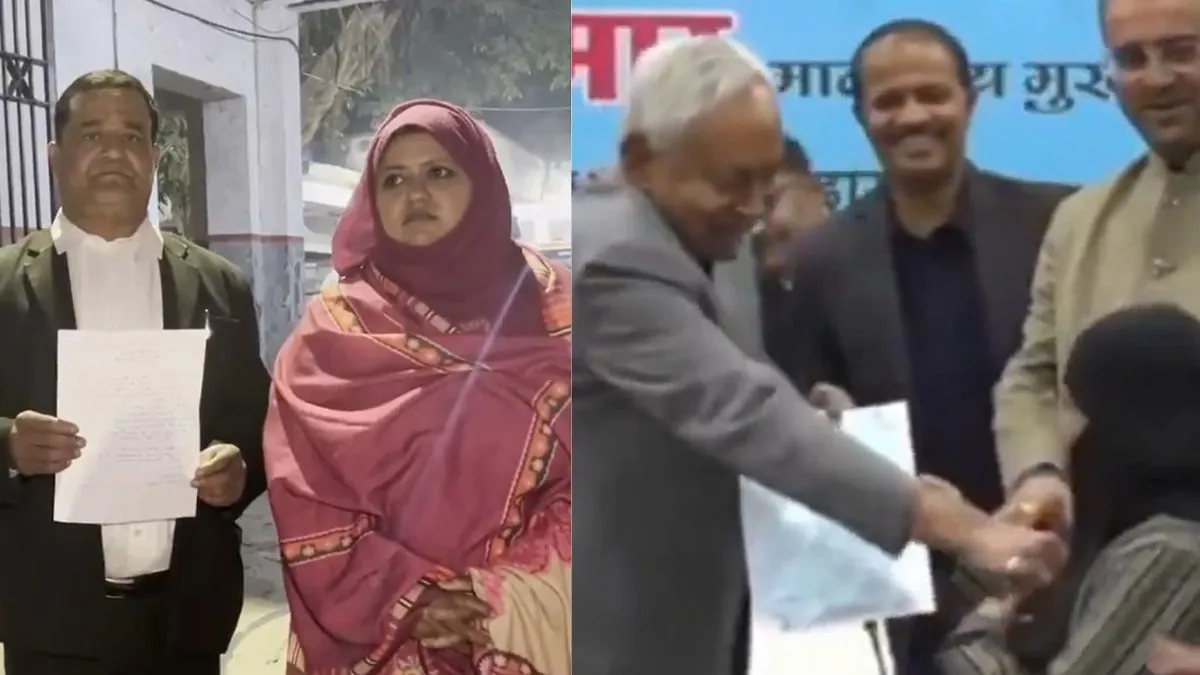
Nusrat Parveen, the newly appointed AYUSH doctor whose naqab was removed by Bihar Chief Minister Nitish Kumar during an appointment letter distribution ceremony in Patna, did not report for duty by Saturday (December 20) evening, according to the media.
Patna Civil Surgeon Avinash Kumar Singh said Parveen failed to join duty till 7 pm on December 20, after which the “possibility window for the day” was closed.
“I have been informed that the last date of joining has been extended beyond December 20. It remains to be seen whether Parveen joins on Monday or not,” Singh said, as quoted by PTI.
As per standard protocol, selected candidates are required to first report to the civil surgeon’s office in Patna before being posted to their designated health centres.
Parveen was posted to the Sabalpur Primary Health Centre (PHC) in Patna Sadar. Vijay Kumar, a surgeon at the PHC, confirmed that while several doctors joined duty on Saturday, Parveen was not among them.
“Around five-six people have joined today, and Parveen is not among them. Her name is in the list, but we have not received her appointment letter from the civil surgeon’s office,” he said.
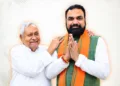
The controversy erupted earlier this week when Parveen, one of ten AYUSH doctors, arrived at the Chief Minister’s Secretariat to receive her appointment letter. When her turn came, Nitish Kumar pointed to her face veil and remarked, “What is this?” before pulling it down briefly, exposing her face.
The moment, captured on video, went viral within hours and was later weaponised by political and ideological groups, transforming a routine administrative event into a nationwide controversy.
While officials maintain they have had no direct contact with Parveen or her family, many argue that the real reason behind her absence may lie outside the administrative framework, pointing instead to pressure from conservative Islamist elements who objected to her public appearance without a face covering.
Though no official complaint or statement confirms such pressure, a familiar pattern: a Muslim woman steps into the public workforce, controversy erupts, and ideological forces, leaving the woman herself to bear the consequences.
Adding a contrasting note to the charged atmosphere, Bihar Governor Arif Mohammad Khan expressed disappointment over the incident being labelled a “dispute.”
“It pains me to hear the word ‘row’. Can there be a dispute between a father and a daughter?” he asked.
Speaking to reporters, Khan said Nitish Kumar views female students and professionals as his daughters. “What have you people made out of it?” he asked, criticising attempts to communalise the episode.
The incident drew criticism from opposition leaders and was amplified internationally, including reactions from some West Asian commentators. PDP leader Iltija Mufti went a step further, filing a police complaint against Nitish Kumar at Kothibagh police station.
Her complaint described the act as “vile” and said it caused distress among Muslims, particularly women. JD(U), meanwhile, rejected accusations that the Chief Minister acted with any communal intent or under ideological influence.
Mahfoozur Rahman, Principal of Government Tibbi College & Hospital (GTCH), where Parveen is a second-year student, confirmed that authorities were considering an extension in this “special case.”
“Ayush doctor Nusrat Parveen has not joined yet, and there is no update on her future course of action,” Rahman said, adding that the family wanted to avoid media glare.
He also dismissed reports claiming the family had relocated to Kolkata, calling them “false.”
Rahman quoted Parveen’s husband as saying that the family was neither angry with Nitish Kumar nor the Bihar government, but disappointed with the scale and tone of the media-driven controversy.
“The family feels the issue has been unnecessarily escalated,” he said.
As the dust settles, one uncomfortable question remains: who truly benefited from this controversy?
The government offered employment. The system kept the door open. Yet, amid political posturing, ideological outrage, and external pressure, the woman at the centre of the storm remains without a workplace.
This episode once again exposes how hardline Islamist narratives, operating through social pressure rather than formal diktats, end up curtailing women’s agency, even when the state extends opportunity.