The defence sector in India was analysed over the decades through the lens of expenditure based on security requirements. Even the budgets related to defence were discussed as expenditure and not investments. The manufacturing was limited in nature and the procurement process was quite delayed. The role of the indigenous sector was marginal. Indigenous paradigm has given way to a major shift to boost defence corridor. Defence in India today no longer pertains to preparedness, it contributes to a sector of building a nation.
This shift in thinking is the result of policy interventions by Modi government over a period of decade, based on the fundamental conviction that strategic autonomy is directly linked to economic capability. Defence sector is self-reliant rather than an idea but an ecosystem to counter enemies nation.
Indian defence production statistics reflects the shift from the previous growth pattern. Indigenous defence production achieved an all-time high of ₹1.27 lakh crores in FY 23-24, with a growth of 174 percent from the FY 14-15. This trend was further witnessed in FY 24-25, during which the overall defence production amounted to ₹1.54 lakh crores, a new record in defence budget. This achievement is more than just a figure, it represents the rise of a new entity that is competent enough to handle the complex requirements of the defence sector.
The Defence Public Sector Undertakings (DPSUs) remain major players, there has been steady growth in the contribution of the private sector, which has accounted for almost a quarter of the total defence production, as reported for the latest fiscal year. This has brought about greater competitiveness into the sector, which was largely controlled by a few players only.
Budgetary Commitment as Strategic Signaling
Enhanced production in the defence sector rests on a definite fiscal message. Indian defence expenditure has increased progressively from 2.53 lakh crores in 2013-14 to 6.81 lakh crores in 2025-26. There is a change in the pattern of expenditure incurred by the Indian government. An increasing share of capital procurement expenditure is allocated to domestic industry, thereby maximising the impact of government expenditure on domestic capacity rather than foreign value chains.
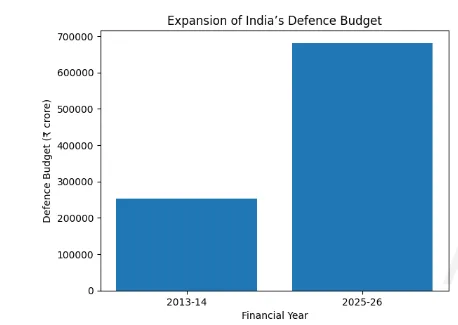
This stable demand environment has led to a change in how the industry functions. The Indian manufacturing sector now invests in long-run capacity, tools, and skill development because earlier it was assumed that Defence expenditure would not shift consumption toward capital formation. Thus, supporting the broader goals of the “Make in India” and “Aatmanirbhar Bharat” schemes.
Procurement Reform to Heal the System
One of the biggest challenges in the Indian defence sector has always been the efficiency in procurement. Delays and a lack of transparency had often led to the generation of requirements and the resulting expenditures being overlooked. The Defence Acquisition Procedure (DAP) 2020 has ushered in a new era.
DAP 2020 emphasises the Indian First philosophy by prioritising Buy (Indian-IDDM), thereby giving the highest preference to systems designed, developed, and manufactured in India. The focus is now shifted to value and capacity building, rather than to the lowest-price importation. The decision-making process has also become time-bound and has become increasingly digital.
To support the Swadeshi structure, the Defence Procurement Manual (DPM) 2025 has been drawn up. It focuses on the area of revenue procurement by goods and services, that are vitally needed for day to day defence operations. This has become effective from November 2025. The Defence Procurement Manual (DPM) 2025 aims at harmonising all activities through simplified procedures and also promotes involvement by Indian suppliers, especially with MSMEs. The DAP and DPM describe the overall integrated architecture for military preparation and growth
Defence Corridors a modern Geography of Defence Manufacturing
The establishment of Defence Industrial Corridors has added volume to the country’s Atmanirbhar Bharat Initiative. The Uttar Pradesh Defence Industrial Corridor and Tamil Nadu Defence Industrial Corridor have proved to be drivers for growth and foreign investments amounting to Rs 9,000 crore and business opportunities worth ₹66,000 crore are on the cards for these corridors.
These corridors are not just ordinary industrial estates. They provide a combination of manufacturing, testing, certification and logistics activity in designated areas, thus cutting the cost of transactions and creating synergies between different companies. They have introduced defence manufacturing in areas that were obstacles beyond the high-technology domain of India.
One of the most significant aspects of India’s defence developments is the growth of Micro, Small, and Medium Enterprises. Today over 16,000 MSME units are involved in the defence manufacturing sector, making components, subsystems, electronics, materials and precision parts. This marks a clear shift from the previous pattern where the defence production sector comprised only large PSE units.
MSME have brought transformation, specialisation and innovation. MSME integration has led to supply chain compression, improved quality control, and reduced costs. Policies including easing licensing, online platforms and guaranteed procurement opportunities have directly helped MSMEs to scale up production without any hassle. The military manufacturing industry is increasingly a system or ecosystem.
Research, Innovation and Technological Sovereignty
The production capacity does not guarantee autonomy. The government of India has invested heavily in research and development frameworks. There has been a shift in the role of the Defence Research and Development Organisation (DRDO) from a standalone research and development entity to a more integrated organisation. Initiatives such as the Technology Development Fund, the Innovations for Defence Excellence (iDEX) scheme, and the Defence Industry-Academia Centres of Excellence have focused on startups, academia, and industry.
A dedicated corpus for research in deep technology, along with technology transfer, has now expedited the lab-to-production process. The emphasis on generating intellectual property also ensures that the Indian defence system not only has indigenous assembly, production, or manufacturing capabilities.
The extent of in-home purchases also indicates that this is not a unity-in-diversity exercise in name only. In FY 24-25 alone, contracts valued at over Rs 2 lakh crore were finalised by the Ministry of Defence, a record for a single financial year. This is in addition to 177 contracts that were awarded to the Indian industry.
This volume procurement also enhances the generation of employment opportunities and the development of skills in engineering, metallurgy, electronics, and systems integration, which are highly significant for India’s overall industrial plans.
An Investment in the Long-Term Future of the Nation
This defence transformation in the Indian context is all about resilience. A self-sufficient defence economy will make a country less susceptible to global imbalances, increase its defence readiness, and reduce its dependence on foreign sources for security policies.
It appears that defence is a new, productive engine of the economy, as it sustains manufacturing, development, innovation, and depth. This path from dependency to capability lays the groundwork for a new era in which the defence sector in India will become a national resource.