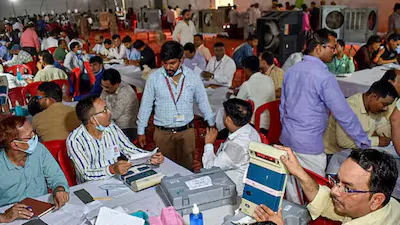
The much-awaited results of Maharashtra’s local body elections are being declared today, December 21, 2025, with counting commencing at 10 am across 246 municipal councils and 42 nagar panchayats. Polling for these elections was conducted in two phases on December 2 and December 20, amid reports of violence, bogus voting, and alleged cash distribution in certain areas. Despite these challenges, voting for remaining seats, including 23 civic body president posts and 143 vacant member posts, concluded on Saturday at 5.30 pm.
Key Political Contest: Mahayuti vs MVA
The elections are being viewed as a crucial litmus test for the BJP-led Mahayuti alliance and the opposition Maha Vikas Aghadi (MVA). The Mahayuti comprises the BJP, the Eknath Shinde-led Shiv Sena, and the Ajit Pawar-led faction of the NCP, while the MVA brings together the Congress, the Uddhav Balasaheb Thackeray faction of Shiv Sena, and Sharad Pawar’s NCP. Early trends suggest a favourable position for the Mahayuti in several regions, reinforcing the alliance’s strong showing in the 2024 Maharashtra Assembly elections, where it won 235 seats with nearly 50% vote share compared to the MVA’s 49 seats.
Vidarbha, a traditional BJP stronghold, has emerged as a key region in these civic polls. The BJP is contesting all 27 municipal councils in the region, with Congress fielding candidates in 18 of these. Early indications show gains for the Mahayuti in urban centres, including parts of Nagpur, as the alliance seeks to consolidate its influence in both rural and semi-urban municipalities.
High-Stakes Contests in Traditional Opposition Strongholds
Several historically opposition-dominated areas witnessed intense electoral battles. Sillod, where Congress had previously secured 24 of 28 seats in 2019, saw stiff competition this year, while Tuljapur, a traditional NCP bastion with 13 of 23 seats earlier, experienced closely watched contests. Other prominent civic bodies that went to the polls include Baramati in Pune district, a known NCP stronghold, and Ambernath in Thane district. Analysts note that victories in such regions are critical for both alliances to assert dominance ahead of larger state and municipal elections.
The Mahayuti’s strategy appears focused on building upon its 2024 assembly election success. With strong organisational machinery, the alliance has been able to secure voter mobilisation in critical areas. The MVA, conversely, has faced difficulties in several multi-cornered contests, particularly in regions with overlapping influence of Shiv Sena factions and the NCP. Political observers note that these civic polls are not just about municipal governance but also a proxy indicator of broader political trends ahead of the 2026 Assembly elections.
Counting and Result Tracking
Counting of votes for municipal councils and nagar panchayats began promptly at 10 am. Voters and political analysts can follow real-time updates on the official websites of the Maharashtra State Election Commission: mahasec.maharashtra.gov.in and mahaseclec.in. Early trends, particularly from Vidarbha and urban centres, indicate that Mahayuti candidates are performing well, although several closely fought contests remain undecided at the time of reporting.
Sunday’s results are also being seen as a precursor to the state’s next major electoral test: elections to the Brihanmumbai Municipal Corporation (BMC) and 28 other municipal corporations, scheduled for January 15, 2026, with counting on January 16. A total of 2,869 seats will be contested in these upcoming elections, with approximately 3.48 crore voters eligible to participate. Political analysts predict that the BMC elections, often dubbed the “mini-state elections,” will be fiercely contested, with allegations of vote manipulation and local-level horse-trading expected to intensify the campaign atmosphere.
The Mahayuti’s early lead in several councils suggests consolidation of support among its core voter base, particularly in areas influenced by the BJP and Shinde-led Shiv Sena factions. The MVA, meanwhile, is focusing on traditional strongholds and leveraging local issues to regain lost ground, though the fragmented nature of its coalition poses organisational challenges.
In Vidarbha, the BJP’s strategy to contest all municipal councils appears to have provided it with a logistical advantage, while Congress’s targeted approach in select councils seeks to maximize seat conversions. In Baramati, NCP’s home turf, outcomes are being watched closely as they may indicate the party’s resilience or decline in local politics. Ambernath, with its urban demographics, serves as a microcosm of larger trends in Thane district, including the impact of civic governance performance and local leadership appeal.