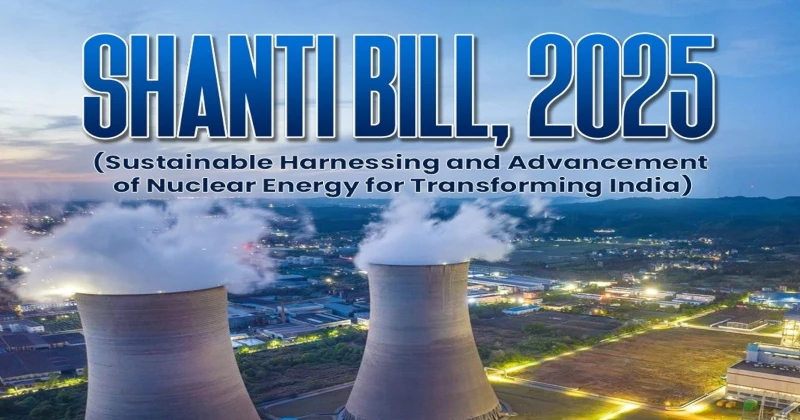
When historians look back at India’s long journey towards energy self-reliance, the Sustainable Harnessing and Advancement of Nuclear Energy for Transforming India (SHANTI) Bill, 2025 may well be remembered as a decisive inflection point. At a time when India is balancing rapid economic growth, climate commitments, and geopolitical uncertainty, the Bill seeks to answer a fundamental national question: How does a billion-plus nation power its future without remaining hostage to fossil fuels or foreign energy supplies?
India today stands at the crossroads of aspiration and constraint.
On one hand, the country is among the world’s fastest-growing major economies. Manufacturing is expanding, digital infrastructure is exploding, artificial intelligence and data centres are multiplying, and millions of households are being lifted into the middle class. All of this requires enormous quantities of uninterrupted electricity.
A look at how the Sustainable Harnessing and Advancement of Nuclear Energy for Transforming India (SHANTI) Bill, 2025 is a true game changer for India’s Energy Self Reliance 🇮🇳
Here’s a quick explainer 👇🧵 pic.twitter.com/oUuh7oazlM
— Dr Jitendra Singh (@DrJitendraSingh) December 19, 2025
On the other hand, India’s power system remains deeply dependent on coal, which still accounts for over 60 per cent of electricity generation. Coal brings with it three structural vulnerabilities:
- Environmental cost, in the form of pollution and carbon emissions
- Economic risk, from fluctuating global fuel prices
- Strategic dependence, as imports rise despite domestic reserves
Renewables have grown rapidly, but solar and wind by their very nature are intermittent. They cannot, on their own, guarantee 24×7 power for hospitals, railways, factories, defence installations, or data centres.
This is where nuclear energy becomes not optional, but essential. Nuclear energy occupies a unique position in India’s energy mix:
- It delivers continuous baseload power, independent of weather or time of day
- It produces zero carbon emissions during generation
- It requires far less land compared to large-scale renewable installations
- It insulates the economy from fuel price volatility
In strategic terms, nuclear power is energy sovereignty. Once a plant is built and fuel secured, electricity generation remains stable for decades often 60 to 80 years.
Yet despite these advantages, India’s nuclear capacity has grown slowly, constrained by financing limitations, restricted participation, and an outdated framework that placed the entire burden on the state.
The SHANTI Bill aims to remove these bottlenecks. The Bill does not emerge in isolation. It builds upon a decade of steady investment.
Budgetary allocation for nuclear energy:
- 2014: Rs 13,879 crore
- 2025: Rs 37,483 crore
- A 107 per cent increase
Installed nuclear capacity
- 2014: 4.7 GW
- 2025: 8.9 GW
This growth reflects political commitment—but also reveals a hard truth: public funding alone cannot scale nuclear energy to the levels India needs. To reach 100 GW by 2047, India requires new capital, faster execution, advanced manufacturing, and a deeper ecosystem. That necessitates reform.
The SHANTI Bill introduces regulated private participation in nuclear energy not as a retreat of the state, but as an expansion of national capability. Nuclear plants have high upfront costs but extremely low operating costs over time. With lifespans of several decades:
- Power becomes cheaper year after year
- Electricity tariffs remain stable
- Citizens are protected from fuel price shocks
Importantly, the government retains full control over tariffs, ensuring affordability and preventing profiteering.
Every major nuclear power nation the United States, France, the United Kingdom, Japan, and South Korea has allowed private sector participation under strong regulatory oversight. The results have been consistent:
- Lower electricity costs
- Faster capacity expansion
- Strong domestic nuclear industries
- Exportable expertise
India’s move is not experimental. It is aligned with global best practices. Concerns about private participation in strategic sectors are not new. India has faced and overcome them before.
Before 2014:
- Space was exclusively government-driven
- ISRO achieved scientific excellence, but
- There were no startups, no private launch market, and negligible commercial presence
After reforms:
- Private launch companies emerged
- Satellite startups flourished
- Manufacturing ecosystems developed
The result, India’s space economy surged from ~$8 billion to a projected $45+ billion, creating thousands of high-skilled jobs and opening global markets. A similar transformation occurred in defence:
- Imports gave way to exports
- Private manufacturers entered high-tech production
- Defence corridors created employment and innovation
The lesson is clear: reform, when paired with regulation, delivers national strength. The SHANTI Bill draws an unmistakable boundary safety is non-negotiable. Even with private participation:
- Licensing and inspections remain stringent
- The Atomic Energy Regulatory Board operates independently
- Authorities retain powers to inspect, seize, and shut down facilities
Crucially, nuclear fuel, spent fuel, heavy water, and nuclear waste remain entirely under government custody, in line with global norms. There is no dilution of responsibility. There is no transfer of risk to citizens. One of the Bill’s most significant structural reforms is its graded liability framework.
- Large reactors carry higher liability
- Medium reactors carry proportionate liability
- Small reactors and ancillary facilities carry lower liability
This ensures:
- Fair risk allocation
- Wider participation without compromising safety
- Strong accountability at every level
It creates an ecosystem where innovation is possible, responsibility is clear, and public interest remains protected. The impact of nuclear energy extends far beyond electricity generation. It enables:
- Advanced cancer treatment and medical diagnostics
- Food preservation and irradiation for safety
- Clean drinking water through desalination
- Improved crop yields and seed quality
- Precision industrial quality testing
As India’s digital economy expands, nuclear power ensures data centres, hospitals, metros, and industrial clusters operate without interruption. The SHANTI Bill anchors India’s long-term nuclear roadmap:
- 2025: 8.9 GW
- 2032: 22 GW
- 2037: 47 GW
- 2042: 67 GW
- 2047: 100 GW
This trajectory aligns clean energy, economic growth, and strategic autonomy into a single national mission.