In the first half of November 2025, a video claiming to show Chief of Army Staff (COAS) General Upendra Dwivedi announcing a controversial policy regarding “non-caste Hindus” in the Indian Army began circulating across multiple social media platforms. Within hours, the clip was viewed and shared hundreds of thousands of times, igniting widespread outrage, anxiety, and intense debates across communities, online forums, and traditional media outlets. The speed and intensity of the reaction highlighted not only the viral potential of digital misinformation but also the fragility of public trust in critical national institutions.
At first glance, the footage appeared authentic. It combined real visuals of General Dwivedi delivering a routine speech at an official event with AI-generated audio that distorted his words into a false and inflammatory narrative. The manipulation was executed with such precision that even observers familiar with military communications were momentarily deceived, transforming a motivational address into a purported policy announcement with potentially explosive social and political consequences.
This incident highlighted the evolving nature of modern information warfare. When paired with social media virality, such content can challenge not only individual reputations but also the credibility of institutions that underpin national stability.
Beyond the immediate controversy, the episode raises pressing questions about accountability, verification, and the public’s ability to discern truth in the digital age. How did the video gain such rapid traction? Why did even experienced analysts initially accept it as real? And more importantly, what does this imply for national security when the trustworthiness of the army – a cornerstone of India’s defence apparatus – can be called into question by a single doctored clip?
This report seeks to provide a comprehensive account of the incident. It chronicles the timeline of events, identifies and analyses the actors behind the hoax, evaluates its social and security impact, documents official responses, and draws broader lessons for policy, digital literacy, and public resilience.
The Viral Trigger: What the video claimed
Between November 4 and 16, 2025, social media saw the emergence and rapid spread of a video clip purportedly showing Upendra Dwivedi, Chief of Army Staff (COAS) of the Indian Army, declaring a controversial policy: that the Army would dismiss “non‑caste Hindu” soldiers, aiming to reduce their numbers by 50 per cent by 2028.
The post’s caption and accompanying comments claimed this was part of a “saffronisation” push, and invoked communal and identity‑based rhetoric. This message triggered immediate outrage, chatter across political/social circles, and widespread dissemination – both within India and internationally.
But within days, fact‑checkers and official sources raised red flags. The clip was not genuine: its audio had been artificially altered and overlaid on real footage, making the claim a manufactured deepfake. (FACTLY)
This article reconstructs how the hoax spread via 14 identified social‑media handles, why the manipulation fooled many, and what the fallout tells us about emerging threats in the information sphere.
Authentic Footage vs The Fake Clip
What the original video shows
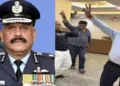
Journalistic review traced the viral clip back to genuine footage released on November 1, 2025. In that recording – published by a credible media agency – General Dwivedi visits a college in Rewa (TRS College, Madhya Pradesh) and speaks about his outreach, the significance of youth engagement, discipline, and national service. He mentions Operation Sindoor and delivers a speech aimed at motivating young students. There is no reference to religion, caste, or any intention to change the Army’s composition. (Alt News)
What changed: how the deepfake was created
The viral version retains the same video frames but replaces the original audio with a forged, inflammatory message. Independent forensic analysis using AI‑detection tools (such as voice‑deepfake detectors) flagged the audio as artificial: lip movements did not sync with the voice, intonation and pauses felt unnatural, and artefacts (distortion, mismatched overlays) appeared. (FACTLY)
Authorities quickly weighed in: the Press Information Bureau (PIB) labelled the video “AI‑generated fake” and urged the public not to forward or believe it. No credible evidence or official statement corroborated the claim. (India Today)
In short – the viral clip was not a speech at all. It was a manufactured propaganda tool, designed to exploit trust and provoke division.
Who amplified it – The 14 Handles Behind the Hoax
These are the social‑media users and pages that played key roles in spreading the manipulated video. Their involvement ranged from initial seeding to amplification within domestic and international networks.
Domestic Promoters
Mohammed Zubair – @zoo_bear (Nov 15, 2025)
A journalist and co‑founder of an online media outlet. On November 15, he posted the clip with a provocative caption in Hindi implying the COAS intended to reduce non‑Hindu numbers. Given his reach and reputation, the post added a veneer of credibility to the hoax.
Kavish Aziz – @azizkavish (Nov 15, 2025)
Also a journalist. On the same day, he shared the video, framing it as evidence of political interference in the Army. His post has since been deleted – but by then, the video had already circulated widely.
Pratik Sinha – @free_thinker (Nov 15, 2025)
Co‑founder / editor at the same media outlet as Zubair. He shared the clip with a text similar to Zubair’s, contributing to further spread among media‑consuming audiences.
Chandradeo Yadav – @CHANDRADEOYad12 (Nov 15, 2025)
A self-proclaimed activist, whose repost amplified the narrative among regional and grassroots networks.
Subhash Kumar Sharma – @sharmass27 (Nov 5, 2025)
One of the earliest Indian users to share the misinformation. His post – ahead of the wider wave – carried alarmist and communal language, referencing minority-targeting and suggesting the Army’s traditional backbone (e.g. Sikh regiments) could be destabilised.
Kohli Mahesh – @maheshkohli433 (Instagram, Nov 9, 2025)
A political‑worker (per publicly available profile data) who reposted Sharma’s earlier alarmist post, amplifying it across platform boundaries (from X to Instagram).
Harleen Kaur Dhillon – @Harleenkaur44 (Nov 16, 2025)
Shared the clip with a claim that only certain caste groups (referred to in derogatory and provocative caste‑based language) would remain in the Army. This post further inflamed communal sentiments and stirred reactions among diaspora audiences.
Foreign / International Amplifiers
Baba Thoka – @Baba_Thoka (Nov 4, 2025)
One of the earliest handles to circulate the doctored clip. The caption was overtly provocative, mocking the idea of “patriotism now requiring a gotra certificate”. Set the tone for a hostile, communal narrative.
The Whistle Blower – @InsiderWB (Nov 4, 2025)
Posted “Breaking News” claiming the Army had officially announced the removal of non‑caste Hindus, 50 percent sacked by 2028. The account was later withheld in India, but the initial post had already seeded the narrative.
Sadia Khalid – @SadiasOfficial (Nov 4, 2025)
Used explicitly hateful and communal language, claiming only Hindus would be allowed – “not invading Muslims” – if the purge went ahead. The post was deleted later, but copies remain archived.
Zaryab Ali – @zarybali720 (Nov 5, 2025)
Repeated the removal narrative, using Hindutva-themed hashtags, adding to cross-border amplification targeting international and diaspora audiences.
Meera MJ – @vibrantpakistan18 (Instagram, Nov 5, 2025)
Linked to Pakistani social media network; reposted the hoax, framing it as evidence of aggression against minorities, aimed at stirring outrage among Pakistani and global audiences.
Annu Malik – Facebook user (Bangladesh, Nov 5, 2025)
Shared the same narrative, using Hindutva‑agenda hashtags. This demonstrates how the misinformation spread beyond India – reaching South‑Asian social spaces.
Houston Tribune – Facebook page (USA, Nov 8, 2025)
Represented perhaps the most strategic amplification – this U.S.-based page falsely claimed that Indian media (including leading agencies) reported the policy. By doing so, it attempted to confer legitimacy on the hoax among international and diaspora audiences unfamiliar with the original context.
The Spread Pattern: From Seeds to Cascade
Phase 1: Early Seeding
The first posts appeared on November 4-5 from foreign or pseudonymous handles such as @Baba_Thoka, @InsiderWB, @SadiasOfficial, @zarybali720, and an Instagram user from Pakistan. Their language was overtly provocative, communal, and designed to shock. These initial shares acted as seeds – planting the false narrative in social media timelines and message‑chains, ready for wider amplification.
Phase 2: Domestic Amplification
Within days, Indian social media users began to repost the clip, including @sharmass27 (Nov 5), who invoked communal anxiety, referencing Sikh contributions to the Army. Political‑worker accounts and activists joined by early November.
On November 15, the clip jumped to media‑linked handles like @zoo_bear (Mohammed Zubair) and @free_thinker (Pratik Sinha), whose followings and reputations helped thrust the video into broader public visibility. That day became a turning point – from fringe sharing to mainstream awareness.
Phase 3: Cross‑platform & International Amplification
After domestic amplification, foreign networks – Pakistani, Bangladeshi, diaspora, and even U.S.-based pages – took up the narrative. Identical script templates, similar hashtags, and uniform messaging across handles suggest coordinated, template‑based propagation.
This cross‑platform push (X, Instagram, Facebook) and cross-border spread gave the hoax international visibility – turning what began as a domestic rumor into a global propaganda incident.
Why this Fake Video mattered: Risks Beyond Social Media
Institutional Trust and Army Cohesion at Stake
The Indian Army derives its strength not just from weaponry but from unity: across castes, religions, regions. It stands as a secular institution that binds citizens through service, duty, and national identity. A widely-circulated claim that the Army intends to purge “non‑caste Hindus” – particularly minority communities – threatens that core unity. If believed, it could sow distrust, fear, and communal suspicion among soldiers and civilians alike, potentially eroding cohesion, morale, and public faith.
Weaponisation of AI and Digital Propaganda
This incident highlights how advancing AI tools – specifically deepfake video/audio editing – are being used as weapons in information warfare. A real speech, repurposed with fake audio, becomes a tool to manufacture communal anger, undermine institutions, and spread discord. The ease, speed, and (initial) plausibility of such content make it a powerful tool for anyone with malicious intent. The attack isn’t with bombs, but with bytes – subtle, insidious, viral.
Strategic Timing and Psychological Warfare
The timing of the spread appears calculated. International handles seem to have seeded the clip, while domestic users amplified it. By November 15, with the involvement of high‑visibility domestic media‑linked handles, the narrative had enough momentum to stoke widespread anger and speculation. Given concurrent regional tensions and security concerns, such misinformation could act as a force multiplier for hostile psychological operations – potentially destabilising public sentiment and affecting internal security.
Official Facts, Fact‑Checkers and Public Warning
Independent fact‑checking organisations (including Factly, BOOM Live and others) analysed the viral clip and concluded that the video is a deepfake: the original footage is real, but audio has been AI‑generated and overlaid. (FACTLY) The official spokesperson of the Press Information Bureau publicly flagged the video, along with several others targeting senior leaders, as part of a coordinated disinformation campaign – urging citizens to rely only on verified sources and avoid forwarding suspicious content. (India Today). As of now, there is no credible media report, official order, or defence ministry communication supporting any claim that the Army intends to alter recruitment or retention based on religion or caste – the video’s core allegation remains completely baseless.
The spreading of this video, in the face of quick fact‑check responses, underscores a key problem: once misinformation gains initial traction, retractions and corrections rarely reach as wide an audience. Many may continue to believe or forward the content long after it has been debunked.
What this incident teaches
1. Artificial‑intelligence tools can now create convincingly false audio‑visual content. A real person’s speech can be twisted, a respected institution’s reputation manipulated, and public trust exploited – all within hours.
2. Content that taps into communal sensitivities – religion, caste, identity – spreads faster. Emotional triggers often suppress skepticism. For many, the claim aligned with latent fears or prejudices; for others, it did not need to be true to feel real.
3. When misinformation moves across platforms (X, Instagram, Facebook) and across geographies (domestic, Pakistani, Bangladeshi, diaspora, international), tracking and containment become exponentially more difficult. What begins as a local rumor can turn into global propaganda.
4. While agencies like PIB and independent fact‑checkers acted promptly, their reach is limited compared to the viral spread of misinformation. Once the video was out, many would have seen or saved it before clarification. Once seeded, a lie persists even after being disproved.
5. Public awareness campaigns to educate citizens, stricter checks by social‑media platforms, and robust legal frameworks to deter coordinated misinformation are essential. Without such safeguards, the next deepfake – more sophisticated, better distributed – can cause far greater damage.
Not Just Another Viral Video
The manipulated “non‑Hindu soldiers purge” video was not a harmless prank. It was a carefully constructed disinformation tool, designed to exploit communal anxieties, undermine institutional trust, and stoke division – within India and across borders.
The 14 identified handles may have different motivations – some ideological, some opportunistic, some malicious. But the result was the same: a dangerous narrative that threatened the credibility of one of India’s most respected institutions.
That the video was exposed, debunked, and condemned is a relief. That it spread so widely and so fast – before verification – should be a warning. In today’s world, wars are being fought not just with weapons, but with bytes and misinformation.
The COAS deepfake incident serves as a wake-up call for India and the global community. It shows that the frontline of modern conflict is not limited to land, sea, or air – it extends decisively into cyberspace, where perception can be weaponised and reputations destroyed in moments. Fourteen social media handles, spanning domestic and international actors, were identified as primary amplifiers, working in concert to maximise the video’s reach and emotional impact.
Even after official clarifications and fact-checks, the clip had already influenced public discourse, demonstrating the enduring power of misinformation once it embeds itself in collective consciousness. The episode highlights three critical vulnerabilities: first, the potential for AI-generated content to convincingly mimic real figures; second, the speed at which social media can amplify unverified content; and third, the challenge of restoring trust once it has been undermined.
For national security, the stakes are high. The Indian Army, like any disciplined institution, relies on cohesion, morale, and public trust. Deepfakes targeting military leadership are not just attempts to spread falsehoods; they are strategic acts aimed at weakening institutional credibility and sowing discord among citizens. Beyond defense, the incident is a case study in the broader societal risks posed by digital misinformation: polarisation, fear, and misinformed debates that can have long-lasting consequences.
Above all, the COAS deepfake episode is a stark reminder that in the digital age, the battle for truth is ongoing, complex, and collective. Every citizen, institution, and platform has a role in safeguarding facts, defending credibility, and preventing manipulation. The stakes are high, and vigilance is not optional – it is essential.