Why are anti-India protests erupting in Bangladesh and what does the ‘Seven Sisters’ threat signal?
August 31, 2026
  • Read Ecopy
  • Circulation
  • Advertise
  • Careers
  • About Us
  • Contact Us
Android AppiPhone AppArattai
Organiser
  • ‌
  • Bharat
    • Assam
    • Bihar
    • Chhattisgarh
    • Jharkhand
    • Maharashtra
    • View All States
  • World
    • Asia
    • Europe
    • North America
    • South America
    • Africa
    • Australia
  • Editorial
  • International
  • Opinion
  • RSS @ 100
  • More
    • Op Sindoor
    • Analysis
    • Sports
    • Defence
    • Politics
    • Business
    • Economy
    • Culture
    • Special Report
    • Sci & Tech
    • Entertainment
    • G20
    • Azadi Ka Amrit Mahotsav
    • Vocal4Local
    • Web Stories
    • Education
    • Employment
    • Books
    • Interviews
    • Travel
    • Law
    • Health
    • Obituary
  • Subscribe
    • Subscribe Print Edition
    • Subscribe Ecopy
    • Read Ecopy
  • ‌
  • Bharat
    • Assam
    • Bihar
    • Chhattisgarh
    • Jharkhand
    • Maharashtra
    • View All States
  • World
    • Asia
    • Europe
    • North America
    • South America
    • Africa
    • Australia
  • Editorial
  • International
  • Opinion
  • RSS @ 100
  • More
    • Op Sindoor
    • Analysis
    • Sports
    • Defence
    • Politics
    • Business
    • Economy
    • Culture
    • Special Report
    • Sci & Tech
    • Entertainment
    • G20
    • Azadi Ka Amrit Mahotsav
    • Vocal4Local
    • Web Stories
    • Education
    • Employment
    • Books
    • Interviews
    • Travel
    • Law
    • Health
    • Obituary
  • Subscribe
    • Subscribe Print Edition
    • Subscribe Ecopy
    • Read Ecopy
Organiser
  • Home
  • Bharat
  • World
  • Operation Sindoor
  • Editorial
  • Analysis
  • Opinion
  • Culture
  • Defence
  • International Edition
  • RSS @ 100
  • Magazine
  • Read Ecopy
Home World

Why are anti-India protests erupting in Bangladesh and what does the ‘Seven Sisters’ threat signal?

Marches towards Indian diplomatic missions, threats involving India’s Northeast, and sharp diplomatic exchanges point to a deepening crisis in India-Bangladesh relations as Dhaka heads into a volatile election season

WEBDESKWEBDESK
Dec 19, 2025, 08:00 am IST
inWorld, South Asia, Asia
Follow on Google News
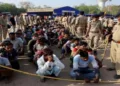
Anti-India protests in Bangladesh

Anti-India protests in Bangladesh

Facebook
Twitter
WhatsAppTelegramEmail

Fresh anti-India protests have erupted across Bangladesh, with demonstrators attempting to march towards Indian diplomatic missions and political leaders issuing provocative statements targeting India’s sensitive northeastern region. The unrest comes amid a deteriorating political situation under Bangladesh’s interim government, rising street mobilisation, and escalating diplomatic tensions between New Delhi and Dhaka.

The protests, coupled with threats referencing India’s “Seven Sisters” the northeastern states connected to the mainland by the narrow Siliguri Corridor, have raised alarm in New Delhi, prompting diplomatic protests and heightened security measures around Indian missions in Bangladesh.

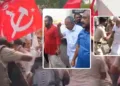
On Thursday (Dec 18), dozens of protesters attempted to march towards the office of the Assistant Indian High Commissioner in Rajshahi, a key city in northwestern Bangladesh. Chanting slogans and carrying placards, the demonstrators demanded the “repatriation of all the killers including Sheikh Hasina,” referring to the former Bangladeshi prime minister currently staying in India.

Bangladeshi police moved quickly to block the march, erecting barricades and deploying personnel in riot gear near the Indian mission. Officials said the protesters were stopped before reaching the premises and were informed that their demands would be conveyed to higher authorities.

A brief confrontation occurred when some demonstrators attempted to push past the barricades, but the situation was later brought under control. Local officials said they were not aware of further planned demonstrations in Rajshahi but expressed hope that the situation would remain calm.

A similar protest unfolded a day earlier in Dhaka, where demonstrators attempted to march towards the Indian High Commission.

Following the incident, Indian authorities temporarily shut down visa services at two Indian Visa Application Centres (IVACs) in Bangladesh, citing security concerns.

In response to the protests and reported threats by extremist groups, India’s Ministry of External Affairs summoned Bangladesh’s High Commissioner to India, M. Riaz Hamidullah, to formally convey New Delhi’s concerns.

India reminded Dhaka of its obligations under international diplomatic conventions to ensure the safety and security of foreign missions and personnel. Officials stressed that threats to Indian diplomatic premises were unacceptable and called on the interim Bangladeshi government to take decisive steps to prevent further escalation.

India-Bangladesh relations have remained tense since former Prime Minister Sheikh Hasina fled to India following a massive student-led uprising last year that culminated in the collapse of her Awami League government. Hasina later resigned and has since been residing in India at a secure, undisclosed location.

Bangladesh has repeatedly sought her extradition to face trial for alleged crimes linked to the violent crackdown on protesters. Last month, a Bangladeshi court sentenced the 78-year-old leader to death in absentia for crimes against humanity.

India has maintained that Hasina’s extradition request is under examination, a stance that has drawn criticism from sections of Bangladeshi political opinion and fuelled street protests.

The political vacuum has been further compounded by the banning of Hasina’s Awami League from contesting the upcoming national elections scheduled for February 12, leaving Bangladesh without one of its largest political forces at a critical juncture.

Tensions escalated further after Hasnat Abdullah, a leader of Bangladesh’s National Citizen Party (NCP), issued a controversial statement warning that Dhaka could “give refuge to separatists of the Seven Sisters” if India attempted to destabilise Bangladesh.

Abdullah claimed that Bangladesh could “isolate” India’s northeastern states by exploiting their dependence on the narrow Siliguri Corridor, often referred to as India’s “Chicken’s Neck.” The remarks were widely seen as provocative, touching upon one of India’s most sensitive strategic vulnerabilities.

Only 27, Abdullah rose to prominence during the 2024 protests and is known for his aggressive and confrontational rhetoric. His comments triggered strong reactions in Indian strategic and diplomatic circles, which viewed the statement as irresponsible and inflammatory.

India has categorically rejected what it described as a “false narrative” being pushed by extremist and radical elements in Bangladesh. The Ministry of External Affairs reiterated that India supports peace, stability, and democratic processes in Bangladesh and has no intention of interfering in its internal affairs.

New Delhi has also made it clear that any threats to India’s territorial integrity or attempts to link Bangladesh with separatist movements in the Northeast are unacceptable.

With Bangladesh heading into elections under an interim administration and political rhetoric becoming increasingly strident, notably, bilateral relations could face further turbulence in the coming months.

Topics: Indian High Commissionindia bangladesh relationsanti-India protestsBangladesh unrestSheikh Hasina extraditionSeven Sisters threat
Share
Tweet
SendShareSend
✮ Subscribe Organiser YouTube Channel. ✮
✮ Join Organiser's WhatsApp channel for Nationalist views beyond the news. ✮
Previous News

“27,397 births in 100 days”: Kirit Somaiya flags birth certificate racket, alleges interstate cyber fraud

Next News

Goa Liberation Day: A lesson in national will over colonial complacency

Related News

Hundreds try to flee to Bangladesh as West Bengal CM Suvendu Adhikari says quit India

West Bengal: Hundreds of inflitrators try to flee to Bangladesh as Suvendu govt intensifies crackdown

Lok Sabha Speaker Om Birla and Bangladesh Prime Minister Tarique Rahman

Time to reset Indo-Bangladesh ties

Dhaka is reassessing its trade and diplomatic strategy as shifting tariff regimes and reduced regional support alter economic calculations

India’s trade wins and budget cuts strike Bangladesh

(Left) PM Narendra Modi (Right) Mohammad Yunus, the Chief Adviser of the interim government of Bangladesh

Union Budget 2026 signals diplomatic reset: India cuts aid to Bangladesh, drops Chabahar port funding

40-year-old Hindu widow in Bangladesh was gang-raped, tortured, and publicly humiliated by two men

Brutality in Bangladesh: Hindu widow gang-raped, tortured & publicly humiliated by Shahin and Hasan in Jhenaidah

The lynching incident took place amid fresh wave of violence last week following the death of Sharif Osman Hadi

13 days, 13 incidents: Bangladesh sees wave of violence targeting Hindus, media, and Indian outlets

Load More

Latest News

Students at the Gautam Buddha University, Greater Noida

Mann Ki Baat: PM Modi praises GBU’s mission ShakthiSAT, says dreams of daughters are now taking flight to space

Dutch TikTokker Angelo Bryson, known as Superhuman Unchained, at a pro-Palestine protest.

Dutch TikTokker recently converted to Islam livestreams stabbing three in Amsterdam; Watch video

From Kanchipuram to Kalamkari, India’s traditional textiles reflect its rich regional cultures and centuries-old craftsmanship

From Kanchipuram to Kalamkari: Exploring India’s rich traditional textiles and regional clothing heritage

Punjabi Influencer Abducted, Burnt Alive Near Morinda

Punjab Law and order crisis: Influencer Manjeet Kaur abducted, burnt alive after attack near Morinda

‘Dimagi Naxals’ romanticising Mao, Stalin and Pol Pot

The Swadeshi movement turned Indian enterprise into a powerful force for economic self-reliance, national pride and the struggle for Swaraj

Building Economic Swaraj: How Indian enterprises fought foreign rule and reclaimed national pride

Prime Minsiter Narendra Modi and Uzbekistan President Shavkat Mirziyoyev

India-Uzbekistan Herald New Chapter: Uranium deal, 30-day visa-free entry to Indians & $5bn trade propel bilateral ties

The new FCRA rules seek to curb unchecked foreign funding, strengthen financial accountability, and protect Bharat’s national security

Stopping Unchecked Foreign Money: How new FCRA rules protect Bharat’s security and financial sovereignty

Keralam CM VD Satheeshan, DCC member Chembil Anil (Left to Right)

Keralam Congress infighting surfaces in CM VD Satheeshan’s vehicle blockade; DCC member Chembil Anil arrested, remanded

Indian Logistics Data Bank tracks ten crore containers, transforming freight visibility and strengthening the nation’s logistics network

From Lothal Dockyard to Ten Crore Containers: India’s Logistics Data Bank transforms EXIM freight tracking

Load More
  • Privacy
  • Terms
  • Cookie Policy
  • Refund and Cancellation
  • Delivery and Shipping

© Bharat Prakashan (Delhi) Limited.
Tech-enabled by Ananthapuri Technologies

  • Home
  • Search Organiser
  • Bharat
    • Assam
    • Bihar
    • Chhattisgarh
    • Jharkhand
    • Maharashtra
    • View All States
  • World
    • Asia
    • Africa
    • North America
    • South America
    • Europe
    • Australia
  • Editorial
  • Operation Sindoor
  • Opinion
  • Analysis
  • Defence
  • Culture
  • Sports
  • Business
  • RSS @ 100
  • Entertainment
  • More ..
    • Sci & Tech
    • Vocal4Local
    • Special Report
    • Education
    • Employment
    • Books
    • Interviews
    • Travel
    • Health
    • Politics
    • Law
    • Economy
    • Obituary
  • Subscribe Magazine
  • Read Ecopy
  • Advertise
  • Circulation
  • Careers
  • About Us
  • Contact Us
  • Policies & Terms
    • Privacy Policy
    • Cookie Policy
    • Refund and Cancellation
    • Terms of Use

© Bharat Prakashan (Delhi) Limited.
Tech-enabled by Ananthapuri Technologies