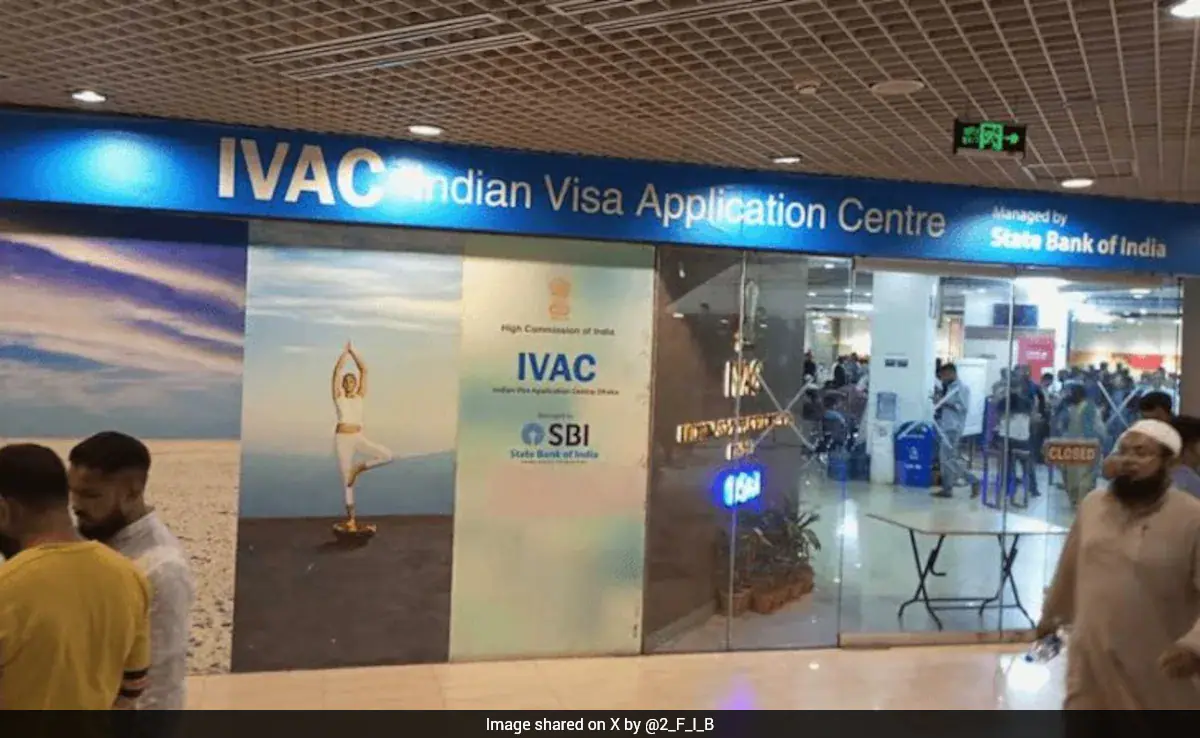
India on Thursday (December 18) resumed operations at its Indian Visa Application Centre (IVAC) in Dhaka, a day after the facility was temporarily closed due to security concerns triggered by an anti-India protest march towards the Indian High Commission in the Bangladeshi capital. However, two other IVACs located in Khulna and Rajshahi continued to remain shut amid continuing protests and heightened security alerts.
The IVAC at Jamuna Future Park (JFP) in Dhaka, which functions as the principal integrated centre for processing Indian visa applications in the capital, reopened after authorities reviewed the security situation. The centre had been closed following a call for a protest march by a hardline group named July Oikyo, which announced a “March to Indian High Commission” programme.
According to news agency PTI, the protest march was organised to demand the “return” of former Bangladesh Prime Minister Sheikh Hasina and former Home Minister Asaduzzaman Khan Kamal. Both leaders were recently sentenced to death by Bangladesh’s International Crimes Tribunal on charges of crimes against humanity linked to last year’s student-led protests and the subsequent violent crackdown.
Fearing possible unrest and security breaches, Indian authorities had temporarily suspended operations at the Dhaka IVAC as a precautionary measure. With the immediate threat receding, visa services at the Jamuna Future Park centre were restored on Thursday.
While the Dhaka centre resumed work, IVACs in southwestern Khulna and northwestern Rajshahi remained closed due to continuing protests and security concerns in those regions.
An official notice issued on the IVAC website stated: “In view of the on-going security situation, we wish to bring to your kind notice that IVAC Rajshahi and Khulna will be closed today (18.12.2025). All applicants who have appointment slots booked for submission today will be given a slot at a later date.”
Authorities clarified that applicants affected by the closures would be accommodated on future dates once normalcy is restored.
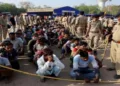
In Rajshahi, dozens of protesters attempted to march towards the office of the Assistant Indian High Commissioner, raising slogans and demanding the “repatriation of all the killers including Sheikh Hasina.” Police personnel in riot gear blocked the marchers near the Indian mission, citing security concerns.
A brief clash occurred when some protesters tried to break through the barricades. Law enforcement officials later said they had taken note of the demonstrators’ demands and assured them that their concerns would be conveyed to higher authorities, after which the situation was brought under control.
A similar situation unfolded in Khulna, where protesters under the banner ‘Unity Against Indian Hegemony’ attempted to march towards the Assistant High Commission of India. Security forces prevented the demonstrators from approaching the mission.
Khulna’s Deputy Commissioner of Police, Tajul Islam, was quoted as saying that strict vigilance had been enforced to ensure the safety of the diplomatic premises.
“We had enforced a stringent vigil preventing them from proceeding towards the mission. They left the scene after staging a ‘peaceful’ rally,” he said.
Series of Anti-India Protests
Officials noted that such anti-India protests have been occurring intermittently in Dhaka and other parts of Bangladesh over the past several weeks, reflecting growing political volatility in the country.
India operates five IVAC centres across Bangladesh, in Dhaka, Khulna, Rajshahi, Chattogram and Sylhet. While services at Dhaka have resumed, the situation at Khulna and Rajshahi remains under close review.
The developments come against the backdrop of heightened diplomatic tensions between New Delhi and Dhaka. Recently, India summoned Bangladesh’s High Commissioner to India, Muhammad Riaz Hamidullah, to lodge a formal protest over threats to the Indian High Commission in Dhaka and inflammatory anti-India remarks made by Bangladeshi political leaders.
Earlier, Bangladesh’s foreign ministry had summoned Indian envoy to Dhaka, Pranay Verma, expressing concern over what it described as “incendiary” statements made by Sheikh Hasina from Indian soil. In response, New Delhi firmly stated that it has never allowed its territory to be used for activities inimical to Bangladesh’s interests.
India-Bangladesh relations have remained strained since August 5, 2024, when the Sheikh Hasina-led Awami League government collapsed following massive student-led protests. Hasina resigned and fled to India, where she has since been staying at a secure, undisclosed location in New Delhi.
Recently, Bangladesh’s International Crimes Tribunal sentenced Hasina to death on three counts related to crimes against humanity, concluding a months-long trial. The court held her responsible for ordering a violent crackdown on protesters, which eventually led to the fall of her government.
Dhaka has repeatedly sought Hasina’s extradition, a request that India has said is currently under “consideration.”
Bangladesh is presently governed by a caretaker administration led by Nobel laureate Muhammad Yunus, as the country grapples with political uncertainty, street protests, and diplomatic challenges.