Between 11 December and 24 December 2025, Bangladesh witnessed a series of violent incidents targeting media offices, Hindu communities, and Indian diplomatic missions, reflecting heightened tensions ahead of the national elections scheduled for February 2026. The unrest included mob assaults, arson attacks, vandalism, and anti-India demonstrations, affecting cities such as Dhaka, Chattogram, Rajshahi, and Rangpur. Authorities reported multiple casualties, injuries, and widespread property damage, while law enforcement and army personnel were deployed to contain the situation.
The violence appears to have been catalysed by the killing of Inqilab Moncho leader Sharif Osman Hadi, leading to attacks on media outlets, political offices, cultural institutions, and private residences. Hindu communities were disproportionately affected, with multiple incidents of arson, assault, and killings reported. In addition, protests targeting Indian diplomatic missions prompted temporary closures of Indian visa application centres and official summoning of diplomats by the Bangladeshi government.
The period has also highlighted concerns about the safety of minorities, journalists, and foreign missions, as well as the challenges faced by authorities in maintaining law and order during politically sensitive times. The detailed incidents from December 1 to December 7, 2025, are given below.
1. Madhu’s Canteen Vandalised
Madhu’s Canteen at Dhaka University was vandalised by an unidentified young man. The incident occurred inside and in front of the canteen premises. Video footage of the incident later circulated on social media. The footage shows the individual speaking incoherently, chanting religious slogans, and reciting Kazi Nazrul Islam’s poem Bidrohi. He is also seen kicking and damaging a Chhatra Dal banner placed in front of the canteen and throwing tables inside the premises.
In the video, the man identified himself as Mohammad Sagar. He stated that he was from Titas upazila of Comilla and worked in Islampur. He is also heard saying that he came to the area to visit the grave of Sharif Osman Hadi.
Dhaka University proctor Saifuddin Ahmed told New Age that university authorities initially believed the man to be mentally unstable. He said that the mobile proctorial team detained the individual and handed him over to the police.
2. Locked Doors, Burning Homes: Arson Attacks in Raozan
A series of night-time arson attacks on Hindu homes were reported over the past five days in Raozan upazila of Chattogram district. According to police and local residents, at least seven houses belonging to Hindu families were set on fire in Sultanpur, Keotia, and Dheuapara villages. The attacks took place after midnight and followed a similar pattern.
Victims stated that in the latest attack, assailants locked families inside their homes before setting them on fire. Eight people survived by breaking through tin walls and bamboo fencing. One survivor from Sultanpur village said the attackers locked the doors from outside and poured kerosene. In an earlier incident on December 22, a Hindu family’s home was burned completely, killing household pets and destroying all belongings. Local officials said the homes of Bimal Talukdar and Rubel Dash were also burned.
Residents reported that the attackers used accelerants, blocked exits, and left behind a handwritten banner threatening the Hindu community. The banner warned residents to stop activities described as “against Islam” or face the destruction of their homes, property, and businesses, and stated that residents were under constant surveillance.
Raozan Police Station Officer-in-Charge Sajedul Islam said two houses were burned in the most recent attack and that the pattern matched earlier incidents. Upazila Nirbahi Officer SM Rahatul Islam visited the affected families and said the motive behind the sabotage would be known after receiving the investigation report.
3. Hindu Rickshaw Puller Assaulted in Jhenaidah
A mob in the Jhenaidah district of Khulna Division assaulted a Hindu rickshaw puller. The incident occurred near the Jhenaidah district municipality gate, where a group gathered after a rumour was circulated about the man following the sighting of a red sacred thread on his wrist.
The victim, identified as Gobinda Biswas, was beaten by the mob and sustained injuries to his throat and chest. After the assault, he was handed over to police and taken to Jhenaidah Sadar police station. While being taken away, he was heard pleading that he was a rickshaw driver and asking to be released. He remains in police custody.
According to reports, the mob acted after claims were circulated that Biswas was an agent of India’s intelligence agency, RA&W. In a video from the police station, an unidentified person is heard alleging that there were WhatsApp transactions with the Reserve Bank of India on Biswas’s phone and that he had received a call from a person named Akash from India. Biswas stated that Akash was someone he knew.
The officer-in-charge of Jhenaidah police station confirmed the incident and said that Biswas had lived in India for a long time. Police said that the allegations regarding his alleged links were under investigation.
4. Mob Attack on Prothom Alo and Daily Star Offices in Dhaka
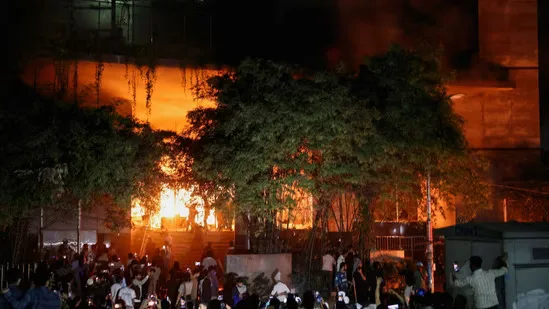
A violent mob attacked the offices of Bangladeshi newspapers Prothom Alo and The Daily Star on the night of December 18 in Dhaka. The two buildings were vandalised and set on fire, causing extensive damage. No journalists or employees were injured. The violence followed the death of Sharif Osman Hadi in Singapore, a week after he was shot in Dhaka.
According to reports, the mob moved freely through Dhaka streets, first entering the Prothom Alo office and later the Daily Star office. Both organisations had earlier requested security after anticipating possible attacks. Security forces arrived at the Prothom Alo office after the attack had begun. At the Daily Star office, security personnel arrived while the mob was present but the building was still vandalised and set on fire.
A video that later surfaced shows Bangladesh Army personnel interacting with the mob outside the Daily Star office. In the footage, an army officer is heard requesting 20 minutes to evacuate people trapped inside the building, stating that the forces would leave afterward. The officer is heard saying, “Make some space, give us just 20 minutes.” The mob leaders are seen agreeing to the request and asking others to allow time for the evacuation.
As reported by The Daily Star, staff members working late on the night of the incident received calls warning that the nearby Prothom Alo office was under attack and that their office could be targeted next. They attempted to leave but were forced to retreat to the rooftop after the mob began smashing glass panels and furniture. The building was later set on fire, filling the area with smoke. Fire service personnel later reached the rooftop, and the staff were eventually rescued after army personnel arrived and facilitated evacuation.
The ground and first floors of the Daily Star Centre on Kazi Nazrul Islam Avenue were completely gutted, and the upper floors were vandalised. The Prothom Alo building sustained similar damage. Both newspapers stated that the attack was an attempt to destabilise the country ahead of national elections scheduled for February 2026, describing it as a “dark day” for independent journalism and attributing the violence to vested interests exploiting public anger over Sharif Osman Hadi’s killing.
5. Hindu Journalist’s Residence Vandalised in Habiganj
The residence of Hindu journalist Sushant Dasgupta was vandalised, December 19, in the Chirakandi area of Habiganj town in Bangladesh’s Sylhet Division. The incident took place amid demonstrations following the death of Osman Hadi. Dasgupta is associated with the daily Amar Habiganj and has been living in the United Kingdom since his release on bail after an arrest under the Digital Security Act in 2020.
According to visuals circulated on social media, a mob entered the house and carried out vandalism. Journalist B Jahanara Nuri stated that Dasgupta’s mother and sister were present at the residence at the time and narrowly escaped during the attack.
Many described the perpetrators as a Muslim mob that gathered following the demonstrations. Author Deep Halder wrote on social media that Dasgupta is an investigative journalist based in London who has written on financial fraud and attacks on Hindus, and described the vandalism as retaliation directed at his family remaining in Bangladesh.
6. Media Offices Attacked in Dhaka After Sharif Osman Hadi’s Death
An uneasy calm prevailed in Dhaka and several other cities of Bangladesh following widespread unrest late Thursday night after the death of Inqilab Moncho convenor Sharif Osman bin Hadi. According to BD News24, mobs carried out attacks on media houses, political offices, cultural institutions, and private residences, leading to vandalism, arson, and road blockades across multiple locations.
One of the most serious incidents occurred at Karwan Bazar, where the offices of English-language daily The Daily Star and Bangla daily Prothom Alo were attacked. A journalist said staff at The Daily Star received a phone call warning that a mob, after vandalising the Prothom Alo office, was heading toward their building. As staff attempted to evacuate, the mob reached the ground floor, vandalised the premises, and set it on fire.
Thick smoke filled the building, forcing journalists to abandon attempts to leave through the stairs. Twenty-eight people fled to the rooftop on the 10th floor and became trapped. A canteen worker who tried to escape using an external fire-exit ladder was reportedly beaten by the mob upon reaching the ground, after which others did not attempt to descend.
Fire Service personnel later extinguished the blaze on the lower floors and attempted to evacuate those trapped. BD News24 reported that staff initially refused to come down as attackers continued vandalising the building. Senior journalist Zyma Islam posted on Facebook during the incident, stating she was unable to breathe due to smoke. Reports also said that Editors’ Council President and New Age Editor Nurul Kabir was harassed and verbally abused by the crowd when he arrived at the scene.
Army personnel later opened a section of the staircase, after which attackers moved upward and resumed vandalism. Eventually, The Daily Star staff were evacuated through the fire-exit staircase and taken out from the rear of the building. The evacuation was completed around 3:45 am, with at least 25 journalists rescued after more than four hours.
Following the attacks, both Prothom Alo and The Daily Star announced they would not publish it in their editions. BBC Bangla reported that online operations at both outlets were also nearly paralysed, as staff were ordered to evacuate.
Unrest was also reported elsewhere. In Dhanmondi, the cultural institution Chhayanaut was attacked after 1 am, vandalised, looted, and later set on fire. In Rajshahi, an Awami League office was demolished using a bulldozer. In Chattogram, protesters torched the residence of former city mayor ABM Mohiuddin Chowdhury Nowfel.
Road blockades were reported in several districts, including Jhalakathi and Barisal, where protesters blocked highways, set fires, and halted traffic. Student protests took place in Dhaka and other areas, including Shahbagh and Old Dhaka, with participation from multiple student organisations.
Amid the unrest, Inqilab Moncho issued a late-night Facebook appeal urging restraint and warning against violence, vandalism, and arson, calling on citizens to maintain stability as national elections approach.
7. Seven-Year-Old Killed in Arson Attack on BNP Leader’s House in Lakshmipur
A seven-year-old girl was killed and three members of her family were injured after a house was set on fire late at night, December 20, in Lakshmipur Sadar upazila of Bangladesh. The incident occurred around 2:00 am at the residence of local BNP leader Belal Hossain in the Sutargupta area of Char Mansa village.
The victim, Ayesha Akter, the younger daughter of Belal Hossain, died at the spot due to severe burn injuries. Belal Hossain, his wife, and their two other daughters, Bithi Akter and Smriti Akter, were inside the house when the fire broke out. Belal and his two daughters sustained serious burn injuries. Local residents rescued them from the burning house and took them to Lakshmipur Sadar Hospital. Bithi Akter and Smriti Akter were later shifted to the burn unit of Dhaka Medical College Hospital, where doctors said their condition was critical.
Police said unknown attackers arrived at night, locked the front door of the house from outside, poured petrol around the structure, and then set it on fire. Fire service official Ranjit Kumar Das said firefighters brought the blaze under control after reaching the scene, but the house had already been destroyed. Police officers visited the site and said an investigation was underway to determine who carried out the attack and whether it was planned sabotage.
8. Hindu Youth Killed in Bhaluka, Mymensingh
A Hindu youth was beaten to death in Bhaluka upazila of Mymensingh district following allegations that he had made remarks offensive to religious sentiments. According to local sources, the incident involved a mob attack. The youth was assaulted with sticks and rods, and his body was later set on fire. The killing took place before any legal verification of the allegations.
Police officials said they reached the spot after the incident and have started an investigation. A senior police officer stated that efforts were underway to identify those involved and that legal action would be taken.
9. Protesters Attack Indian Assistant High Commissioner’s Residence in Chattogram
A group of protesters attacked the residence of India’s assistant high commissioner in Chattogram in the early hours of December 19. According to police sources, the protesters gathered in front of the residence near MES College and threw brickbats at the premises.
Chattogram Metropolitan Police (CMP) Commissioner Hasib Aziz said that around 1,000 people initially gathered at the site and were spoken to by CMP DC North before dispersing. Later, a smaller group of about 50-60 people allegedly from a nearby slum returned and threw bricks toward the residence and office. Some bricks crossed the main gate, causing minor injuries to CMP personnel, including one officer who injured his leg. Police said there was no material damage and no harm to high commission officials.
Police used stun grenades and tear gas to disperse the group. Bangladesh Army personnel were also deployed as tensions escalated. Police said twelve people, including an alleged leader, were arrested, and a case under the Speedy Trial Act will be filed against them. Additional security has been deployed at the site, with authorities stating it will remain in place as needed.
Police said the incident took place amid widespread protests that erupted across Dhaka and several districts late Thursday night following the death of Inqilab Mancha leader Sharif Osman Hadi.
10. Anti-India Protests and Clashes with Police in Rajshahi
Anti-India protests continued in Bangladesh, with demonstrators attempting to march toward Indian diplomatic missions in several cities. In Rajshahi, protesters organised under the banner “Bharityo Adhipotto Birodhi July 36 Mancha” began a march from Bhadra Mor toward the Assistant High Commission of India.
Police set up barricades to stop the procession, leading to clashes when protesters attempted to push forward. Rajshahi Metropolitan Police said the march was blocked to maintain law and order, preventing protesters from reaching the Indian mission. ADC Farhad Hossain of the Boalia Zone said the protesters’ demands had reached the appropriate authorities through media coverage. Some protesters stated that they would continue attempts to reach the mission despite police action.
Following the protests, the Indian Visa Application Centre (IVAC) operated by the State Bank of India announced that its centres in Rajshahi and Khulna would remain closed on Thursday due to the security situation. The notification said applicants with appointments scheduled for the day would be given new dates.
Similar protests took place in Dhaka on December 17, when a group under the banner “July Oikya” marched demanding the extradition of former prime minister Sheikh Hasina. Police blocked the demonstration near the Indian High Commission in Gulshan, after which the IVAC in Dhaka was closed at 2 pm.
India’s Ministry of External Affairs summoned Bangladesh’s High Commissioner on December 17 to raise concerns regarding the security of Indian missions in Bangladesh.
11. Indian Visa Application Centre in Dhaka Closed Amid Security Concerns
The Indian Visa Application Centre (IVAC) in Jamuna Future Park, Dhaka, was closed due to a deteriorating security situation and threats directed at the Indian High Commission. The closure affected all applicants with scheduled appointments, who will be given slots at a later date. The State Bank of India operates all 16 visa application centres across Bangladesh, which collectively process around 2.2 million visa applications annually.
The closure followed India summoning of Bangladesh’s High Commissioner, Muhammad Riaz Hamidullah, to formally protest recent threats to the High Commission and inflammatory anti-India statements by Bangladeshi political leaders. The Ministry of External Affairs stated that extremist elements had announced plans to create security issues around the mission and that the interim government had not shared meaningful evidence regarding the incidents.
The MEA reiterated that India maintains close relations with Bangladesh and expects the interim government to ensure the safety of diplomatic missions in line with its obligations. The closure comes amid escalating anti-India rhetoric, including claims by a leader of Bangladesh’s National Citizen Party that India’s northeastern “seven sisters” states could be separated from the country. India has rejected these assertions and emphasised that its territory has not been used for activities harmful to Bangladesh.
Dhaka has also summoned the Indian High Commissioner, Pranay Verma, in connection with these developments.
12. Indian High Commissioner Summoned Over Sharif Osman Hadi Attack
India’s High Commissioner to Dhaka, Pranay Verma, was summoned by Bangladesh’s Ministry of Foreign Affairs on Sunday. The interim government requested India’s cooperation in preventing the suspects involved in the attack on Sharif Osman Hadi, convener of Inqilab Moncho, from fleeing to India. Officials also urged that if the attackers have already entered India, they should be arrested and extradited to Bangladesh.
The Ministry of Foreign Affairs raised concerns over continued provocative statements by deposed Prime Minister Sheikh Hasina, who has been in Delhi since fleeing Bangladesh on 5 August last year. Authorities claimed that statements from Hasina and other Awami League leaders were inciting supporters to carry out activities aimed at sabotaging the upcoming elections. Bangladesh requested that fugitive leaders, including Hasina and former home minister Asaduzzaman Khan, be returned to face justice.
During the meeting at the state guest house Padma, Foreign Secretary Asad Alam Siam conveyed the interim government’s concerns. The Indian High Commissioner stated that India expects a peaceful election in Bangladesh and expressed readiness to provide full cooperation. This marks at least the fifth time the ambassador has been summoned by the interim government regarding various incidents.
13. Hindu Freedom Fighter and Wife Murdered in Rangpur
A 1971 Liberation War freedom fighter and his wife were found murdered in their home on December 7, in Rahimapur Khiyarpara village, Rangpur. The victims, 75-year-old Jogesh Chandra Roy and his 60-year-old wife Surbana Roy, had their throats slit. Their deaths raised fears among Hindu families in the region.
The couple received state honours on December 9. Their bodies were first taken for autopsy and then returned to their home, where hundreds of villagers offered condolences. A guard of honour was held at Chakla crematorium, with officials, political leaders, police officers, and fellow freedom fighters present.
The couple’s elder son, Shoven Chandra Roy, filed a case at Taraganj Police Station, naming 10-15 unidentified individuals as suspects. Jogesh Chandra Roy had retired in 2017 as headmaster of Uttar Rahimapur Nayahat Muktijoddha Government Primary School. The elder son serves with the Rapid Action Battalion (RAB) in Joypurhat, and the younger son, Rajesh Khanna, serves with Bangladesh Police in Dhaka. Multiple police teams have begun investigating the case, but no arrests have been made.
The killings come amid ongoing concerns about attacks on Hindu minorities in Bangladesh. India has previously raised the issue with Bangladeshi authorities, citing thousands of such incidents since 2021.
The incidents between 11 and 24 December 2025 highlight a significant escalation of violence, particularly targeting Hindu minorities, journalists, and Indian diplomatic missions. Attacks were widespread and varied in nature, including arson, vandalism, mob assaults, and targeted killings. Media offices were heavily damaged, demonstrating a potential attempt to destabilise civil institutions ahead of elections.
The unrest shows the fragile security situation in Bangladesh and the continuing challenges faced by law enforcement and diplomatic authorities. Anti-India sentiment and politically motivated violence remain key concerns, while the repeated targeting of vulnerable communities raises questions about minority protection and the rule of law in the country.