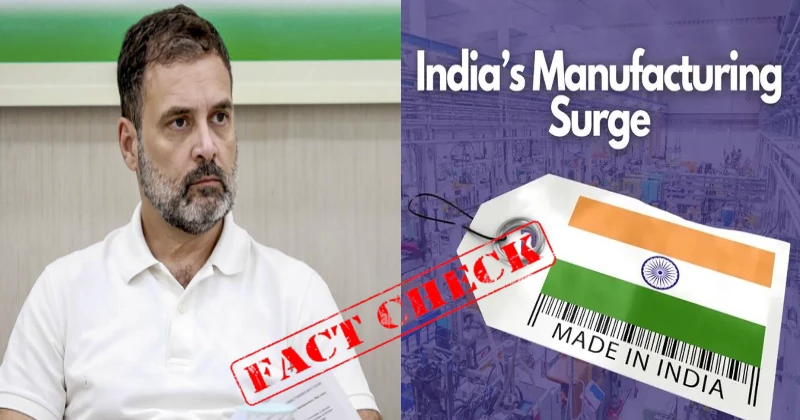
When Rahul Gandhi claimed that “production in India has gone down,” the statement was framed as a sweeping indictment of the country’s economic direction. But a closer look at sector-wise production, export data, factory capacity, and employment figures over the past decade reveals a starkly different picture one that directly contradicts the Congress narrative.
Rather than declining, India’s production ecosystem has expanded in scale, depth, and global integration. In multiple sectors once cited as symbols of industrial weakness, India has moved from import dependence to export competitiveness. The numbers are neither selective nor anecdotal they are structural.
Fact Check: Rahul Gandhi’s claim that production in India has gone down is FAKE.
The claim that production in India has declined is not supported by available data. Over the past decade, India’s manufacturing base, particularly in electronics and mobile phones, has expanded… pic.twitter.com/pjPA5Qd8ex
— Amit Malviya (@amitmalviya) December 18, 2025
Manufacturing has not merely survived the past decade; it has transformed. Capacity expansion, technology adoption, supply-chain localization, and export orientation have reshaped the industrial base. This transformation is most visible in electronics and mobile phones, but it extends well beyond them.
India today is a net exporter in several high-value sectors:
- Electronics
- Pharmaceuticals
- Engineering goods
- Defence equipment
A country experiencing a production collapse does not become a net exporter across strategic industries. That single fact alone undermines the core premise of Rahul Gandhi’s claim.
In 2014–15, electronics manufacturing in India was limited in scale and overwhelmingly import-driven. A decade later, the situation has reversed.
- Electronics production increased from Rs 1.9 lakh crore (2014–15) to Rs 11.3 lakh crore (2024–25).
- Electronics exports rose from Rs 38,000 crore to Rs 3.27 lakh crore in the same period.
This is not incremental growth; it represents a fundamental shift in India’s manufacturing capabilities. Domestic production has multiplied nearly six times, while exports have grown almost nine-fold. India has emerged as a critical node in global electronics supply chains a development incompatible with any claim of declining production.
The mobile phone sector offers the clearest, most quantifiable rebuttal to the assertion that production has gone down.
Manufacturing footprint
- 2014–15: 2 mobile manufacturing units
- 2024–25: 300 mobile manufacturing units
This expansion reflects not just policy support but sustained private investment and ecosystem development.
Production and exports
- Mobile phone production grew from Rs 18,000 crore to Rs 5.45 lakh crore.
- Mobile phone exports surged from Rs 1,500 crore to Rs 2 lakh crore.
India is no longer assembling phones solely for its domestic market. It has become a global export base, supplying advanced markets and competing with long-established manufacturing hubs. This level of output growth is impossible in an environment of declining production.
While Congress rhetoric often cherry-picks selective stress indicators, the broader industrial landscape tells a different story. Pharmaceuticals, engineering goods, and defence manufacturing have all recorded sustained output growth, pushing India into net exporter status.
Defence production, once almost entirely import-driven, has increasingly shifted toward domestic manufacturing. Engineering goods exports have consistently expanded, reflecting rising industrial capability and scale. Pharmaceuticals continue to anchor India’s position as a global supplier.
Decline narratives collapse when viewed against this diversified, sector-spanning expansion. Another pillar of the Congress argument is employment distress allegedly caused by falling production. The data again tells a different story.
- Approximately 17 crore jobs have been created over the past decade.
- Manufacturing job growth rose from 6 per cent during 2004–14 to 15 per cent in the last decade.
Labour force indicators further weaken the claim:
- Worker Population Ratio (PLFS, Aug 2025): 52.2 per cent
- Female Worker Population Ratio: 32 per cent
- Female Labour Force Participation Rate: 33.7 per cent
- Unemployment rate: 5.1 per cent overall; 5.0 per cent for males
If production were genuinely collapsing, such employment and participation metrics would reflect severe deterioration.