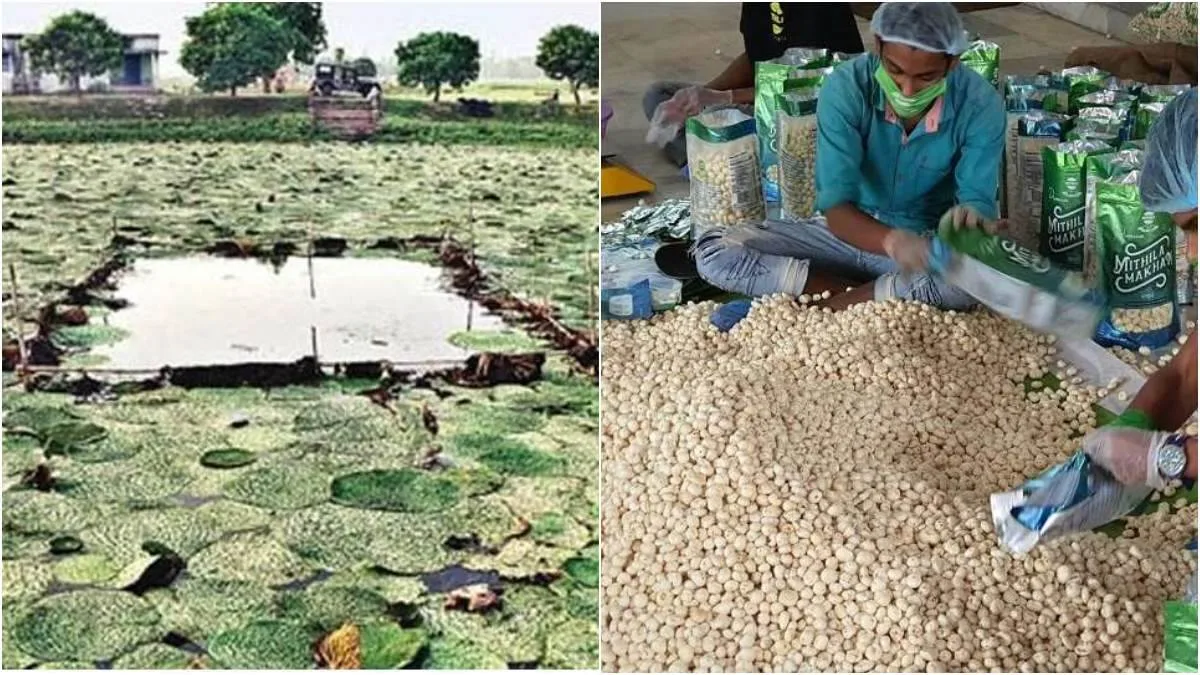
India has emerged as the undisputed global leader in makhana production, accounting for nearly 80 per cent of the world’s total output. This information was shared in Parliament on Tuesday, underlining the country’s dominant position in a niche agricultural commodity that has seen growing domestic and international demand due to its nutritional value and versatility.
The government’s disclosure also highlights how India’s makhana sector, once largely confined to traditional and local markets, is now being viewed as a strategic agri-product with significant economic and export potential.
Bihar: The backbone of India’s Makhana economy
At the heart of India’s makhana success lies Bihar, which contributes approximately 85 per cent of the country’s total production. The state’s unique agro-climatic conditions, coupled with generations of traditional knowledge, have made it the epicentre of makhana cultivation.
Within Bihar, Darbhanga district has emerged as one of the most important hubs for both cultivation and processing. In a written reply in the Rajya Sabha, Minister of State for Agriculture and Farmers’ Welfare Ramnath Thakur described Darbhanga as widely recognised for its strong potential in the makhana sector.
“Darbhanga district is widely known as one of the primary hubs of makhana production in Bihar, and it has been acknowledged for its strong potential in cultivation and processing,” the minister stated.
The district’s prominence reflects not only its production volumes but also its growing role in research, innovation, and value addition.
Darbhanga’s importance is further reinforced by the presence of the ICAR-National Research Centre on Makhana, the country’s premier institution dedicated exclusively to makhana research. The centre plays a critical role in developing improved varieties, refining cultivation practices, and addressing challenges related to productivity and post-harvest losses.
In addition, Darbhanga has been identified under the One District One Product (ODOP) initiative for makhana, a recognition that places the crop at the centre of local economic development strategies. The ODOP tag is expected to facilitate focused investment, branding, and market access for makhana produced in the region.
Together, these institutional mechanisms are aimed at transforming makhana from a largely unorganised, traditional crop into a modern, market-oriented agricultural product.
Livelihood potential for farmers and fishermen
The government has emphasised that the makhana sector holds immense potential to improve the economic condition of farmers and fishermen, particularly in regions where the crop is widely grown. Makhana cultivation is often undertaken in ponds and wetlands, providing livelihood opportunities to fishing communities alongside small and marginal farmers.
With rising awareness about makhana’s health benefits, including its high protein content, low glycaemic index, and antioxidant properties, demand has expanded beyond traditional consumption patterns. This shift has opened new income streams for producers, processors, and traders.
However, the government has also acknowledged that realising this potential requires targeted interventions to overcome challenges such as low productivity, limited mechanisation, and inadequate post-harvest infrastructure.
National Makhana board established
In a major policy push, the government has established the National Makhana Board through a gazette notification dated September 14, 2025. The board has been tasked with providing focused and coordinated support to the makhana sector across the country.
According to the minister, the National Makhana Board aims to enhance production, processing, value addition, marketing, and export promotion of makhana. The creation of a dedicated board marks a shift towards a more structured and long-term approach to developing the sector.
The board is expected to act as a central coordinating body, bringing together research institutions, state governments, farmer groups, and exporters to strengthen the entire ecosystem.
A key priority of the National Makhana Board is to increase productivity through scientific research and the adoption of improved farming practices. This includes the development and dissemination of high-yielding varieties, better pond management techniques, and modern harvesting methods.
The board will also focus on upgrading processing technologies to reduce post-harvest losses and improve product quality. Traditional processing methods are labour-intensive and often lead to inconsistent output, affecting both yields and market prices.
By promoting better harvesting and processing technologies, the government aims to ensure that farmers receive higher returns while meeting the quality standards required for domestic and international markets.
Rs 476 Crore scheme to boost the sector
Complementing the institutional framework, the government has approved a Central Sector Scheme for the Development of Makhana with a total outlay of Rs 476.03 crore. The scheme will be implemented over six years, from 2025-26 to 2030-31.
The scheme covers a wide range of interventions, including research and innovation, production and distribution of quality seeds, skill development of farmers and other stakeholders, and improved post-harvest management. It also places strong emphasis on value addition, branding, marketing, and export promotion.
By addressing gaps across the value chain, the scheme aims to enhance India’s competitiveness in the global makhana trade.
With India already commanding nearly 80 per cent of global makhana production, the government sees significant scope to increase exports. Improved quality standards, branding, and processing capabilities are expected to help Indian makhana products penetrate premium international markets.
The emphasis on export promotion under the new scheme reflects a broader strategy to position makhana as a high-value agri-export, similar to other niche Indian products that have found global acceptance.
The government’s recent initiatives signal a clear intent to move the makhana sector from a largely informal, region-specific activity to a structured and nationally significant agri-industry. With Bihar and Darbhanga in particular, at the centre of this transformation, the sector is poised for steady growth.
As institutional support deepens and investment flows into research, technology, and market development, makhana could emerge as a model for how traditional crops can be integrated into India’s modern agricultural and export strategy, delivering sustainable livelihoods and reinforcing the country’s leadership in global niche commodities.




![A Representative image [ANI Photo]](https://organiser.org/wp-content/uploads/2025/12/representative-image-e1765612818961-120x70.webp)