The Congress party’s latest attempt to paint the Modi government as “anti-poor” and “anti-Gandhi” has once again unravelled under scrutiny. Rahul Gandhi’s claim that Prime Minister Narendra Modi harbours a “deep dislike” for Mahatma Gandhi and is “erasing” MGNREGA is not just politically charged rhetoric it is a gross distortion of facts aimed at preserving a failed status quo that benefitted middlemen more than rural workers.
At the centre of this controversy is the Viksit Bharat Guarantee for Rozgar and Ajeevika Mission (Gramin): VB-G RAM G Act, 2025, which the Congress has branded an “insult” to Gandhi’s vision of Gram Swaraj. The reality, however, tells a very different story: the BJP-led government is modernising, strengthening, and future-proofing rural employment, while Congress is desperately clinging to a 20-year-old framework riddled with leakages, inefficiencies, and corruption.
Rahul Gandhi has claimed that Prime Minister Modi harbors a “deep dislike” for Mahatma Gandhi’s ideas and the rights of the poor, alleging that the government is systematically weakening and now “erasing” MGNREGA altogether. He describes the new Viksit Bharat – Guarantee for… https://t.co/36Ce8pVgXI pic.twitter.com/oMRsRVgR5o
— Amit Malviya (@amitmalviya) December 16, 2025
For Congress, MGNREGA is no longer a policy tool it is a political crutch. By invoking Mahatma Gandhi’s name, Rahul Gandhi seeks to mask uncomfortable truths: under Congress rule, MGNREGA became synonymous with ghost beneficiaries, incomplete assets, machine-driven works, and massive misuse of public funds.
The Modi government, in contrast, has systematically cleaned up the scheme over the past decade introducing Aadhaar-based verification, direct benefit transfers, and digital attendance. These reforms alone pushed wage payments through digital channels from just 37 per cent under Congress to nearly 100 per cent today, ensuring money reaches workers, not contractors or party-linked intermediaries.
The VB-G RAM G Act is the logical next step in this reform journey not abolition, not dilution, but transformation.
Congress leaders argue as if MGNREGA were immutable scripture. But policies are meant to evolve. When MGNREGA was launched in 2005, rural India was poorer, less connected, and more vulnerable. Today, rural India has changed dramatically:
- Poverty levels have fallen sharply.
- Financial inclusion is near universal.
- Digital infrastructure has reached the last mile.
- Aspirations have shifted from survival to sustainability.
Persisting with the same framework despite these changes would be irresponsible governance. The BJP’s reform acknowledges this transformation and aligns rural employment with the Viksit Bharat 2047 vision something Congress has failed to articulate for decades.
One of Rahul Gandhi’s loudest accusations is that the new Act centralises power. This is deeply ironic coming from a party whose governance record was marked by Delhi-centric decision-making and bureaucratic opacity.
The VB-G RAM G Act does exactly the opposite:
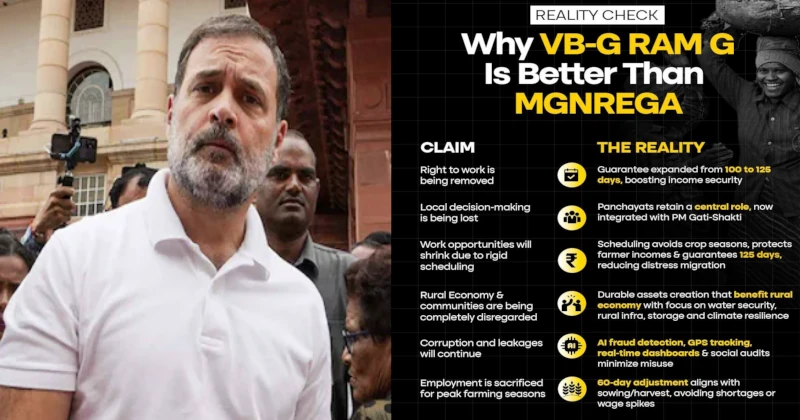
- Gram Panchayats prepare their own Viksit Gram Panchayat Plans.
- Planning is hyperlocal, saturation-based, and village-driven.
- Works are focused on long-term assets water security, infrastructure, livelihoods, and climate resilience.
- What Congress calls “centralisation” is, in reality, coordination ensuring rural assets actually serve economic purposes instead of lying abandoned after photo-ops.
Rahul Gandhi’s claim that states are being “forced” to bear 40 per cent of costs conveniently ignores history. States have always contributed to material and administrative expenses under MGNREGA. What changes now is accountability.
The revised funding structure incentivises efficiency and discourages misuse an issue Congress refuses to address despite documented cases of misappropriation running into hundreds of crores under the old system.
Moreover:
Demand-based budgeting ensures funds do not “run out”.
Unemployment allowance remains legally binding.
Disaster-hit states receive special protections.
Northeastern and Himalayan states retain favourable funding ratios.
If Congress truly cared about states’ finances, it would explain why it tolerated rampant misuse for years instead of reforming the system.
The Congress narrative that workers will be denied employment during harvest seasons is another half-truth designed to inflame emotions. Seasonal pauses already exist in practice. The new Act simply rationalises them.
During peak sowing and harvesting periods:
- Labour demand in agriculture rises.
- Wages are often higher than MGNREGA rates.
- Farmers depend on local labour availability.
Allowing up to 60 days of aggregated pause protects farmers, prevents wage distortion, and ultimately benefits workers without reducing the total 125 days of guaranteed employment.
The truth is simple: Congress fears reform because reform exposes its failures. The party that once treated rural poverty as a permanent vote bank is uncomfortable with a government that aims to eliminate dependence rather than manage it.
AI-driven fraud detection, GPS monitoring of works, real-time dashboards, and mandatory social audits threaten the old ecosystem of opacity that thrived under Congress rule. Transparency is bad news for those who benefited from inefficiency.
Invoking Mahatma Gandhi to block reform is both cynical and dishonest. Gandhi’s vision of Gram Swaraj was about dignity, self-reliance, and empowerment—not endless dependence on inefficient schemes. The VB-G RAM G Act honours that spirit by creating productive assets, strengthening livelihoods, and integrating villages into India’s growth story.