Bharat strengthening global south leadership
September 20, 2026
  • Read Ecopy
  • Circulation
  • Advertise
  • Careers
  • About Us
  • Contact Us
Android AppiPhone AppArattai
Organiser
  • ‌
  • Bharat
    • Assam
    • Bihar
    • Chhattisgarh
    • Jharkhand
    • Maharashtra
    • View All States
  • World
    • Asia
    • Europe
    • North America
    • South America
    • Africa
    • Australia
  • Editorial
  • International
  • Opinion
  • RSS @ 100
  • More
    • World Hindu Congress 2026
    • Op Sindoor
    • Analysis
    • Sports
    • Defence
    • Politics
    • Business
    • Economy
    • Culture
    • Special Report
    • Sci & Tech
    • Entertainment
    • G20
    • Azadi Ka Amrit Mahotsav
    • Vocal4Local
    • Web Stories
    • Education
    • Employment
    • Books
    • Interviews
    • Travel
    • Law
    • Health
    • Obituary
  • Subscribe
    • Subscribe Print Edition
    • Subscribe Ecopy
    • Read Ecopy
  • ‌
  • Bharat
    • Assam
    • Bihar
    • Chhattisgarh
    • Jharkhand
    • Maharashtra
    • View All States
  • World
    • Asia
    • Europe
    • North America
    • South America
    • Africa
    • Australia
  • Editorial
  • International
  • Opinion
  • RSS @ 100
  • More
    • World Hindu Congress 2026
    • Op Sindoor
    • Analysis
    • Sports
    • Defence
    • Politics
    • Business
    • Economy
    • Culture
    • Special Report
    • Sci & Tech
    • Entertainment
    • G20
    • Azadi Ka Amrit Mahotsav
    • Vocal4Local
    • Web Stories
    • Education
    • Employment
    • Books
    • Interviews
    • Travel
    • Law
    • Health
    • Obituary
  • Subscribe
    • Subscribe Print Edition
    • Subscribe Ecopy
    • Read Ecopy
Organiser
  • Home
  • Bharat
  • World
  • Operation Sindoor
  • Editorial
  • Analysis
  • Opinion
  • Culture
  • Defence
  • International Edition
  • RSS @ 100
  • Magazine
  • Read Ecopy
Home Bharat

Bharat strengthening global south leadership through Africa, West Asia

At a time of shifting global power equations and growing demands for equitable representation, the outreach to West Asia and Africa highlighted New Delhi’s intent to strengthen political trust, expand economic cooperation, and reinforce people-to-people ties through a partnership-driven approach rooted in mutual respect, development, and strategic autonomy

Anubha MishraAnubha Mishra
Dec 16, 2025, 09:20 pm IST
inBharat, World, West Asia, Africa
Follow on Google News
Fostering South-South Partnership through West Asia and Africa

Fostering South-South Partnership through West Asia and Africa

Facebook
Twitter
WhatsAppTelegramEmail

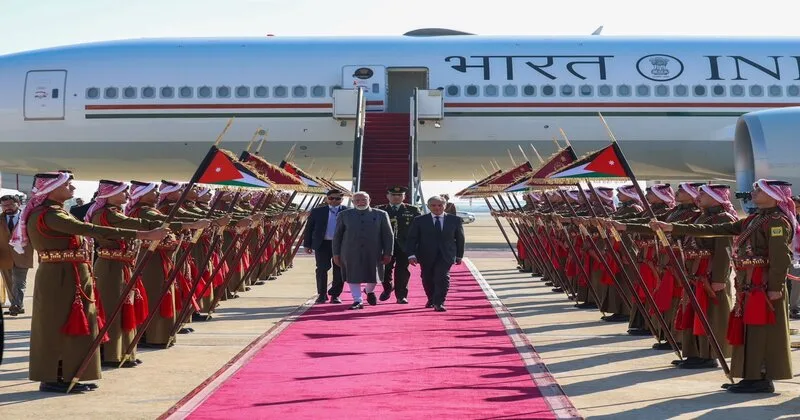
The Prime Minister’s visit to Jordan and Ethiopia marked a significant moment in India’s evolving engagement with the Global South, reflecting a diplomatic approach that combines historical solidarity with contemporary strategic interests. At a time when global power structures are in flux and developing nations seek greater voice in international decision-making, India’s outreach to West Asia and Africa underscores its aspiration to act as a credible partner rather than a prescriptive power. The visits highlighted India’s intent to strengthen political trust, expand economic cooperation, and deepen people-to-people ties, while reinforcing a shared developmental narrative rooted in mutual respect and non-interference.

Jordan occupies a unique position in West Asia, acting as a bridge between regions often marked by instability. The Prime Minister’s engagement with Jordan reaffirmed India’s long-standing ties with the Arab world, grounded in civilizational exchanges, trade links, and cultural interaction. Jordan’s role as a moderate and stabilizing force in the region aligns with India’s own emphasis on dialogue, restraint, and peaceful coexistence. Discussions during the visit focused on political cooperation, counterterrorism, and regional security, areas where both countries face overlapping challenges. India’s approach emphasized cooperation without militarization, highlighting its preference for stability through institutional strengthening and inclusive governance.

Economic engagement formed a central pillar of the India-Jordan dialogue. The Prime Minister’s visit sought to expand bilateral trade, particularly in pharmaceuticals, information technology, fertilizers, and renewable energy. Jordan’s strategic location offers Indian businesses access to broader West Asian and Mediterranean markets, while Indian expertise in affordable healthcare and digital infrastructure aligns well with Jordan’s development priorities. This economic partnership reflects India’s broader Global South strategy of promoting sustainable growth through capacity building and technology sharing rather than extractive economic models.

Cultural and educational cooperation further reinforced the bilateral relationship. India’s soft power, expressed through yoga, traditional medicine, and academic exchanges, has found resonance in Jordan. The Prime Minister’s emphasis on civilizational links and shared values projected India as a nation that values cultural plurality and historical continuity. Such engagement strengthens people-to-people connections, which remain a durable foundation for long-term diplomatic relations, especially within the Global South where historical memory of colonial exploitation continues to shape political consciousness.

The visit to Ethiopia carried even greater symbolic and strategic significance. Ethiopia is not only one of Africa’s oldest civilizations but also the seat of the African Union, making it central to continental diplomacy. By engaging Ethiopia at the highest level, India signaled its commitment to Africa as a whole, rather than limiting its outreach to resource-driven or narrowly commercial interests. The visit aligned with India’s vision of Africa as a partner in shaping global governance rather than a passive recipient of aid or investment.

India’s historical relationship with Ethiopia dates back to shared anti-colonial experiences and cooperation within the Non-Aligned Movement. The Prime Minister’s visit revitalized this legacy by focusing on contemporary priorities such as infrastructure development, defence cooperation, education, and healthcare. Indian lines of credit, capacity-building programs, and development partnerships in Ethiopia illustrate India’s model of development cooperation, which emphasizes local ownership and long-term sustainability. This approach contrasts with debt-intensive or politically conditional models often criticized within the Global South.

Trade and investment featured prominently in discussions with Ethiopian leadership. India is among the largest foreign investors in Ethiopia, particularly in manufacturing, agriculture, and textiles. The Prime Minister’s visit aimed to encourage further private sector participation while addressing challenges faced by Indian businesses operating in the region. By advocating stable policy frameworks and skill development, India positioned itself as a partner invested in Ethiopia’s industrial transformation and employment generation, rather than short-term profit extraction.

The Ethiopia visit also reinforced India’s role as a voice for the Global South in multilateral forums. As Africa seeks greater representation in global institutions, India’s consistent advocacy for reforms in the United Nations Security Council and international financial institutions resonates strongly across the continent. The Prime Minister reiterated India’s support for Africa’s demand for equitable representation, reflecting a shared belief that global governance structures must evolve to reflect contemporary realities rather than post-war hierarchies.

Together, the visits to Jordan and Ethiopia highlighted India’s balanced diplomacy across regions, linking West Asia and Africa through a common Global South framework. India’s engagement strategy emphasizes dialogue, development, and dignity, seeking partnerships that are responsive to local priorities. This approach enhances India’s credibility as a nation that understands the developmental challenges of post-colonial societies and offers cooperation without coercion. The visits also demonstrated India’s ability to engage diverse political systems while maintaining strategic autonomy and principled foreign policy positions.

In a broader sense, the Prime Minister’s visits reinforced India’s emerging role as a bridge between developing nations and the wider international system. By engaging Jordan and Ethiopia, India showcased its capacity to operate across geopolitical divides while remaining anchored in Global South solidarity. These visits were not isolated diplomatic events but part of a sustained effort to reshape international engagement through inclusivity and shared growth. As global uncertainties persist, India’s outreach to Africa and West Asia strengthens its claim to leadership rooted in partnership, responsibility, and a collective vision for a more equitable world order.




Topics: PM Narendra ModiGlobal SouthEthiopia
Share
Tweet
SendShareSend
✮ Subscribe Organiser YouTube Channel. ✮
✮ Join Organiser's WhatsApp channel for Nationalist views beyond the news. ✮
Previous News

Indigo Crisis: Indi’s No-Go Zone

Next News

Kerala: Post-poll violence, internal dissent rock CPM after Kerala local body results, as BJP makes historic inroads

Related News

Veteran Kannada Actor Ananth Nag wins Dada Saheb Phalke award

Anant Nag Wins Dadasaheb Phalke Award: PM Modi praises his natural acting, versatility

BJP’s Rajasthan Civic Surge: 4,179 Wards Won, Modi Hails People’s Mandate

Rajasthan Civic Body Polls: BJP tops 4,179 wards; PM Modi hails ‘resounding victory’ 

New Delhi, Sep 12 (ANI): Prime Minister Narendra Modi holds a bilateral meeting with Chinese President Xi Jinping on the sidelines of the BRICS Summit 2026, in New Delhi on Saturday. External Affairs Minister S. Jaishankar, NSA Ajit Doval and Principal Secretaries to the PM, Pramod Kumar Mishra and Shaktikanta Das also present. (@MEAIndia X/ANI Photo)

BRICS 2026: Why Putin, Xi and Pezeshkian meetings stand out in PM Modi’s diplomacy

(Left) Prime Minister Narendra Modi and Russian President Vladimir Putin (Right) Prime Minister Narendra Modi and Chinese President Xi Jinping in the backdrop of the Rameshwaram temple corridor in the backdrop of the BRICS 2026 summit

Bharat’s civilisational pride at BRICS 2026: Rameswaram temple corridor frames world leaders

AI-generated representative image

Fragile Five to Fastest-Growing Major Economy – Incredible India’s Transformation in 12 Years

BRICS Summit 2026: Troika, seafarers support network & UNSC reforms; PM Modi pitches Global South as “rule shaper”

Load More

Latest News

Chinese President Xi Jinping and his South African counterpart Cyril Ramaphosa are allegedly sick according to a widespread social media campaign. The MEA has now debunked these claims.

Fact Check: MEA flags false claims that Xi Jinping, Ramaphosa fell ill after BRICS summit

What Rahul Gandhi’s ‘Chhatron Ki Goonj’ and CJP Protests Meant for Campus Politics?

Three posts for ABVP, zero for NSUI: DUSU verdict puts Rahul Gandhi’s ‘Chhatron Ki Goonj’ & CJP impact under scanner

A representative image

LPG subsidy rule change from October 1: Aadhaar biometric authentication mandatory

NITI Aayog Focuses over the Strategies for Empowering Caregivers in the path of Viksit Bharat@2047

Reimagining Caregiving: Bharat’s action for empowering the hands that hold us

BMS launches National Organisation for Digital Employees (NODE) for IT workforce; aims to strengthen employee welfare

GalaxEye’s US patent for OptoSAR marks a major boost for India’s private space sector, advancing its global Earth-observation ambitions

GalaxEye secures US patent for OptoSAR technology, boosting India’s private space and deep-tech ambitions

The arrested Bangladeshi national

Keralam: Series of Bangladeshi arrests raises questions over alleged support ecosystem of fake IDs, jobs and shelter

The Indian Army has launched AASHVAST to detect hidden software and electronic vulnerabilities in military drones

Indian Army strengthens drone security with AASHVAST lab to detect software vulnerabilities & Chinese components

Nileema Mishra’s grassroots work empowered women and helped transform more than 200 villages across Maharashtra

Nileema Mishra: The woman who transformed more than 200 villages across rural Maharashtra

Shree Stambheshwar Mahadev Mandir in Gujarat

Shiva Mandir that disappears into the sea and returns with the tide: The fascinating story of Stambheshwar Mahadev

Load More
  • Privacy
  • Terms
  • Cookie Policy
  • Refund and Cancellation
  • Delivery and Shipping

© Bharat Prakashan (Delhi) Limited.
Tech-enabled by Ananthapuri Technologies

  • Home
  • Search Organiser
  • Bharat
    • Assam
    • Bihar
    • Chhattisgarh
    • Jharkhand
    • Maharashtra
    • View All States
  • World
    • Asia
    • Africa
    • North America
    • South America
    • Europe
    • Australia
  • Editorial
  • Operation Sindoor
  • Opinion
  • Analysis
  • Defence
  • Culture
  • Sports
  • Business
  • RSS @ 100
  • Entertainment
  • More ..
    • Sci & Tech
    • Vocal4Local
    • Special Report
    • Education
    • Employment
    • Books
    • Interviews
    • Travel
    • Health
    • Politics
    • Law
    • Economy
    • Obituary
  • Subscribe Magazine
  • Read Ecopy
  • Advertise
  • Circulation
  • Careers
  • About Us
  • Contact Us
  • Policies & Terms
    • Privacy Policy
    • Cookie Policy
    • Refund and Cancellation
    • Terms of Use

© Bharat Prakashan (Delhi) Limited.
Tech-enabled by Ananthapuri Technologies