Hind-di-Chadar: Guru Tegh Bahadur’s timeless sacrifice for dharma
August 16, 2026
  • Read Ecopy
  • Circulation
  • Advertise
  • Careers
  • About Us
  • Contact Us
Android AppiPhone AppArattai
Organiser
  • ‌
  • Bharat
    • Assam
    • Bihar
    • Chhattisgarh
    • Jharkhand
    • Maharashtra
    • View All States
  • World
    • Asia
    • Europe
    • North America
    • South America
    • Africa
    • Australia
  • Editorial
  • International
  • Opinion
  • RSS @ 100
  • More
    • Op Sindoor
    • Analysis
    • Sports
    • Defence
    • Politics
    • Business
    • Economy
    • Culture
    • Special Report
    • Sci & Tech
    • Entertainment
    • G20
    • Azadi Ka Amrit Mahotsav
    • Vocal4Local
    • Web Stories
    • Education
    • Employment
    • Books
    • Interviews
    • Travel
    • Law
    • Health
    • Obituary
  • Subscribe
    • Subscribe Print Edition
    • Subscribe Ecopy
    • Read Ecopy
  • ‌
  • Bharat
    • Assam
    • Bihar
    • Chhattisgarh
    • Jharkhand
    • Maharashtra
    • View All States
  • World
    • Asia
    • Europe
    • North America
    • South America
    • Africa
    • Australia
  • Editorial
  • International
  • Opinion
  • RSS @ 100
  • More
    • Op Sindoor
    • Analysis
    • Sports
    • Defence
    • Politics
    • Business
    • Economy
    • Culture
    • Special Report
    • Sci & Tech
    • Entertainment
    • G20
    • Azadi Ka Amrit Mahotsav
    • Vocal4Local
    • Web Stories
    • Education
    • Employment
    • Books
    • Interviews
    • Travel
    • Law
    • Health
    • Obituary
  • Subscribe
    • Subscribe Print Edition
    • Subscribe Ecopy
    • Read Ecopy
Organiser
  • Home
  • Bharat
  • World
  • Operation Sindoor
  • Editorial
  • Analysis
  • Opinion
  • Culture
  • Defence
  • International Edition
  • RSS @ 100
  • Magazine
  • Read Ecopy
Home Bharat

Hind-di-Chadar: Guru Tegh Bahadur’s timeless sacrifice for dharma

Guru Tegh Bahadur, throughout his life nurtured communities, travelled extensively to spread spiritual wisdom and composed hymns that spoke of detachment, divine love, humility and inner strength. His teachings emphasized that true worship lies in purity of thought, compassion for all beings and the courage to uphold righteousness

Anubha MishraAnubha Mishra
Nov 25, 2025, 08:00 pm IST
inBharat, Culture
Follow on Google News
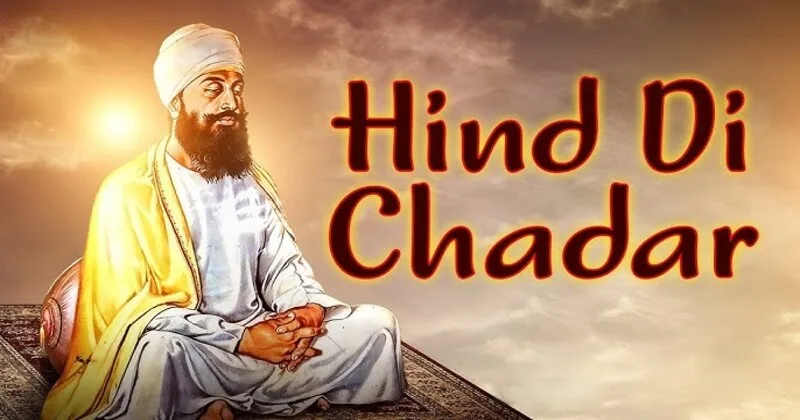
Guru Tegh Bahadur’s martyrdom stands among the most profound sacrifices

Guru Tegh Bahadur’s martyrdom stands among the most profound sacrifices

Facebook
Twitter
WhatsAppTelegramEmail

Guru Tegh Bahadur’s martyrdom stands among the most profound sacrifices in world history, a moment when moral courage, spiritual conviction and compassion converged in a single act that safeguarded the freedom of worship for countless individuals. As we commemorate the 350th anniversary of his supreme sacrifice, it is essential to reflect on the universality of his message, the depth of his devotion to God and his extraordinary role in protecting the cultural and spiritual fabric of India. His life was guided by an unwavering belief that every person—regardless of their background or faith—deserves the right to practice their spiritual traditions without fear. This principle lies at the heart of his legacy and continues to inspire people across traditions even today.

In the 17th century, Sikhism, though already a distinct faith revealed through the teachings of the Sikh Gurus, shared deep cultural and civilizational roots with India’s broader spiritual heritage. The Sikh tradition emerged from the same cultural milieu that had shaped Hindu dharma for millennia—drawing from a shared landscape of languages, philosophies and devotional practices. Because of this shared civilizational foundation, the Sikh Gurus naturally felt a profound sense of duty toward the safety and dignity of all communities living within this cultural sphere. Guru Tegh Bahadur, with his expansive spiritual vision, saw Hindu dharma not as something separate from himself, but as part of a rich and diverse Indian tradition whose freedom was essential for the spiritual health of the nation.

When the Kashmiri Pandits approached him seeking protection during a period of immense distress, Guru Tegh Bahadur recognized the moral and spiritual significance of their plea. Their traditions—rooted in ancient Hindu philosophy, ritual and scholarship—represented a continuum of knowledge and devotion that had shaped India’s identity for centuries. Guru Tegh Bahadur understood that the preservation of their freedom of belief was inseparable from preserving the broader civilizational values that affirmed the dignity of all individuals. His decision to stand for them was not a political gesture but a deeply spiritual one, aligned with Sikh principles of justice, compassion and the defence of the vulnerable.

He accepted the path of sacrifice with complete serenity, knowing that his stand was for a universal principle rather than any particular group. His martyrdom in defence of the freedom of conscience earned him the enduring title Hind-di-Chadar, the Shield of India. It symbolized his role as a protector of the subcontinent’s pluralistic ethos, ensuring that diverse traditions—including the various schools of Hindu dharma—could continue to flourish. His sacrifice also reinforced the Sikh commitment to upholding justice and standing against coercion in any form, while remaining firmly rooted in devotion to God.

Guru Tegh Bahadur’s legacy does not rest solely on his final act, as extraordinary as it was. Throughout his life, he nurtured communities, travelled extensively to spread spiritual wisdom and composed hymns that spoke of detachment, divine love, humility and inner strength. His teachings emphasized that true worship lies in purity of thought, compassion for all beings, and the courage to uphold righteousness. These messages resonated deeply with people across religions, creating a bridge between different faiths and reinforcing the shared values that unify the spiritual traditions of India.

His relationship with Hindu dharma must be understood through this lens of mutual respect and shared cultural ground. Sikhism was and remains, a distinct spiritual path, yet its emergence within the Indian civilizational framework meant that it always upheld the principle that no tradition can thrive unless all are free. Guru Tegh Bahadur’s sacrifice therefore becomes a shining example of interfaith solidarity—an affirmation that one’s own spiritual identity becomes stronger, not weaker, when one protects the rights of others.

Also Read: 350 Years of Guru Tegh Bahadur’s Martyrdom: The universal and timeless message of sacrifice

The repercussions of his martyrdom were transformative. It infused the Sikh community with renewed strength and purpose, while providing reassurance to Hindu practitioners that their traditions would endure. His sacrifice prepared the ground for Guru Gobind Singh’s future leadership and the eventual formation of the Khalsa, which would carry forward the ideals of courage, justice and equality for all.

Today, three and a half centuries later, Guru Tegh Bahadur’s example continues to illuminate the path of harmonious coexistence. His life reminds us that true spirituality does not create divisions; it builds bridges. It calls individuals to stand for what is right, to defend the dignity of others and to uphold the shared values that enrich humanity. His sacrifice for the freedom of Hindu dharma was not an act of opposition to any community—it was an act of profound love for humanity and for the principles that elevate human conscience.

By honouring Guru Tegh Bahadur, we honour a legacy of courage rooted in compassion, strength grounded in humility and faith expressed through the defence of universal rights. His martyrdom remains a timeless symbol of India’s spiritual greatness and its enduring commitment to freedom of belief.
Topics: SikhismGuru Tegh BahadurHind di Chadar
Share
Tweet
SendShareSend
✮ Subscribe Organiser YouTube Channel. ✮
✮ Join Organiser's WhatsApp channel for Nationalist views beyond the news. ✮
Previous News

Pak-Afghan tensions escalate: Islamabad airstrikes kill 9 children in Khost province of Afghanistan

Next News

Assam Government tables prohibition of polygamy bill 2025 in state assembly amid walkout by Congress and Left

Related News

Guru Tegh Bahadur

Guru Tegh Bahadur Prakash Purab 2026: Celebrating Guru’s Bani and timeless message of courage & sacrifice

Scheduled Caste status to be revoked upon conversion to any religion other than Hindu, Sikh and Buddha dharma

Representative image

350th Shaheedi Samagam of ‘Hind Di Chadar’ Guru Tegh Bahadur to be marked in Navi Mumbai with massive outreach

Guru Teg Bahadur

Guru Tegh Bahadur: The embodiment of sacrifice and martyrdom

(Left) Guru Tegh Bahadur (Right) Sant Namdev

Guru Tegh Bahadur and Sant Namdev: The convergence of core ideas

Representative image

Unaccounted 328 Saroops of Sri Guru Granth Sahib explained: Why FIR has sparked clash between SGPC & Punjab government

Load More

Latest News

Great Calcutta Killings 1946

Great Calcutta Killings in August 1946: Urban pogrom and the teleology of partition in colonial Bengal and India

Independence Day 2026: World leaders wish India, hail its global rise & growth story; Signals deeper strategic ties

Kerala: Halal Fayida Islamic Banking Cooperative Society depositors stranded as crores remain unaccounted for

Abusive language used during recent protest in Delhi cannot be the language of Bharatiya youth. It is time to introspect yourself where are we making mistakes in guiding our future generation

80th Independence Day: Youth and Nation – Change begins with responsibility

The Tiranga embodies India’s freedom, unity and values, inspiring us to turn patriotism into responsible action

From Tiranga in Every Home to Tiranga in Every Heart: Turning national pride into everyday patriotism

Atul Limaye, Sah Sarkaryavah, RSS, while addressing at an Akhil Bharatiya Vidyarthi Parishad (ABVP), the student wing of the RSS, event held in Chhatrapati Sambhajinagar in Maharashtra, on August 2

Independence Day 2026: Youth and Nation – The Anarchic alternative

Keralam: CM Satheeshan omits Vande Mataram on Independence Day at govt offices; BJP events render full version

Decolonisation saw nations across Africa and Southeast Asia reclaim their cultures, languages and identities after independence (This image is generated by AI)

From Colonial Rule to Cultural Revival: How African and Southeast Asian nations shed their colonial legacies

Rashtriya Swayamsevak Sangh (RSS) Sarsanghchalak Dr Mohan Bhagwat went viral by adopting the Gen Z slang phrase "clock it" and making the corresponding hand gesture during a youth conference in Mumbai on August 6

Independence Day 2026: Anarchy vs Freedom – Revisiting Ambedkar on protest in democracy

The Pakistan-Saudi Arabia-Türkiye defence pact faces an early test amid rising regional tensions and security challenges

Pakistan-Saudi Arabia-Turkiye Defence Pact: A shaky beginning and growing questions over its strategic credibility

Load More
  • Privacy
  • Terms
  • Cookie Policy
  • Refund and Cancellation
  • Delivery and Shipping

© Bharat Prakashan (Delhi) Limited.
Tech-enabled by Ananthapuri Technologies

  • Home
  • Search Organiser
  • Bharat
    • Assam
    • Bihar
    • Chhattisgarh
    • Jharkhand
    • Maharashtra
    • View All States
  • World
    • Asia
    • Africa
    • North America
    • South America
    • Europe
    • Australia
  • Editorial
  • Operation Sindoor
  • Opinion
  • Analysis
  • Defence
  • Culture
  • Sports
  • Business
  • RSS @ 100
  • Entertainment
  • More ..
    • Sci & Tech
    • Vocal4Local
    • Special Report
    • Education
    • Employment
    • Books
    • Interviews
    • Travel
    • Health
    • Politics
    • Law
    • Economy
    • Obituary
  • Subscribe Magazine
  • Read Ecopy
  • Advertise
  • Circulation
  • Careers
  • About Us
  • Contact Us
  • Policies & Terms
    • Privacy Policy
    • Cookie Policy
    • Refund and Cancellation
    • Terms of Use

© Bharat Prakashan (Delhi) Limited.
Tech-enabled by Ananthapuri Technologies