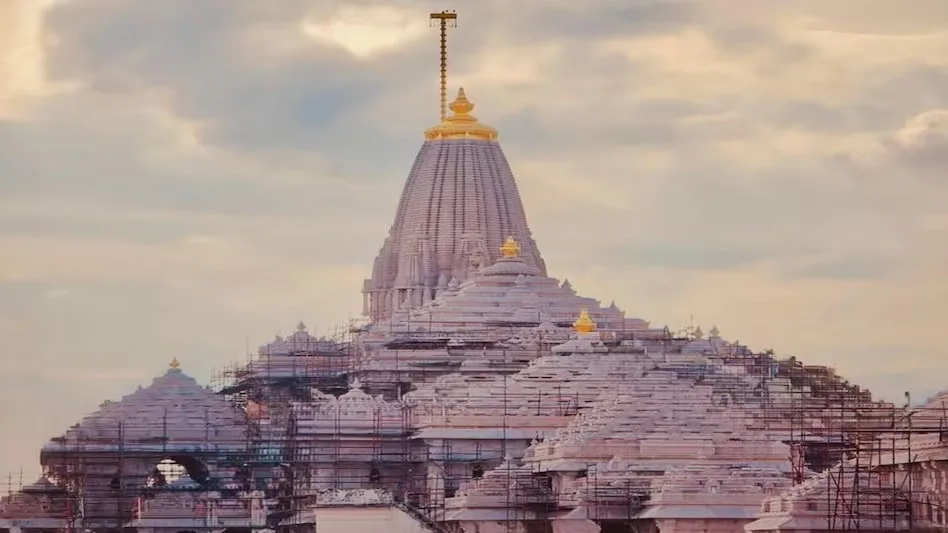
The sacred city of Ayodhya, deeply revered by millions of Hindus across the globe as the birthplace of Shri Ram Lalla, is witnessing an unprecedented moment in its modern history. After years of anticipation, emotional devotion and elaborate construction work, the Shri Ram Mandir now stands fully completed. The grand structure symbolises not only a cultural renaissance but also a profound civilisational shift that reconnects Bharat with its ancient ethos.
The completion of the mandir has paved the way for a landmark ceremony on November 25, when Prime Minister Narendra Modi will perform Dhwajarohan, the ceremonial hoisting of the Bhagwa Dhwaj atop the mandir’s sanctum spire. Uttar Pradesh Chief Minister Yogi Adityanath and RSS Sarsanghchalak Dr Mohan Bhagwat will also participate, marking the beginning of continuous public worship and full-scale pilgrimage.
For devotees, the sight of the Bhagwa Dhwaj rising above the sanctum is not merely symbolic. It represents the formal activation of the temple, a declaration to the world that the abode of Bhagwan Ram is ready to welcome pilgrims without interruption. The ritual, rooted in ancient Hindu tradition, marks the commencement of temple operations and the spiritual culmination of a decades-long movement.
The story of the Ram Mandir is inseparable from one of the most defining judicial and civilisational moments in contemporary Bharat. For centuries, generations of devotees carried the pain of a lost temple, passing down memories, songs and silent hopes that one day justice would prevail. Ram is not merely a deity; Ram is the guiding conscience, the timeless moral centre, and the very soul of this nation. Every Sanatani feels an innate, unbroken bond with Prabhu Sri Ram, a connection that transcends geography, caste, language and time. The mandir rising in Ayodhya is not just the fulfilment of an ancient dream; it is the restoration of a cultural heartbeat, a healing of collective wounds, and a reaffirmation that dharma, however delayed, ultimately triumphs.
On November 9, 2019, the Supreme Court of India delivered a unanimous verdict that brought closure to a centuries-long dispute. The court allotted the entire 2.77-acre contested land for the construction of the Ram Mandir, reaffirming the cultural and historical significance of the site for millions of believers.
This verdict was widely hailed as a triumph of justice and a step toward national reconciliation. The judgment underscored India’s constitutional commitment to peace, pluralism and due process. Following the verdict, the Government of India approved the formation of the Shri Ram Janmabhoomi Teerth Kshetra Trust on February 5, 2020, entrusting it with overseeing the mandir’s construction and future operations.
The Trust, architects, engineers and thousands of artisans have since worked tirelessly to give form to a vision cherished across generations.
Masterpiece of Nagara Architecture
The completed Ram Mandir stands as a grand testament to the traditional Nagara architectural style of North India. The structure rests on 392 intricately carved pillars and features 44 majestic entrance gates, each adorned with detailed sculptures inspired by the Ramayana and Hindu symbolism.
At the heart of the temple lies the Garbha Griha, housing the idol of Ram Lalla in Bal Roop. The sanctum is accessible through the eastern entrance known as Singh Dwar, reached by climbing 32 exquisite steps carved from stone. Every element of the structure reflects painstaking craftsmanship, from its mandaps dedicated to Nritya, Rang, Sabha, Prarthana and Kirtan, to the revived heritage sites within the complex.
Among the restored structures are the ancient Shiv Mandir located at Kuber Tila and the sacred Sita Koop, both revived to retain the region’s spiritual legacy.
The mandir design has been conceptualised by renowned architect Chandrakant Sompura, whose family has contributed to temple architecture for decades. The construction has been executed by Larsen and Toubro, with Tata Consulting Engineers serving as advisory consultants. Structural guidance from experts at IIT Madras, IIT Delhi, IIT Bombay and IIT Guwahati has ensured that the stone framework is built to last for centuries.
Blending Tradition and Technology
The Ram Mandir project is a unique fusion of age-old craftsmanship and modern technological expertise. While the architectural design stays true to ancient principles, the construction has incorporated advanced engineering to ensure longevity and resilience.
Solar power installations have been added to meet a portion of the complex’s energy needs, demonstrating a commitment to sustainability. The temple premises also include modern amenities such as emergency medical facilities, ramps for persons with disabilities, and a fully equipped Pilgrimage Facility Centre to ensure convenience for visitors.
In parallel with the temple’s construction, Ayodhya has undergone a rapid and ambitious infrastructural overhaul. The city’s road networks have been expanded and strengthened to accommodate the anticipated surge of tourists. The Maharishi Valmiki International Airport, already operational, now links Ayodhya with major cities across India and abroad, creating new avenues for spiritual tourism.
The city’s makeover reflects the Uttar Pradesh government’s vision of blending cultural heritage with modern amenities. Ayodhya’s development is no longer confined to the temple complex alone. It extends to public transport, riverfront beautification, hospitality infrastructure and urban planning.
The global Hindu diaspora has also contributed to this cultural wave. In Trinidad and Tobago, for instance, work has begun on constructing a new Ram Mandir in Port of Spain after a replica of the Ram Lalla idol was installed earlier in May 2025. The influence of Ayodhya’s mandir has thus travelled far beyond India’s borders, inspiring renewed cultural identity among overseas communities.
Ayodhya gears up for the Bhagwa Dhwaj Dhwajarohan ceremony
With the completion of the mandir structure, preparations for the Dhwajarohan ceremony have electrified the city. Streets are decorated, floral arrangements cover the mandir complex, and crowds have begun arriving from early hours to witness the historic moment. ANI has reported that around 100 kilograms of flowers have been used to adorn the area around the sanctum.
The ceremonial Bhagwa Dhwaj that will be hoisted measures 22 feet in length and 11 feet in width. It will be mounted on a 42-foot mast erected atop the temple’s 161-foot shikhar. This dhwaj is not ordinary. It carries profound symbolism rooted in Hindu tradition and Ramayana history.
The dhwaj features three sacred emblems:
1. Om, representing the eternal cosmic sound.
2. The Sun, symbolising the Suryavanshi lineage of Bhagwan Ram.
3. The Kovidara tree, a hybrid of the Mandar and Parijat trees as described in ancient scriptures and created by Rishi Kashyap.
Indologist Lalit Mishra has been credited with identifying this ancient dhwaj design. His discovery emerged during an examination of a Mewar pictorial Ramayana painting, which he later verified through references in the Ayodhya Kand of the Valmiki Ramayana. The revival of this emblem is seen as a cultural restoration of Ayodhya’s lost heritage.
Who will attend the ceremony?
According to reports, around 6,000 guests have been invited for the Dhwajarohan ceremony. The list includes dignitaries such as Prime Minister Narendra Modi, Uttar Pradesh Governor Anandiben Patel, Chief Minister Yogi Adityanath and RSS Sarsanghachalak Dr Mohan Bhagwat.
Champat Rai Ji, general secretary of the Ram Mandir Trust, has shared that the guest list is intentionally smaller than the January 22 pran pratishtha ceremony, which witnessed nearly 7,500 attendees. The ongoing development work around the parkota and the mandir complex has prompted the Trust to limit the number of invitations.
More than 500 seers from across Uttar Pradesh, as well as local residents and workers associated with Hindu organisations, have been invited. This time, the Trust has prioritised including more people from Ayodhya and eastern Uttar Pradesh.
The Prime Minister’s visit will begin with a tour of the Saptmandir complex at 10 am. The complex includes temples dedicated to revered figures such as Maharshi Vashishtha, Maharshi Vishwamitra, Maharshi Agastya, Maharshi Valmiki, Devi Ahilya, Nishadraj Guha and Mata Shabari.
Following this, he will visit the Sheshavatar Mandir and the Mata Annapurna Mandir before proceeding to the Ram Darbar Garbh Griha to offer prayers before Ram Lalla.
The Dhwajarohan ceremony is scheduled for 12 pm, after which the Prime Minister is expected to address the gathering.
Why November 25 holds special significance
The Uttar Pradesh government has described the ceremony as marking the beginning of a new era for Ayodhya. Chief Minister Yogi Adityanath recently stated that the name of Shri Ayodhya Dham would once again be inscribed in golden letters on the pages of history.
The date of November 25 has not been chosen arbitrarily. According to tradition, Shri Ram and Mata Sita were married on Panchami, the fifth day of Shukla Paksha in the month of Margashirsha, during the Treta Yug. This year, November 25 coincides with the same Panchami, making it highly auspicious for performing Dhwajarohan.
As the Bhagwa Dhwaj rises atop the Ram Mandir, it signifies more than the completion of a grand architectural project. It marks the spiritual culmination of centuries of devotion and the beginning of a new cultural chapter for Ayodhya and Bharat.
Regaining its lost glory, as envisioned in the Ramayan, Ayodhya is once again rising as the cultural heartland of Bharat. With the mandir now fully operational, the ancient city is set to reclaim its place as one of the world’s most significant spiritual and cultural destinations. The ceremony on November 25 will not merely draw national attention; it will stand as a proud reaffirmation of India’s timeless civilisational legacy, inspiring future generations to cherish and uphold the heritage that has shaped this land for millennia.