The United Nations Security Council has endorsed a US-drafted resolution authorising the deployment of an International Stabilisation Force (ISF) to Gaza, marking one of the most consequential global security decisions in recent years. The proposal secured the support of thirteen of the fifteen Council members, with China and Russia notably abstaining, an indication of shifting geopolitical calculations rather than ideological alignment. What stands out is that several leading Islamic nations, including Saudi Arabia, the UAE, Turkey, and Egypt, have backed the initiative. These states, which have agreed to disarm Hamas and endorse a new governance model called the “Board of Peace,” have chosen strategic security and economic priorities over religious narratives. Their favourable stance is also seen as a key reason China and Russia refrained from exercising their veto powers, with Beijing particularly motivated by its self-interest to ensure stability in a region crucial to its energy security.
Security and economic interests drive the new alignment
A permanent military presence in Gaza is now planned to prevent the re-emergence of terrorist organisations such as Hamas. Multiple countries have already expressed readiness to contribute troops, including Pakistan, a nation currently reeling from severe economic distress and unemployment. Islamabad’s willingness to join the mission aligns with its ongoing diplomatic engagements with both Israeli and American officials. The most recent of these was a meeting between Sardar Yasir Ilyas, Pakistan’s Prime Minister’s Coordinator for Tourism, and Michael Izhar-Kov, Director General of the Israeli Ministry of Tourism, at the World Travel Market in London. This development is particularly noteworthy when viewed in light of Donald Trump’s earlier suggestion that Gaza could eventually become an international tourism destination.
In the eyes of many Islamic nations, Iran, advancing nuclear weapons development, is the region’s most destabilising force. Saudi Arabia perceives Tehran with deep suspicion, and Pakistan remains wary of Iranian support for Baloch freedom fighters. Additionally, Islamabad feels threatened by India’s growing influence in Afghanistan as well as its strained relations with both neighbouring states. Iran’s backing of armed non-state actors such as the Houthis in Yemen and Hamas in Gaza is a persistent concern for Israel, which views these groups as direct security threats.
The convergence of interests among Saudi Arabia, Pakistan, the United States, and Israel revolves around containing Iran’s regional influence. Riyadh and Islamabad recently signed a mutual military cooperation agreement, signalling a deeper strategic partnership. The United States, meanwhile, seeks to prevent China, Iran’s closest major ally, from expanding its footprint in the Middle East. With Washington partially shifting its security focus away from Europe and toward the Indo-Pacific, reconfiguring partnerships in the Middle East has also become central to its strategy. Further, Pakistan withdrew from the $62-billion China-Pakistan Economic Corridor (CPEC), including infrastructure projects passing through Pakistan-occupied Jammu and Kashmir (POJ&K). The decision reflects mounting US pressure and coincides with Qatar’s withdrawal from a port project tied to the corridor. Trump had previously visited Qatar twice to reportedly exert pressure on Doha for this.
For Pakistan, realignment with the United States and Gulf powers is driven by economic desperation. The country’s foreign reserves stand at just $16 billion, lower than Nepal’s $20 billion. Inflation, unemployment, and fiscal instability have generated widespread distress nationwide. In return for policy realignments, Pakistan seeks financial support, investment, and backing from US-influenced international financial institutions. Reports also indicate that Trump is prepared to supply F-35 fighter jets to Saudi Arabia, sidestepping Pentagon warnings, as part of a broader regional security architecture aimed at neutralising Iran’s nuclear ambitions.
Saudi Arabia and the UAE have already grown diplomatically closer to Israel in recent years, and both now actively cooperate in efforts to dismantle Hamas, seen as a major threat to regional stability and economic aspirations. India, too, supports initiatives aimed at ending conflict in West Asia, seeking uninterrupted energy supply and regional security.
Economic transformation in the Gulf overrides religious solidarity
The wealthy Gulf monarchies today prioritise economic transformation, security, and social reform over narratives of pan-Islamic unity. Saudi Arabia’s Vision 2030 exemplifies this shift: a blueprint focused on diversifying the economy beyond oil, expanding education, reducing religious extremism, enhancing women’s rights, and fostering global economic integration. As a result, pro-Palestine or pro-Gaza protests are not permitted in Saudi Arabia or the UAE. These states are consciously distancing themselves from extremist ideologies that once found space within the broader Muslim world. The notion of religious unity among Muslim-majority countries is increasingly recognised as a narrative sustained largely by extremist forces operating in regions such as South Asia and Africa. Organisations in India, Pakistan, Bangladesh, Afghanistan, and parts of Africa often weaponise this sentiment for recruitment, fundraising, and ideological radicalisation. For many of these radical groups, financial gain is as important as ideological objectives.
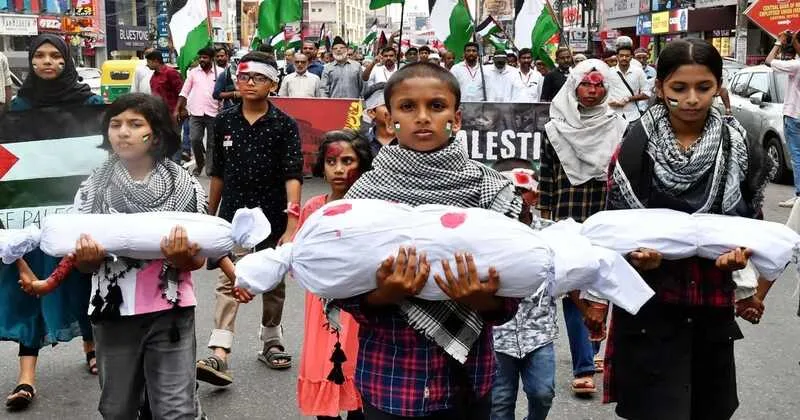
The vast personal fortunes accumulated by Hamas leaders further expose the exploitation underlying extremist mobilisation. Hamas leader Ismail Haniyeh’s wealth was estimated at $4–5 billion, while Khaled Mashal’s personal holdings reportedly range between $2.5 and $5 billion. While ordinary Palestinians endure extreme hardship, senior Hamas leaders live in luxury in countries such as Qatar. Reports indicate that Hamas officials profit by diverting humanitarian supplies, selling them at inflated prices, and imposing taxes on essential goods. Yet, in countries like India and regions like Kerala and Bengal actors, presenters, and segments of the media often uncritically amplify pro-Hamas narratives, contributing to misinformation and emotional manipulation.
The urgent need to resist radical narratives in India
At a time when global security realignments are isolating extremist movements, the persistence of radical propaganda within India poses serious risks. Organisations such as Jamaat-e-Islami, PFI, and SDPI continue to use Palestinian suffering as a tool to mobilise support and spread extremist ideology especially in the Southern states of India. Their messaging is amplified across print and broadcast media, particularly targeting Muslim communities. It is crucial for Indian Muslims to distinguish genuine humanitarian concerns from the political designs of extremist groups seeking to exploit tragedies for ideological and financial gain. As India remains a key target in the global strategy of radical organisations, national unity becomes vital. The country must remain vigilant against extremist propaganda and ensure that tragedies like the Red Fort bombing in Delhi are never repeated. In an evolving geopolitical environment where major Islamic nations themselves are rejecting radicalism and embracing security-focused global cooperation, India’s stance against terrorism is not only justified but necessary.
“Our country has enough issues to deal with. We do not want anything like this. I am sorry to say that you are short-sighted. You are looking at Gaza and Palestine while neglecting what’s happening here. Why don’t you do something for your own country? Look at your own country. Be patriots. People say they are patriots, but this is not patriotism. Show patriotism for the citizens of our own country first,” the Bombay High Court had remarked against the CPI(M) this July, a criticism that now feels even more relevant.