While the national discourse remains fixated on a single day’s violent episode, India’s security and intelligence agencies have been waging a silent and tireless war against terror one that has prevented at least eight major attacks in the last 30 days alone. Behind the scenes, coordinated efforts of the Delhi Police Special Cell, Anti-Terrorism Squads (ATS) from multiple states, and central intelligence units have quietly neutralised multiple terror modules linked to ISIS, Al-Qaeda, Jaish-e-Mohammed, Tehrik-e-Taliban Pakistan, and Babbar Khalsa International.
Each bust represents hundreds, perhaps thousands, of lives saved lives that may never know how close they came to tragedy.
1. Faridabad’s Explosives Haul: 2,900 kg of Bomb Material, 360 kg Ammonium Nitrate
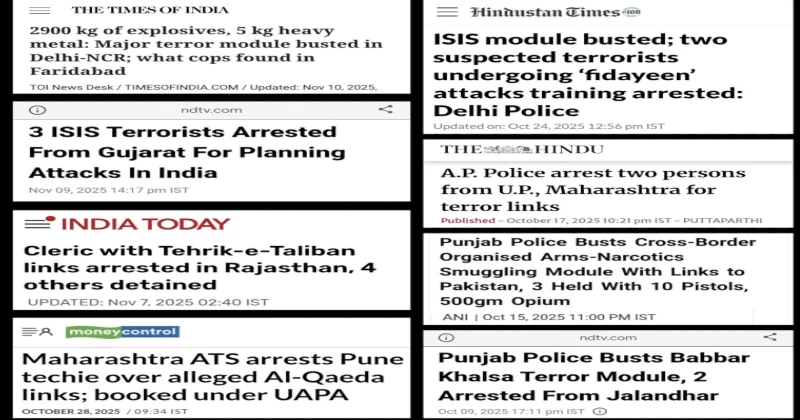
On November 10, in Faridabad, Haryana in one of the most significant terror recoveries in recent years, Jammu & Kashmir Police, in close coordination with the Haryana Police, uncovered an enormous cache of explosives from an apartment in Faridabad. The seized material included 2,900 kg of IED-making components and 360 kg of suspected ammonium nitrate a potential arsenal capable of leveling multiple city blocks.
Two individuals Dr. Muzammil Ahmad Ganaie, an assistant professor at Al-Falah University, and Dr. Adil Ahmad Rather, a doctor from Pulwama, were arrested. Both had allegedly been coordinating with handlers from across the border and were under surveillance for over two weeks. This operation, officials say, averted a possible large-scale terror attack in Delhi-NCR, reminiscent of high-casualty blasts from the early 2000s.
2. Gujarat ATS foils ISIS plot to attack multiple Indian cities
On November 9, in Ahmedabad ,the Gujarat ATS arrested three ISIS operatives who were allegedly plotting coordinated terror strikes across India. The accused had been on the radar of intelligence agencies for nearly a year and were caught while attempting to exchange and distribute weapons within Gujarat.
Sources revealed that the trio belonged to two separate terror modules and had links extending into southern and northern India. Their capture disrupted what could have been simultaneous strikes designed to sow panic nationwide.
3. Rajasthan ATS arrests cleric linked to Tehrik-e-Taliban Pakistan
On November 7, in Sanchore, Jalore, the Rajasthan ATS arrested Osama Umar, a Maulvi with confirmed links to the Tehrik-e-Taliban Pakistan (TTP). For four years, Umar had been in direct contact with top commanders of the Afghanistan-based outfit and was attempting to recruit and radicalize youth along the Gujarat-Rajasthan border.
Officials stated that Umar used encrypted apps to communicate with foreign handlers and had already brainwashed four individuals to join the TTP’s cause. His arrest likely prevented the establishment of a new TTP-linked sleeper cell inside India.
4. Pune Techie with Al-Qaeda links nabbed by Maharashtra ATS
On October 29, in Pune, Maharshtra, a shocking arrest revealed the disturbing reach of online radicalization. Zuber Hungargekar, a software engineer, was arrested by the Maharashtra ATS over his alleged connections to Al-Qaeda. Investigators found photos of him handling an AK-47 and assembling explosives, alongside Urdu translations of Osama Bin Laden’s speeches.
Hungargekar’s digital trail suggested that he had been attempting to establish communication with foreign-based terror recruiters. His capture underscores the increasing sophistication of extremist indoctrination within India’s educated urban class.
5. ISIS ‘Fidayeen’ module busted in Delhi-Bhopal
On October 24, the Delhi Police Special Cell arrested two ISIS recruits, both named Adnan, who were undergoing ‘fidayeen’ (suicide) attack training. Acting on specific intelligence inputs, police teams conducted simultaneous operations in Delhi’s Sadiq Nagar and Bhopal.
Preliminary investigation revealed that the duo were planning a major terror strike in the capital. Several electronic devices and communication logs were seized, indicating coordination with overseas ISIS handlers.
6. Andhra Pradesh Police arrest two over Jaish-e-Mohammed links
On October 30, the Andhra Pradesh Police arrested two individuals in Sri Sathya Sai District from Uttar Pradesh and Maharashtra for their alleged connections with Jaish-e-Mohammed (JeM) operatives in Pakistan. They were part of WhatsApp groups used to disseminate jihadi propaganda and recruit new members.
Earlier, a 40-year-old named Kotwal Noor Mohammed had also been arrested from Dharmavaram for similar links. Police confirmed that the accused were actively coordinating with JeM handlers to identify soft targets within India.
7. Cross-Border arms and drug smuggling module busted in Punjab
On October 15, the Punjab Police in Amritsar dismantled a cross-border arms and narcotics network with direct links to Pakistan. Three men Raja (Amritsar), Surinder (Fazilka), and Jagjit (Tarn Taran) were arrested. The recovery included 10 pistols (including Glock 9mm and Chinese 0.30 calibre models) and 500 grams of opium. Investigations revealed that the weapons were smuggled into India via drones a method increasingly used by Pakistan-based syndicates to arm local networks.
8. Babbar Khalsa International Module crushed in Jalandhar
On October 9, in another breakthrough, the Punjab Counter Intelligence Wing arrested two operatives of Babbar Khalsa International (BKI) and recovered a 2.5 kg RDX-fitted IED with a remote control in Jalandar. The terror cell was being directed by UK-based handlers Nishan Jaurian and Adesh Jamarai, under orders from BKI mastermind Harwinder Singh Rinda, who operates with ISI backing.
Police confirmed that the module was planning a targeted terror strike within Punjab and possibly Delhi.
From urban university cells to border smuggling routes, from encrypted chatrooms to mosques turned recruitment hubs, India’s security agencies have uncovered an intricate and evolving terror network operating within the country’s borders.
The last 30 days alone have shown the scale of the threat and the unseen courage of those who intercept it. While social media debates rage and political narratives dominate headlines, it is India’s intelligence officers, state ATS units, and counterterrorism teams who are preventing another 26/11 or Pulwama every single week.