
There is one discrepancy in Haq that needs to be thrashed out at the very outset. Suparn S Verma’s movie continuously cites that Sharia Law is governed by the Quran. However, this isn’t a substantiated argument as far as Muslim Personal laws are concerned. Sharia Law actually contains several Hadees as well that have been formulated by isolated Muslim scholars and Ulemas. Neither are all these literal derivations from the teachings of the Quran nor do they follow any uniform definition or dictat. These Hadees vary as per understanding and mood of the local Ulemas and political dispensation of Islamic countries. This provides ample scope for misuse and misinterpretation of the laws in favour of the dominating or powerful in the Muslim society and are detrimental to the weaker sections, primarily women.
Have you ever seen similar Sharia laws uniformly played out in all the Islamic countries around the world? If those laws, including Hadees, were derived from the Quran, why are they distinctly individualistic as per the countries they are applicable in? This only proves that these personal laws are nothing but filtered doctrines penned by local Muslim scholars and Maulvis who firstly are men, and secondly, prioritised their agendas and advantages that never factored in equal and just rights for Muslim women.
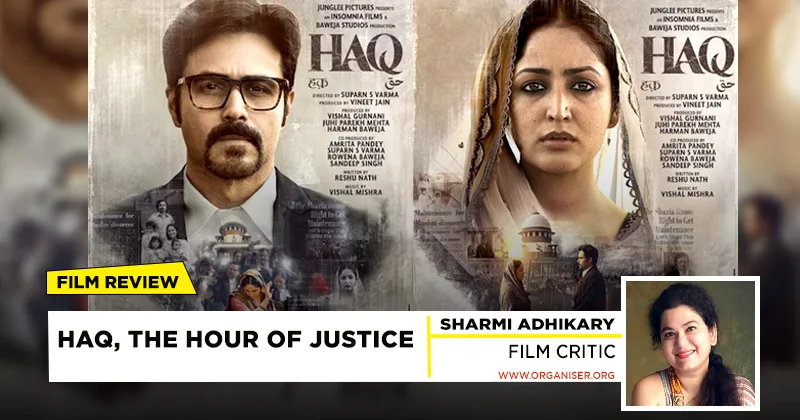
Do keep this deconstruction in mind while watching the otherwise compelling drama written by Reshu Nath that tackles the legality (tussle between Muslim Personal Law and Secular Constitutional Law) about the assurance of a continuing maintenance sum given to women after Talaq (after the exhaustion of the three month period of Iddat and until she remarries). While the scanner is also on the instant Triple Talaq system earlier prevalent among Muslims, it is the tribulations faced by the female protagonist that evokes not just empathy but also raises questions about the rights, position and plight of women in the Islamic society.
A fictionalised account of the Shah Bano case of the 1980s (adapted from journalist Jigna Vora’s book Bano: Bharat Ki Beti), Haq focuses on one woman’s fight for her right in an environment in which the odds are heavily stacked against her. It does not, however, use the character’s quiet fortitude as a stick to beat a religious group with. The restraint becomes its quiet strength even as the narrative stays firmly centred on the question of gender assertion in the face of male entitlement. It examines legal, religious and gender issues through the prism of a protracted trial, and the eyes of one woman at the centre of it, without gloating over the well-documented verdict and its aftermath.
The plot hinges on a landmark legal battle that, four decades ago, pitchforked the practice of Triple Talaq and its repercussions on women into national limelight – but it is mindful of modulating the dramatisation in a manner that keeps sensationalism at bay. At the risk of giving a spoiler, here we must understand what Shazia Bano explains in the film about Triple Talaq. She says that as per the Quran, a man, if he decides to separate from his wife, must do it over a period of three months and not instantly. This length of time (he must utter the word Talaq every month once) needs to be used to pontificate over the relationship issues and if possible mend fences with the wife. Apparently the Quran suggests that the man’s ire and irritation should dissipate in this time as he makes reparations even as the couple try to reconcile.
Note one thing over here. Not once is the woman given any agency or choice about whether she wants to live on with the man who ‘lords’ over her! Not just that, the whole situation feels like her life is hanging on tenterhooks because her future depends on whether the husband would want her as his Begum or not! While many would justify this as a system intrinsic to the Muslim society, this discrimination tantamounts to dehumanising women. Call it conditioning or resignation, Shazia too, after making peace with Abbas marrying the second time, had started hoping that he would take her back. But that was never to be as he felt slighted by her audacious act of reclaiming not just her dignity and rightful place in his life but also what her three children deserved from their father. And to think how the man washed his hands off his responsibilities towards his own children!
Shazia’s decision to approach the courts rather than go through the organisations that administer Sharia, or religious law, is seen as a monumental betrayal. In a bid to checkmate Shazia’s lawyer Indu (Sheeba Chaddha), Abbas frames Shazia’s petition as an assault on Sharia, an attempt to meddle with personal laws that have been protected by the Constitution. The pious and demure Shazia’s campaign is compared to an act no less divisive than Partition. The shift from one woman’s first for her monetary rights to the case becoming a Hindu vs Muslim tug of war is brilliantly depicted when Abbas takes the matter to the Supreme Court not only to teach his wife a lesson but also give the nation a spectacle by making it an issue of infringement on Muslim minority rights that are ruled by their personal laws. If you ask me, the move was mean, devious and had political ramifications even as Shazia, in the movie, looks flummoxed by how the man she once loved was using her as a pawn to draw attention to something completely different. And yet, while all this is going on one cannot ignore the lopsided structure the Muslim society chooses to run with.
Even if you skip the legal nitty gritty, Haq is a mirror to show the state of women when they are treated with an extremely casual attitude. The cinematography by Pratham Mehta makes Shazia’s vulnerability feel personal even as her strength gives you a reason to cheer. The powerful courtroom drama stays entirely rooted in the real world and presents the clash of two codes – one rooted in faith, the other in the domain of jurisprudence, impeccably.
For the uninitiated, here’s a bit about the Mohd. Ahmed Khan vs. Shah Bano Begum case (1985) established that a divorced Muslim woman has the right to claim maintenance under Section 125 of the Criminal Procedure Code (CrPC), even beyond the iddat period. The Supreme Court ruled that this secular law takes precedence over personal law to protect destitute women, prompting a nationwide debate and leading to the Muslim Women (Protection of Rights on Divorce) Act, 1986, which partially reversed the verdict by providing a fixed maintenance amount but allowing for claims against the ex-husband and family.
It is a shame that Rajiv Gandhi’s government, facing pressure from conservative Muslim groups who viewed the Supreme Court’s ruling as an encroachment on personal law, enacted the Muslim Women (Protection of Rights on Divorce) Act, 1986. This law effectively nullified the Supreme Court’s verdict in the Shah Bano case by limiting a divorced Muslim woman’s right to lifelong maintenance and instead stipulating that her husband’s financial responsibility was only for the iddat period (approximately three months after divorce). Critics argued this was a political compromise that undermined women’s rights, while supporters claimed it protected religious autonomy. When you watch Haq, remember what Shah Bano was denied first by her ex-husband and then by the Congress who pandered to their vote bank. Yami Gautam Dhar, in this career defining role that is marked by a fiery performance, signals to the injustice meted out to women in the Islamic society. And while she engages in a tense legal battle with Abbas (Emraan Hashmi’s best performance till date), the exceedingly important issue of the Uniform Civil Code is brought back into mainstream discussion. The time for UCC in India is here. Detractors will keep rummaging for silly excuses to stall it, just like some reviews have foolishly found flimsy loopholes in Varma’s work, but for the country to forge ahead systematically, UCC is the route that will ably guide it.