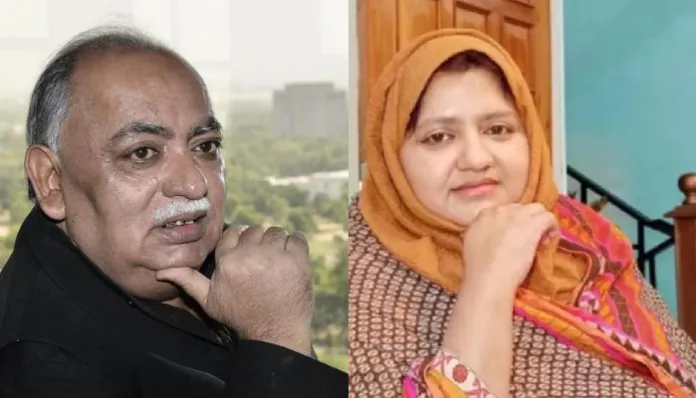
A criminal case has been formally registered against Syed Mohammad Saqib and his family members on the complaint of Hiba Rana, daughter of prominent poet Munawwar Rana, alleging years of dowry harassment, physical and mental cruelty, and the pronouncement of triple talaq. Police officials in Lucknow confirmed that the FIR has been lodged at Sadatganj Police Station following a written complaint submitted by Hiba Rana.
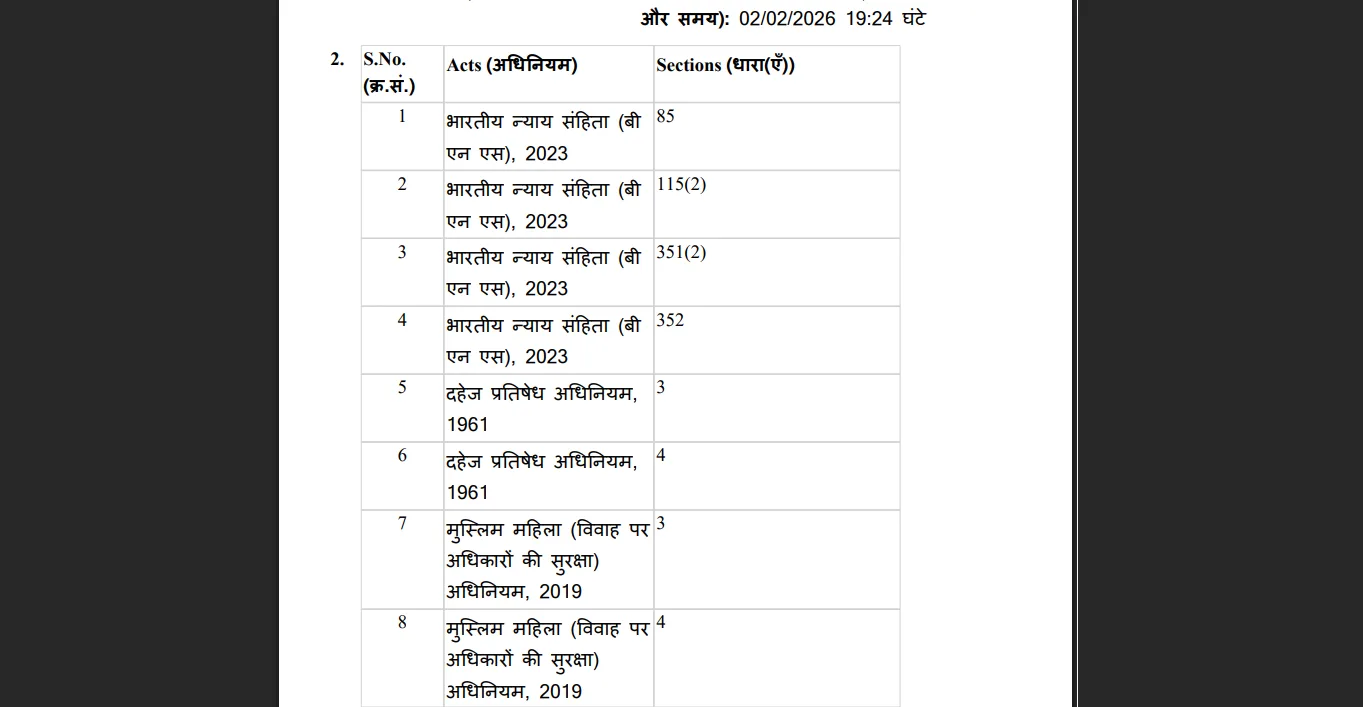
According to police records, the case has been registered under multiple provisions of the Bhartiya Nyaya Sanhita (BNS), 2023, the Dowry Prohibition Act, 1961, and the Muslim Women (Protection of Rights on Marriage) Act, 2019. The accused named in the FIR include Hiba Rana’s husband Syed Mohammad Saqib and his father Syed Hasib Ahmed, both residents of Kareemganj under the jurisdiction of Sadatganj police station in Lucknow .
FIR Details and sections invoked
As per the FIR (No. 0025/2026), dated February 2, 2026, was registered at Sadatganj police station in Lucknow, following which police have invoked Sections 85, 115(2), 351(2) and 352 of the BNS, 2023, which deal with cruelty, assault, criminal intimidation and related offences. Additionally, Sections 3 and 4 of the Dowry Prohibition Act, 1961 have been applied for demanding and accepting dowry. Crucially, Sections 3 and 4 of the Muslim Women (Protection of Rights on Marriage) Act, 2019, have been invoked, which criminalise the pronouncement of instant triple talaq and provide legal protection to Muslim women against such practices.
The FIR records the period of alleged offences from December 19, 2013, to April 9, 2025, indicating a prolonged span of alleged harassment and abuse within the matrimonial home.
Marriage, dowry and initial allegations
In her complaint, Hiba Rana stated that she married Syed Mohammad Saqib on December 19, 2013, according to Sunni Muslim rites and customs. At the time of marriage, her family allegedly gave substantial dowry, including gold and diamond jewellery and Rs 10 lakh in cash. The FIR notes that the dowry was provided “willingly” by her family in the hope of ensuring her marital happiness and security.
However, the situation allegedly deteriorated soon after the wedding.
According to the FIR, Hiba Rana was subjected to repeated taunts, verbal abuse and pressure for additional dowry. Her husband and father-in-law demanded Rs 20 lakh more as extra dowry. The complainant has stated that her parental family, in an attempt to save her marriage, complied with these demands on several occasions.
Police records note that the complainant alleged not just monetary demands but also demands for expensive items and continued mental harassment, which allegedly became routine in her marital life.
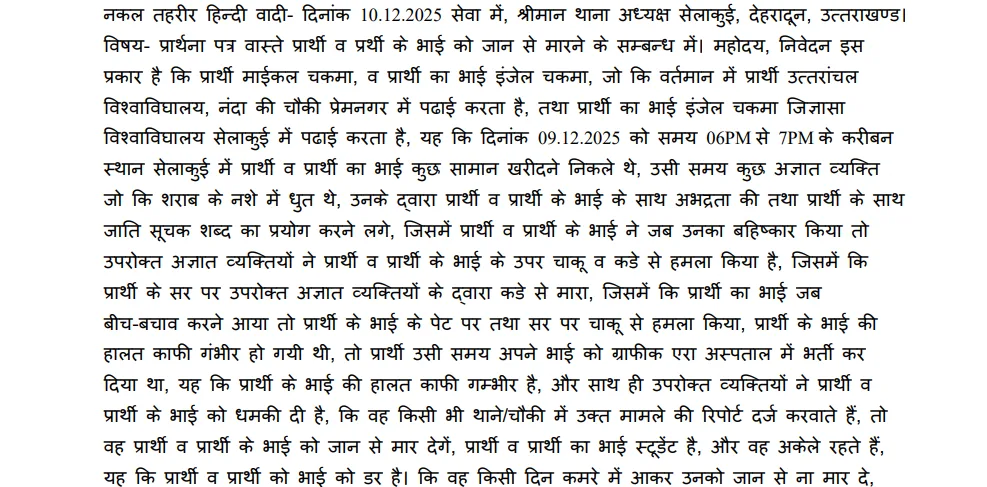
The FIR states that the marriage resulted in two children, a son Syed Fawaz and a daughter Hayyam Fatima. Despite becoming a mother, Hiba Rana has alleged that the harassment did not stop. On the contrary, the complaint claims that the pressure for dowry intensified over time, with repeated threats and intimidation.
According to the FIR narrative, Hiba Rana alleges that she was often beaten and verbally abused, and that attempts were made to psychologically isolate her. The complaint mentions that the accused frequently threatened her with divorce and eviction from the matrimonial home if further demands were not met.
Triple Talaq allegation
A key turning point detailed in the FIR is the incident dated April 9, 2025. Hiba Rana has alleged that on that day, following an argument, her husband verbally abused her, physically assaulted her and pronounced triple talaq, an act prohibited under Indian law since 2019.
The FIR alleges that after pronouncing triple talaq, Saqib forcibly threw her out of the house. More disturbingly, the complaint states that her two minor children were locked inside a room during the incident, causing her severe mental trauma and fear for their safety.
The FIR further records that when Hiba Rana’s sister Ayesha Rana alias Tina intervened and visited the in-laws’ house to speak on her behalf, she too was allegedly assaulted by Saqib. During this confrontation, the husband is accused of once again repeating the pronouncement of triple talaq .
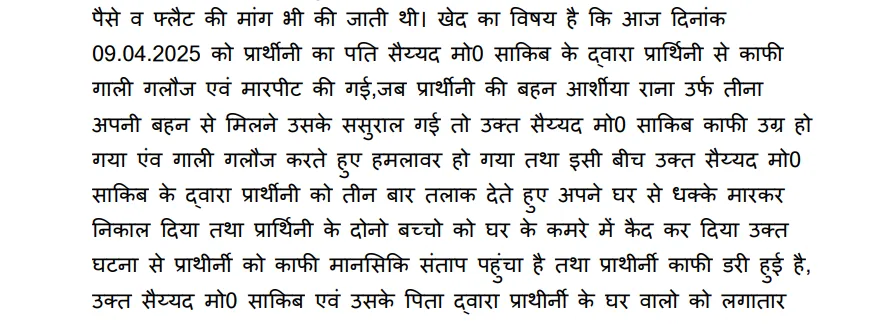
Hiba Rana has told police that the incident left her in a state of severe mental shock and depression. She has expressed apprehension regarding the safety and well-being of her children, stating that she continues to receive threats from the accused and fears further retaliation.
Police action and investigation
Following the registration of FIR, the investigation begun alogwith examination of witnesses, collection of documentary evidence related to dowry payments and verification of the alleged triple talaq pronouncement.
Police officials stated that statements of the complainant, her family members and other relevant witnesses will be recorded under law, and further legal action will be taken based on evidence gathered during the investigation.
Political and ideological irony
The case has drawn widespread attention not only because of the seriousness of the allegations but also due to the public positions previously taken by Munawwar Rana, one of India’s most well-known Urdu poets. It is notable that in 2016, Munawwar Rana had publicly opposed legal intervention on the issue of triple talaq, aligning himself with conservative clerics and sections of the minority leadership who argued that the matter should remain outside the purview of state legislation.
Adding another layer of irony, Hiba Rana’s sister Urusha Rana had once claimed that BJP-RSS brought the triple talaq law to “make Muslims slaves”, a statement that resurfaced on social media after the FIR details became public.
Munawwar Rana himself had courted controversy in 2021 when he declared that he would leave Uttar Pradesh if Yogi Adityanath returned to power, a remark that was widely reported and criticised at the time. The present case, however, has reignited debate on whether the legal safeguards introduced through the Muslim Women (Protection of Rights on Marriage) Act, 2019 have provided recourse to Muslim women facing precisely the kind of situations the law was enacted to prevent.
While the investigation is still at a preliminary stage and the accused have not yet responded publicly to the allegations, the registration of the FIR itself has triggered intense debate across political, legal and social circles, particularly given the complainant’s family background and the historical opposition to triple talaq laws by prominent voices within the same ideological space.
As the police probe progresses, the case is expected to remain under close public scrutiny, both for its legal outcome and for the broader questions it raises about gender justice, religious reform and the application of criminal law in cases of marital cruelty.