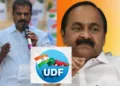

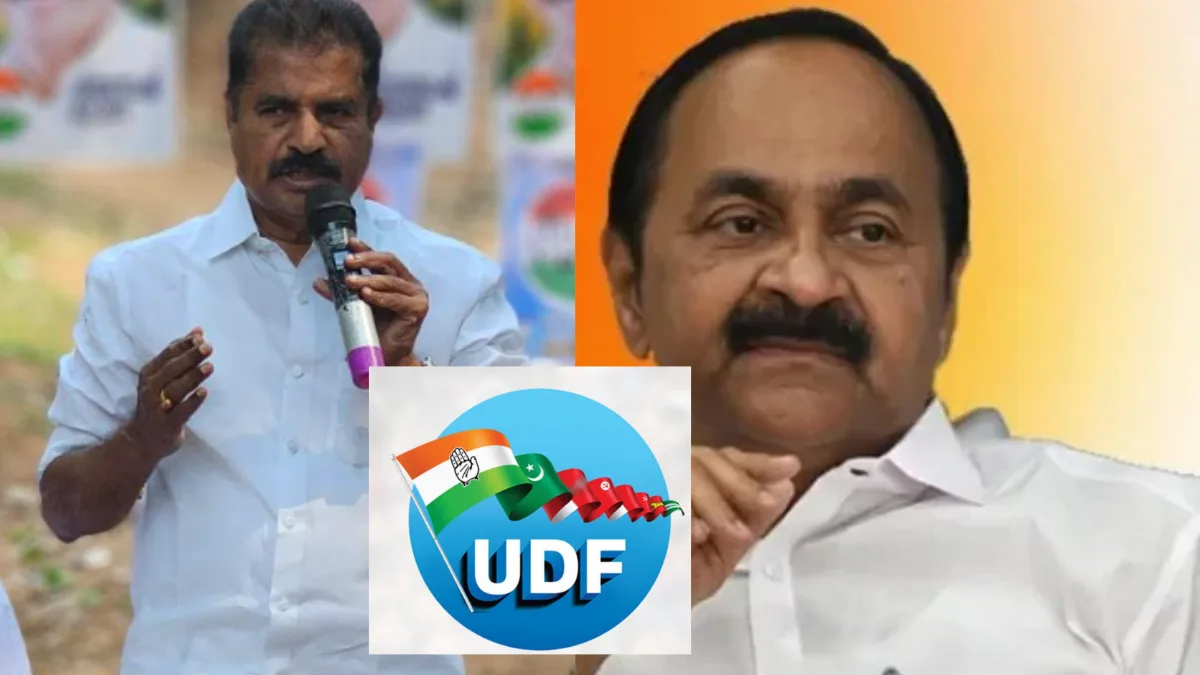
Congress party has a unique template for coalition politics: before elections, ‘we are all united’; if elected, ‘we are supreme and the rest must follow’. The same template now appears to be playing out in Keralam, with senior Congress leader and UDF Convener Adoor Prakash publicly expressing dissatisfaction over Chief Minister V.D. Satheesan’s style of functioning and alleging that key decisions are being taken without consulting coalition partners.
Prakash’s remarks have brought questions over coordination within the Congress-led United Democratic Front (UDF) to the forefront, barely four months after the government assumed office. His criticism centres on cabinet-rank appointments, the functioning of the UDF, delays in replacing nominees of the previous CPM-led Left Democratic Front (LDF) in boards and corporations, and the lack of coordination during recent local body by-elections.
Adoor Prakash, senior Congress leader and Convener of the ruling Congress-led United Democratic Front (UDF), on October 1, blasted Chief Minister V.D. Satheesan over the lack of consultation within the coalition, saying that several important decisions are being taken without informing the leaders of the constituents of the UDF. Adoor Prakash expressed his dissatisfaction while talking to media persons.
Prakash shared the dissatisfaction among UDF workers over the inordinate delay in changing the people appointed by the former CPM-led Left Democratic Front (LDF) and filling the positions of chairpersons of boards and corporations. He demanded that these appointments be implemented at the earliest.
Prakash criticised the Chief Minister over the recent cabinet-rank appointments. He was referring to the appointment of Indian Union Muslim League leader M.K. Muneer as Chairman of the Administrative Reforms Commission and Forward Bloc leader G. Devarajan as the state government’s Special Representative in Delhi. Both appointments were made with cabinet rank designation.
Meanwhile, in view of the above appointments, Kerala Congress (Joseph Group) has been demanding the appointment of its leader P.J. Joseph as Chairman of the State Commission for Senior Citizens with cabinet rank.
Prakash said that the appointments of M.K. Muneer and G. Devarajan were made without consulting him as the UDF Convener. He made it clear that he would not question the credentials of the appointees. They do deserve those positions, he said, but the UDF should have been informed and consulted.
The UDF Convener also stated that the UDF committee is not meeting regularly. He attributed this to the CM, who is also the Front’s chairman. He said the CM has to initiate the process, while the Convener can only work with the consent of the chairman. The UDF coordination committee has not met since July 31, according to reports.
Prakash pointed out that there are several other issues that demand collective discussion. He said that since many decisions are implemented without any discussion, he is unable to answer questions about the Front as he is unaware of the decisions. He said he would convey his dissatisfaction to the AICC leadership.
Adoor Prakash requested media persons not to take his remarks as an attempt to blame the CM. He maintained that his words were based on his experience as UDF Convener and said he felt there was no point in keeping his concerns hidden any further.
Prakash also expressed his dissatisfaction with the manner in which the campaign had been carried out for the recently concluded by-elections to the Local Self-Government Bodies. He regretted that there was no adequate coordination for the election campaign. He had visited some districts for campaigning, but without any specific direction from the party leadership.
According to the figures cited in the discussion, the UDF retained 19 of the 22 seats it held when the regular elections took place in December 2025, while the LDF increased its tally from 15 to 18.
Referring to the Chirayinkeezh controversy involving a physical scuffle involving party MLA Remya Haridas, Adoor said that the incident had created dissatisfaction among party workers. Scarcity of electricity had also affected the UDF’s prospects in the by-elections.
Regarding the controversial chartered-flight travel of the Chief Minister, the UDF Convener said that the CM should explain the circumstances to the people convincingly.
He also opened up about the delay in electing a new Pradesh Congress Committee (PCC) president, even after the completion of four months since the UDF government took over. It is to be noted that Kerala PCC president Sunny Joseph was made a minister in the Satheeshan government, meaning that he holds two positions simultaneously. Prakash said a PCC president should be elected as soon as possible.
The political developments have also triggered speculation within Congress over the wider factional equations surrounding CM Satheeshan.
Some observers have linked Prakash’s criticism to leaders who are unhappy with the Chief Minister, with some pointing to Home Minister Ramesh Chennithala and others to AICC general secretary K.C. Venugopal. Both had been contenders in the race for the Chief Minister’s position, although claims about their role in Prakash’s remarks remain speculation.
Meanwhile, K.C. Venugopal stated that there was no point in dragging his name into Adoor Prakash’s statements. He said he did not agree with disclosing such issues publicly and maintained that they should be discussed on party forums. He also said that some people tried to make him an ‘accused’ in all issues.
K.C. Venugopal’s response has itself added another dimension to the developments within the Congress. While Prakash has said he would convey his concerns to the AICC, Venugopal has maintained that matters requiring discussion within the party should be dealt with through party forums.
There are observers who believe that the developments point to serious fissures within the UDF at an early stage of the government’s tenure. The public disagreement between the UDF Convener and the Chief Minister has brought the question of coalition coordination into focus during what was expected to be the government’s initial period of consolidation.
There are also claims that the Youth Congress workers who staged a black-flag protest against Union Home Minister Amit Shah on September 26 in Kollam were instigated by ‘somebody’ within the Congress with an idea to tarnish the image of CM V.D. Satheeshan or Home Minister Ramesh Chennithala. These remain claims and have not been independently established. Given the intraparty issues Congress has been facing, the question of who is who behind the current developments remains a matter of political speculation.