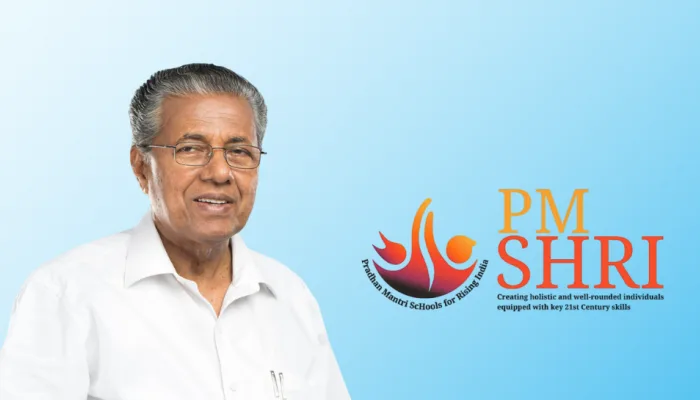
In a decision that has stirred both applause and outrage, the Kerala government, led by Chief Minister Pinarayi Vijayan, has signed a Memorandum of Understanding (MoU) with the Narendra Modi government to join the PM SHRI (Prime Minister Schools for Rising India) scheme. The move marks a striking departure from the state’s earlier resistance to the Centre’s National Education Policy (NEP) 2020, which the Left had branded as “centralising” and “ideologically motivated.”
For years, Kerala had stood as one of the most vocal opponents of NEP, refusing to align its school system with the Centre’s framework. Yet, in October 2025, the state took a decisive step to collaborate under the PM SHRI initiative, a centrally sponsored project launched in 2022 to modernise schools and promote experiential learning across India.
Kerala’s Education Minister V. Sivankutty has sought to allay fears of surrendering academic autonomy, asserting that the agreement “does not compromise the state’s right to publish its own textbooks or design its own curriculum.” His statement, however, has not been enough to silence criticism from within the Left coalition, where ideological purists see the move as capitulation.
What is the PM SHRI Scheme?
Launched by Prime Minister Narendra Modi in 2022, the PM SHRI scheme aims to transform 14,500 schools across India into “exemplary institutions” that embody the spirit of NEP 2020. These schools, drawn from Kendriya Vidyalayas, Navodaya Vidyalayas, state board, and CBSE-affiliated institutions are envisioned as models of integrated, skill-based, and digital learning.
The scheme focuses on improving physical infrastructure, upgrading teacher training, introducing smart classrooms, and adopting green practices. The Centre provides financial and technical support, while the participating states retain administrative control over the schools.
Crucially, signing the MoU enables states to receive central funding for these projects, but it also symbolically aligns them with NEP’s overarching educational vision, something that has made several opposition-ruled states, including Kerala, cautious.
Why Kerala initially resisted
Kerala’s Left Democratic Front (LDF) government had, since 2020, resisted both NEP and its associated schemes, arguing that they violated federal principles by imposing a centralised education model. The state’s education system, celebrated for its literacy and inclusivity, was projected as a successful alternative to Delhi’s prescriptions.
Chief Minister Pinarayi Vijayan and Education Minister V. Sivankutty repeatedly asserted that Kerala’s curriculum, rooted in scientific temper and social justice, was incompatible with the NEP’s framework, which they claimed tilted toward “saffronisation” and “corporatisation” of education.
However, the situation began to change as the Centre linked crucial education funds to participation in PM SHRI. Notably, Kerala faced delays in accessing funds under the Samagra Shiksha Abhiyan (SSA), a major programme supporting infrastructure and teacher development. Without signing the MoU, the state risked losing out on central aid vital for upgrading schools.
Financial realities behind the policy shift
By mid-2025, the financial pressure became evident. Infrastructure projects in several districts stalled, and teachers unions began demanding improved facilities. The pragmatic argument gained traction within the CPI(M)-led government: ideological rigidity could no longer justify losing federal funds that directly benefited schools.
The breakthrough came when the Centre clarified that joining PM SHRI did not imply full NEP adoption. Kerala could access funds for infrastructure and innovation while retaining control over curriculum and textbooks.
V Sivankutty publicly confirmed this distinction, assuring educators and the public that the state’s academic independence would remain intact. “We will participate in the PM SHRI scheme for infrastructural development,” he said, “but our curriculum decisions will continue to reflect Kerala’s educational philosophy.”
A split within the Left
Despite the careful positioning, Kerala’s decision to sign the MoU has exposed deep ideological fissures within the Left Democratic Front (LDF).
The Communist Party of India (CPI), the second-largest ally in the coalition, has emerged as the most vocal critic. CPI general secretary D Raja condemned the move, calling the NEP “a dangerous and divisive policy” that seeks to “saffronise education and centralise control.” He questioned why a government that had so strongly opposed the policy in Parliament and on public platforms would now “lend legitimacy to the very scheme it once rejected.”
Within Kerala, CPI’s state unit echoed the sentiment, accusing the CPI(M) of unilateral decision-making. Senior leader C Divakaran told local media that the alliance had “collectively resolved to oppose NEP in principle,” and that no single party should deviate for administrative convenience.
The controversy has been amplified by the Left’s student and teacher wings. The All India Students’ Federation (AISF) and Kerala School Teachers’ Association (KSTA) accused the government of sending “mixed signals” by cooperating with the Centre while claiming ideological opposition.
CPI(M)’s defence not enough
In response to mounting criticism, the CPI(M) leadership has attempted to contain the backlash by stressing the limited nature of the MoU. Education Minister Sivankutty reiterated that “joining PM SHRI does not mean implementing NEP,” adding that Kerala can withdraw from the agreement at any time if it finds the state’s educational interests compromised.
Chief Minister Pinarayi Vijayan echoed this position, saying the decision was guided by “the practical need to modernise schools and secure resources for teachers and students.” He underlined that Kerala’s model of education, rooted in secular, scientific, and inclusive values, would not be altered by participation in the PM SHRI initiative.
Party members describe the decision as a “strategic balancing act” one that allows Kerala to leverage central funds without surrendering policy control. “It’s a fine line between pragmatism and principle,” said a senior CPI(M) leader, “but refusing funds for our students’ welfare would have been politically indefensible.”
How the move resonates beyond Kerala
Kerala’s U-turn on PM SHRI carries broader national implications. The state’s participation provides a boost to the Modi government’s NEP framework, lending it legitimacy from a state that once stood among its fiercest critics.
For the BJP, Kerala’s move is being cited as a validation of the Centre’s education reforms. Party leaders argue that even ideological opponents have recognised the benefits of collaboration under PM SHRI.
However, for opposition-ruled states such as Tamil Nadu, Telangana, and West Bengal, which continue to oppose NEP, Kerala’s decision presents a new dilemma. It sets a precedent for cooperative federalism in education policy, where even adversarial states can find common ground on developmental goals.
The debate is not merely political but also symbolic. Kerala’s education system, often hailed as a model of social equity and quality, has long been projected as an alternative to the centralised models promoted by the Union government. Joining PM SHRI, therefore, challenges that narrative.
The outcome will depend on how Kerala implements the scheme. If the state succeeds in upgrading its schools while maintaining curricular independence, it could set a new benchmark for balancing ideology with practicality.
Education activists have urged the government to ensure transparency in project implementation, especially in how funds are allocated and how “model schools” are selected. Teacher unions have also demanded that local bodies retain a strong role in decision-making to prevent bureaucratic overreach.
Whether the move will strengthen Kerala’s schools or weaken its political unity remains to be seen. But one thing is certain, the signing of the PM SHRI MoU has reignited the debate over education, autonomy, and the balance between principle and pragmatism in Indian federalism.
As the Left grapples with its internal contradictions, Kerala’s classrooms may soon become the newest testing ground for how ideology and governance coexist in modern India.
(Views are personal and the author is a PhD in political communication from Indira Gandhi National Tribal University)