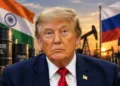
Amid repeated claims by US President Donald Trump that India would completely halt imports of Russian oil, India is steadily moving to strengthen its industrial and trade ties with Russia. Contrary to Trump’s assertions, India has significantly increased its purchases of Russian oil in recent months. While India’s imports stood at 1.6 million barrels per day in September, they have now risen to two million barrels per day this month. Even when accounting for India’s total oil imports in October, Russia remains the largest supplier. Iraq ranks second, with India importing 1.01 million barrels per day, followed by Saudi Arabia at 8.30 million barrels. The United States has overtaken the UAE to claim the fourth position, with 6.94 million barrels arriving daily, while India imported 3.94 million barrels per day from the UAE, according to market researcher Kepler. The rise in Russian oil imports is partly attributable to the increasing discounts offered to India. In July and August, the discount stood at $1.5–2 per barrel, but it has now increased to $3.5–5 per barrel. Effectively, India is acquiring Russian oil at up to a $5 discount compared to global market prices. Reports indicate that Indian companies have entered into agreements with Russian firms for oil imports continuing through November and December. These arrangements demonstrate that India has not adhered to Trump’s statements on ceasing Russian oil imports.
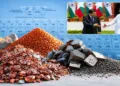
India’s engagement with Russia extends beyond oil. The country is preparing to collaborate with Russian companies on rare earths and infrastructure development, including the coal sector. This pivot toward Russia is partly motivated by restrictions imposed by China, which controls nearly 95 percent of the global rare earth supply. Rare earth elements are critical for several industries, including automobile manufacturing, electronics, and defense. The Union Commerce Ministry confirmed cooperation with Russia in rare earths and indicated plans to explore partnerships in aviation and advanced technologies, including the production of small aircraft engines and 3D printing technologies.
Despite Trump’s claim that Prime Minister Narendra Modi had assured him India would stop importing Russian oil, the Ministry of External Affairs clarified that no conversation on the matter had taken place between Modi and Trump. The ministry did not, however, deny India’s continued purchases of Russian oil. This episode has been described as one of Trump’s “peculiar” claims. So far, the United States has responded only with trade measures. In addition to a 25 percent import duty, the Trump administration has imposed an additional 25 percent penalty on India’s Russian oil purchases, effectively bringing the total import duty to 50 percent. By comparison, China, the largest buyer of Russian oil, faces only a 30 percent duty. According to 2024 estimates, China imported $62.6 billion worth of Russian oil, while India’s imports amounted to $52.7 billion. The European Union, despite its sanctions on Russia, imported $39.1 billion worth of Russian products, including $25.1 billion in oil. The United States spent $3.3 billion on Russian minerals. The Ministry of External Affairs has highlighted this as evidence of double standards, asserting that India’s procurement of Russian oil is in its national interest. Trump, when questioned, responded that he was unaware of US purchases of minerals from Russia.
Pakistan surrenders strategic control to the US through Pasni Port project
In a related geopolitical development, Pakistan’s Army Chief Asim Munir has taken decisive steps that surrenders Islamabad to US completely. Munir recently presented a proposal to the Trump administration for the construction of a port in Pasni, a fishing town in Balochistan, which would allow the US to operate with significant strategic and economic freedom in the region. The project represents a potential setback for China, Pakistan’s longstanding ally. Beyond political and military considerations, Munir is seeking a firm hold over Pakistan government.
The Pasni region is claimed to have rich in rare earth minerals, including neodymium, and copper. Munir’s port project is designed to enable the US to directly access these mineral resources, which are essential for defense, electronics, and electric vehicle (EV) industries. Currently, the United States is heavily reliant on China for rare earths. Reports suggest that China has imposed restrictions on rare earth exports to Pakistan due to Islamabad’s growing ties with the US in this sector. The proposed Pasni port is only 112 kilometers from China’s strategic port in Gwadar, established as part of the China-Pakistan Economic Corridor (CPEC) at a reported cost of $60 billion (approximately Rs. 5.3 lakh crore). Should the Pasni project proceed, it could undermine China’s economic and political position in the region.
Munir has claimed that the port will primarily serve mineral exports, although its proximity to Iran, roughly 150 kilometers, could also allow for potential military applications. The initial investment for the project is estimated at $1.21 billion (approximately Rs. 10,500 crore), to be jointly funded by US investors and the Pakistani government. Pakistan’s collaboration with the United States marks a major setback for China, considering their earlier support for the China-Pakistan alliance. The renewed partnership is partly driven by the fear of India’s continuing “Operation Sindoor,” a counter-offensive against Pakistan sponsored terrorism.
Meanwhile, India is pursuing its own strategic projects in the region. In Chabahar, Iran, India is investing in a commercial port just 100 kilometers from Pasni, aiming to strengthen its access to maritime routes in the Arabian Sea. In the broader context, the competition over ports and rare earth minerals highlights a shifting geopolitical landscape in South Asia. India’s growing engagement with Russia, despite US pressure, underscores its focus on national interest and industrial security. Similarly, Pakistan’s efforts to attract US investment through Pasni reflects its isolation in South Asia and beyond. For the US, participation in Pasni could bolster its presence in the region while diversifying access to critical minerals away from China.
The intensifying competition in the rare earth and energy sectors is closely tied to global industrial priorities. Rare earth elements, including neodymium, are indispensable for advanced manufacturing, renewable energy technologies, defense systems, and the burgeoning EV industry. Countries like India and the United States are seeking to reduce dependence on China, which maintains a near-monopoly over global supply chains. Russia, with its extensive mineral and energy reserves, is emerging as a critical partner for both nations. In the oil sector, India’s continued imports from Russia demonstrate both economic pragmatism and strategic autonomy. With discounts of up to $5 per barrel, Russian oil provides a cost advantage over other sources. By securing long-term import agreements, India is insulating itself from potential global supply disruptions while maintaining leverage in international negotiations. This approach reflects a balance between economic benefit and geopolitical prudence, particularly in light of the penalties imposed by the United States.