When the Communist Party of India (Maoist) convened its Eastern Regional Bureau meeting in 2015, the tone was markedly different from the confident, expansionist communiqués of earlier years. Senior regional commanders openly acknowledged that the new central dispensation, formed in 2014 what they explicitly termed “The Modi threat”, would pose an existential danger to their operation and ideological survival. In a rare moment of candour, the minutes of the meeting revealed discussions on how the Government’s firm political resolve, enhanced intelligence coordination, and administrative reach were dismantling the safe zones that had allowed the movement to flourish for decades. They even went so far as to name former Prime Minister Manmohan Singh as a leader under whose tenure the Maoist networks had a space to sustain and expand their influence. The cadres admitted that the new regime’s no-tolerance approach and its focus on development-led counterinsurgency would challenge their very growth model, one that had thrived in governance vacuums and on exploiting the State’s institutional weaknesses. Analysts later read those minutes as the first candid admission that the movement’s sanctuary was no longer secure, a symbolic moment when the Maoist imagination itself began to contract.
Dismantling Maoist
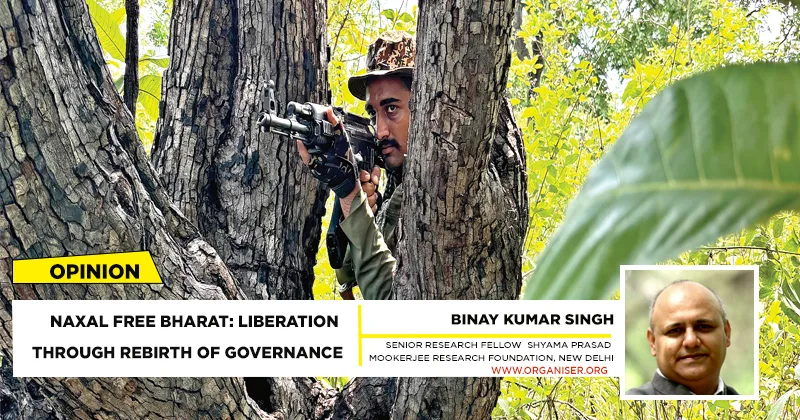
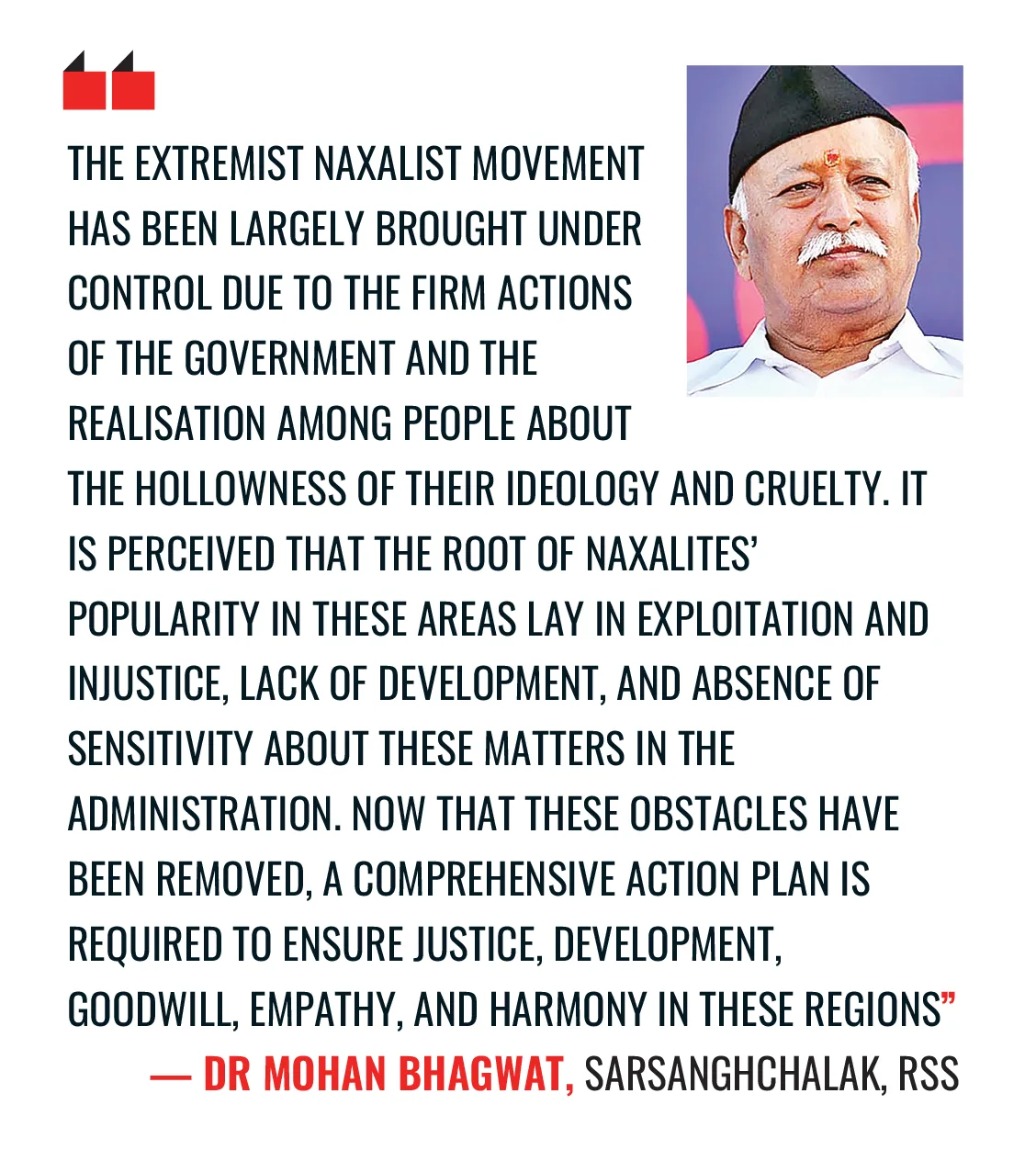
A movement that had grown in the shadows of complacency now faced a State prepared to fill those shadows with intent, precision and relentless pursuit. That fear, once an internal notation, hardened into policy on the other side of the political divide. The state decided to treat Naxalism not as an intractable social phenomenon to be endlessly studied but as an organised armed threat to be dismantled. At the centre of that decision was Amit Shah, Union Home Minister, who framed a single explicit objective: make Bharat free from organised Maoist armed presence. The announcement was final. It became an operational compass for forces and administrators across affected states, converting decade-long ambiguity into a date-driven campaign where every district and force knew the deliverable and the deadline.
The story that follows is a sequence of choices, operations and programmes that together strangled an underground that once seemed perennial. It is also a moral ledger that traces an arc from campus violence where young students lost their lives to jungle operations, where leaders once believed invulnerable were finally cornered. The political decision to pair uncompromising kinetic pressure with visible development, targeted financial choking of insurgent networks and a genuine surrender pathway was the strategic synthesis that finally put the insurgency on the line of elimination.
ABVP Was Targeted During Naxalism
Years before the forests became the theatre of headline operations, campuses in Naxal-influenced regions were battlefield grounds for ideas and, tragically, for blood. Between 1979 and 1997 at least 19 students associated with Akhil Bharatiya Vidyarthi Parishad (ABVP) were killed in colleges located in districts affected by Naxal influence. Those deaths were not statistics in the ledger of unrest; they were human ruptures that became part of the moral reasoning for the state’s eventual resolve. Vinod Kumar Jha, an ABVP member at NIT Warangal, was killed in July 1979, because he publicly engaged with and propagated the ideas of Sri Aurobindo and Swami Vivekananda on campus. Similarly, the killing of Sama Jaganmohan, another ABVP member, on February 6, 1984, for hoisting the flag of India became another emblematic wound in the shared memory of campus activists who saw themselves as defenders of national and civic ideals.
Liquidating Naxalite leader
The moral symmetry of history became literal decades later. One of the men who had risen through the underground and up to General Secretary of the CPI (Maoist), Nambala Keshava Rao, known widely by his alias Basavaraju, and also the murderer of Sri Vinod Kumar Jha was killed on May 2025, through a sustained, intelligence-driven operation. For families who had lost youth in campus politics and for organisations that had mourned student deaths, the sight of a long-accused leader eliminated decades later read as a form of delayed accountability and life coming full circle in a bitter, historical symmetry that the state publicly noted and that many survivors found emotionally resonant.
Centre & States Worked in Tandem
What followed the political decision and the symbolic removals were painstaking operational work. The Centre and States built a coordinated strategy around multiple reinforcing levers: relentless, intelligence-driven operations; fiscal and administrative pressure on the movement’s funding and logistics; visible and rapid development projects that undercut the insurgents’ claim to governance; and a credible, well-advertised surrender-and-rehabilitation pathway that treated exit as an honourable choice. The campaign’s design recognised an old lesson of counter-insurgency: force could suppress but development and reintegration could remove supply lines of recruitment, legitimacy and consent.
Top Naxalites eliminated, arrested or surrendered since 2020
- Maoist’s Central Committee Member [CCM] Deepak Milind Teltumbde killed in an encounter in Maharashtra’s Gadchiroli in November 2021.
- Top Maoist leader and Eastern Regional Bureau Chief Prashant Bose alias Kishan Da and his wife CCM Sheela Marandi were nabbed from Jharkhand in 2021.
- Senior Maoist leader BG Krishnamoorthy was apprehended in Kerala in 2021.
- Vijay Arya, a CCM of the outlawed Maoist outfit arrested by police in 2022.
- Police arrested CCM Mithilesh Mehta alias Mithilesh Sharma in 2022.
- Arun Bhattacharjee alias Kanchan Da was taken into custody by police from Assam in March 2022.
- People’s Liberation Front of India [PLFI] Supremo Dinesh Gope arrested by a joint team of security officials in May 2023.
- Police arrested Maoist’s Politburo member Pramod Mishra from Bihar’s Gaya district in August 2023.
- Police in a swift operation nabbed CCM Sanjay Deepak Rao from Hyderabad in 2023.Maoist’s CCM Sabyascha Goswami alias Kishore Da was arrested by police along the Jharkhand border in January 2024.
- CCM Chalpati alias Jairam was killed in an encounter in Gariyaband in January 2025.
- Nambala Keshav Rao alias Basavaraju, the highest rank leader of CPI [Maoist] neutralized in an encounter in Abujhmad in May 2025.
- CCM Gautam alias Sudhakar was gunned down in an encounter with security forces in Bastar in June 2025.
- Sujata alias Kalpana, a top Maoist leader and CCM surrendered before police in Telangana in September 2025.
- CCM Modem Balakrishna was killed in an encounter in Griyaband’s Bhaludiggi hills in September 2025.
- Sahdeo Soren alias Pravesh Da, a CCM was gunned down in an exchange of fire in Jharkhand’s Hazaribagh district in September 2025.
- CCM Katta Ramchandra Reddy alias Vikalp and CCM Satyanarayan Reddy alias Kosa Dada were neutralized in an encounter along Maharashtra border in September 2025.
- Damodar alias Bade Chokha Rao, secretary of Telangana State Committee was gunned down in an encounter in January 2025.
- Bhaskar, a state committee member, was neutralised in a gun fight in June 2025.
- Sheprilli Sudhakar alias Shankaranna got killed in encounter in Kanker in 2024
- Hardcore Maoist commander Dinesh Modiyam surrendered before police in March 2025.
- Indal Ganjhu, a harcore Naxal facing over 140 cases surrendered in Jharkhand in May 2023.
Recent anti-Naxal operations have been marked by a decisive technological and tactical overhaul, as detailed in several reliable public sources. Specialised State and Central units such as the CRPF, CoBRA, Greyhounds, C-60, and Chhattisgarh’s DRG were critical to jungle campaigns with constant upgrades in doctrine and hardware. More than 40 forward operating bases (FOBs) have been established by CRPF in deeply forested, previously Naxal-dominated districts, allowing relentless pressure near Maoist core areas, rather than from distant highway camps.
Drone squadrons, including models such as the NETRA 3, Bharat, and SWITCH UAV, were placed at every active base, providing real-time video, thermal imaging, and night operations support. These were fused with Heron UAVs, operating at high altitudes for hours, feeding movement tracking and communications intercepts directly to operations centres. In major operations, multiple drone teams sequenced with helicopter reconnaissance, real-time topographical mapping from national technical agencies, and ground patrols with local guides, surrounding and isolating Maoist concentrations before closing in with ground forces.
Ground columns and commando units were now routinely inserted deep into dense forests, something previously considered too risky using precise coordinates drawn from real-time drone intelligence. Tactical insertion teams coordinated closely with air assets and local intelligence, denying Naxals easy escape and intercepting their corridors. Maharashtra’s experiences are illustrative: Gadchiroli’s police, used SWITCH UAVs to provide continuous surveillance in complex terrains, which allowed C-60 and other units to track, map, and neutralise movement, including in “Naxal-free” operations in Wandoli and along the Chhattisgarh border.
The blend of traditional jungle warfare, local fighters, foot patrols, and ambush skills with tech interventions (UAVs, satellite imagery, night-vision, advanced comms) has fundamentally reversed previous Naxal operational advantages. Forested corridors, once safe zones for insurgents, have become transparent, observable, and interceptable. A radical transformation repeatedly credited in after-action reports by commanders from the CRPF and elite state units.
The campaign’s emphasis on information flow turned surrendered cadres and local administrations into sources of decisive human intelligence. Programmes to cultivate local sources, both formal and informal, combined with incentives for villagers to report extortion and safe-house locations. As human tips became more reliable, technical assets could be cued more efficiently and operations executed with fewer collateral risks.
Cutting financial lifelines was another decisive vector. The security architecture targeted the extortion networks that funded cadre salaries, arms and logistics. Enforcement sweeps focused on mineral lease corridors, illicit timber and narcotics revenues that the insurgents had used as revenue sources. Large seizures of caches, arrests of logistics operatives and publicised disruption of extortion rackets diminished the steady money flow that had made long conspiracies possible.
Running parallel to the pressure on funds and personnel was an aggressive development push. The Union and State Governments scaled up the Road Connectivity Project for LWE-affected areas and prioritised electrification, schools, health centres, and water projects in newly secured pockets. Where a road cut travel time from village to market by hours, the calculus of staying under insurgent coercion changed. Where a government pension or scholarship finally reached a tribal household without intermediate levies, the state reclaimed legitimacy.
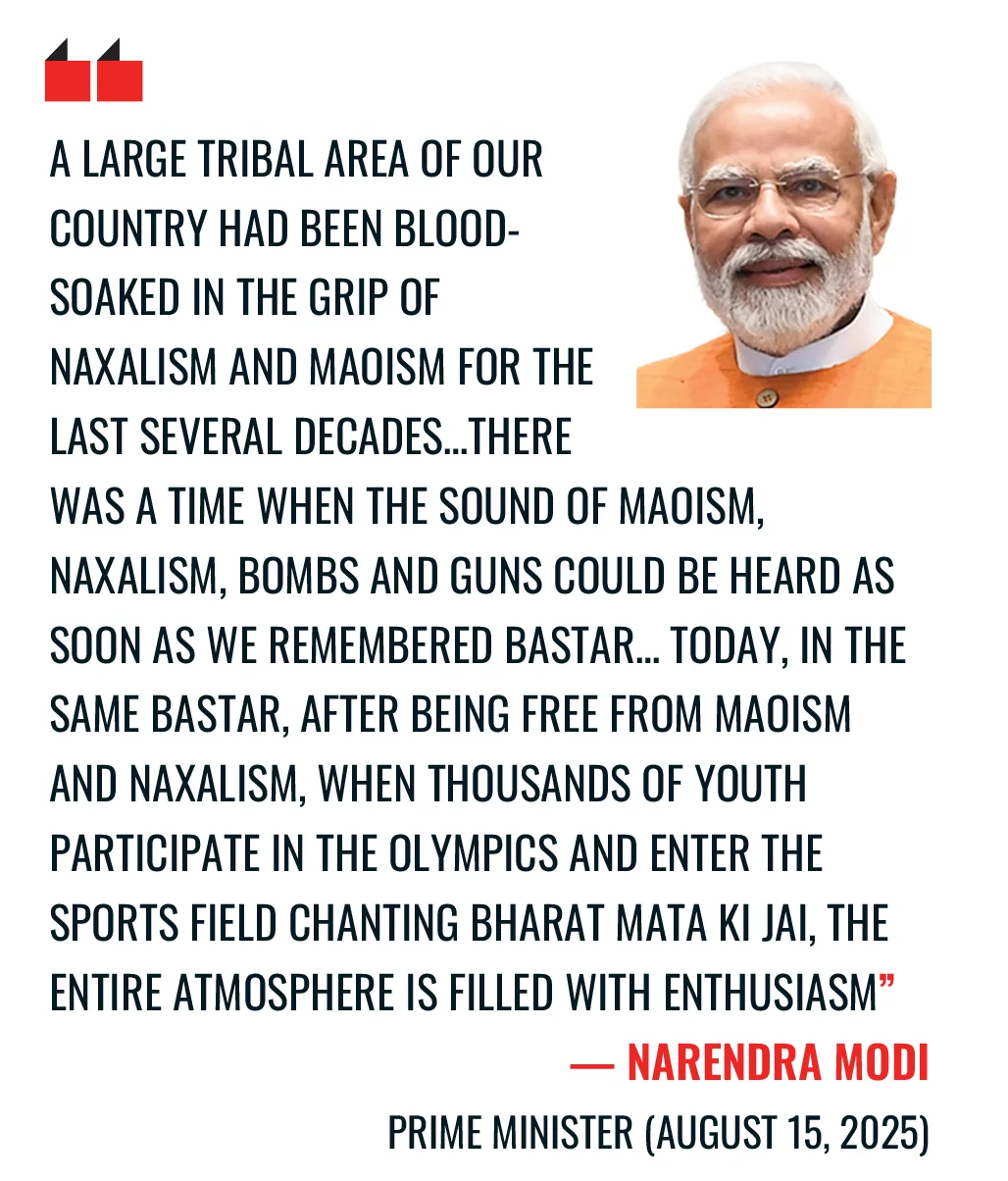
Districts like Dantewada, Bijapur, Malkangiri, and Narayanpur, once synonymous with red terror, witnessed an unprecedented surge in development indices. Through targeted interventions, health and education infrastructure were strengthened, ensuring functional schools, Anganwadi centres, and primary health facilities even in Equally important, the “red-carpet” surrender policy made rehabilitation visible and expedient: surrenderers received immediate assistance, vocational training, housing allotments, and entry into assured livelihood programmes. The aim was simple and pragmatic: make desertion survivable and socially acceptable. The combination of robust security operations, sustained developmental delivery, and empathetic rehabilitation ensured that, under the leadership of Home Minister Amit Shah, Left-Wing Extremism was not merely contained but decisively rolled back replacing fear with faith in governance.
Official statistics and ground reporting from the Ministry of Home Affairs and Press Information Bureau (PIB) confirm that the combination of modern technology, intelligence-driven operations, finance restrictions, and targeted development led to a sharp and observable decline in both Naxal-related incidents and fatalities nationwide. The number of most-affected districts fell consistently over the last decade, with core areas like Buddha Pahad and Chakarbandha cleared and reclassified; by 2025, critical operational centres were either closed or shifted as civil administration returned to areas once controlled entirely by parallel Maoist rule.
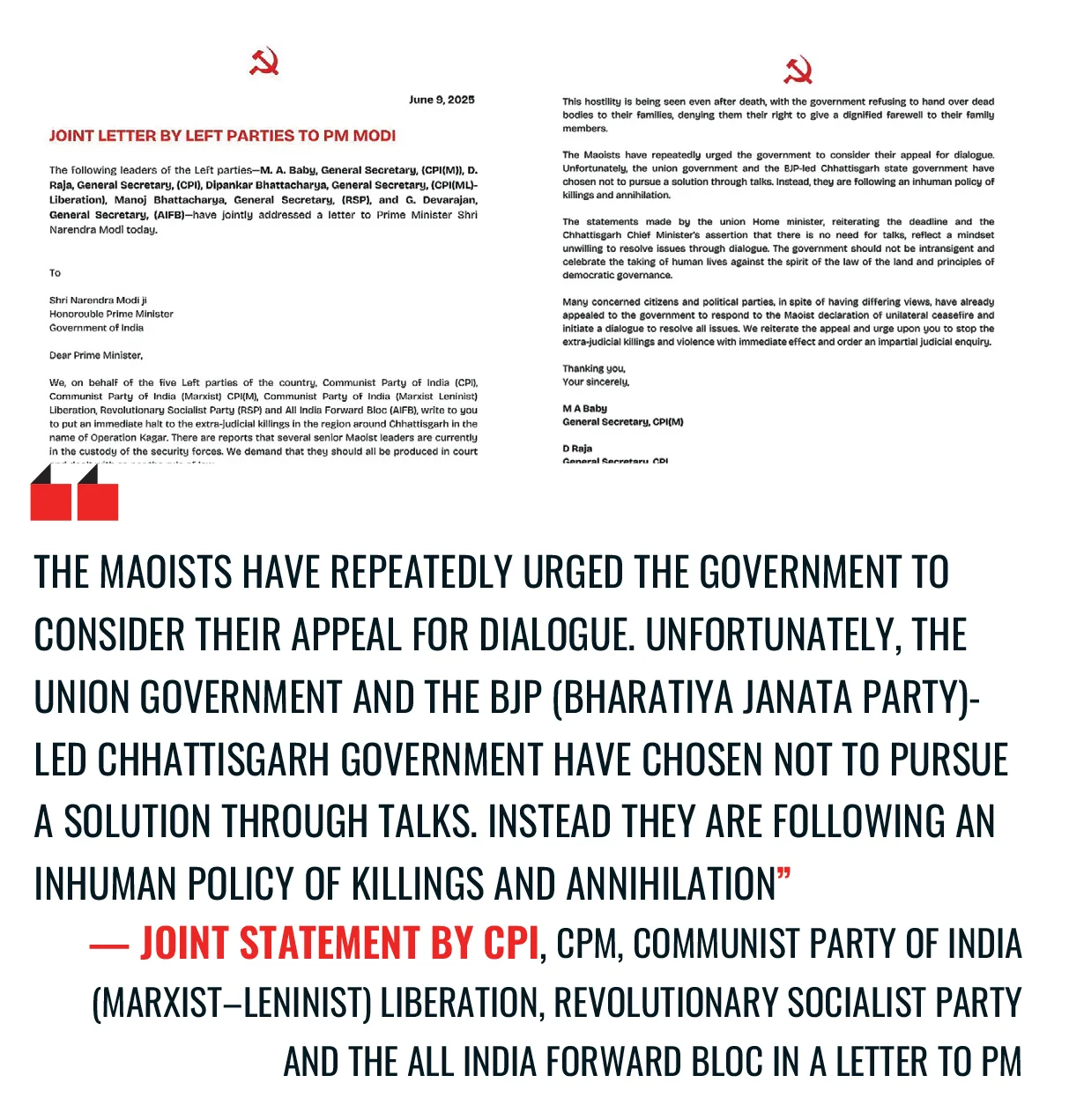
Administrative tools were brought into the same fight. FCRA revocations and suspensions for NGOs with suspect funding were deployed to close channels that could indirectly sustain violence or provide ideological and material cover. Authorities also focused on identifying and countering networks within cities that offered intellectual, logistical or legal support to underground cadres, the phenomenon often termed “Urban Naxals” in public discourse. High-profile probes into the links between urban activists, certain NGOs and alleged underground conduits demonstrated the state’s intent to cut not only jungle pipelines but also sympathetic networks in universities, media and civil-society spaces where legal services, fundraising and safe harbour could be provided.
By mid-2025 the campaign reached a crescendo in a series of large, coordinated operations across the old red corridor in Bastar, Abujhmad, the Karreguttalu Hills, Jharkhand and parts of Odisha and Madhya Pradesh. Operations sometimes lasted days, with multiple service arms cooperating; the recovered material and captured communications revealed demoralisation, logistic shortages and an erosion of command structures. As the leadership pipeline shrank, lower cadres faced a stark choice: surrender and rebuild life, or continue a shrinking fight under hardening pressure.
The campaign’s target date of March 31, 2026, was not symbolic but strategically a disciplined deadline. The goal is clear: armed formations will no longer command territory, levy taxes, or deny civic life to millions. For those who once lived under parallel punishments and fear, the promise is simply a return to normalcy, where welfare replaces violence.