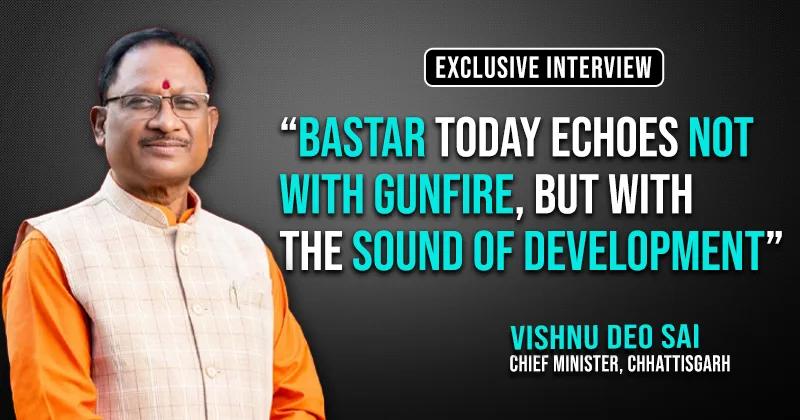
Recently Union Home Minister Amit Shah made it unequivocally clear: there will be no talks with Maoists until they lay down arms and accept the Government’s surrender and rehabilitation policy. He emphasised that violence has no place in Bharat’s democracy. Against this backdrop, Chhattisgarh Chief Minister Vishnu Deo Sai in an email interview with Organiser Senior Assistant Editor Nishant Kumar Azad spoke on the battle against Left Wing Extremism, the State’s coordinated security operations, unprecedented surge in surrenders, and the development push reshaping Bastar. Excerpts:
During his recent address in the Bastar Dussehra Lokotsav and Swadeshi Mela held in Jagdalpur, Union Home Minister Amit Shah ruled out talks with Maoists until they laid down weapons and accepts the Government’s surrender and rehabilitation policy. How do you see this ultimatum by the Home Minister?
The statements of Prime Minister Narendra Modi and Home Minister Amit Shah reflects the Government’s clear and firm commitment to end Naxalism once and for all. Both the Central and State Governments are working with full coordination to ensure peace, security, and development across Bastar and all affected regions. The message is simple and resolute—violence has no place in a building a ‘Viksit Chhattisgarh’. Those who wish to return to the mainstream will find every opportunity to rebuild their lives under the State’s comprehensive surrender and rehabilitation policy, which is among the most progressive in the country. Over the past year, security operations have gained unprecedented momentum, and the results are visible. Hundreds of misguided youths have surrendered and returned back to mainstream, many villages have been declared Naxal-free, and the focus has now shifted firmly to roads, schools, hospitals, and livelihoods. The Home Minister’s call is a message of hope and finality. The Government’s objective is not only to defeat extremism but to secure a lasting transformation that benefits every tribal and Naxal-affected family.
A section of society dubs Naxalism as a “fight for development”. How do you see this narrative?
This perception is completely misplaced. Naxalism was never a fight for development; it has, in fact, been the biggest obstacle to it. For decades, the people of Bastar and other tribal areas were deprived of basic facilities not because the Government neglected them, but because violence and fear kept roads, schools, and hospitals from being built. Today, when the Government is taking development to the remotest corners, those who once took up arms are realising that progress, not conflict, changes lives.
Do you think that the March 2026 deadline is possible? Will you be able to make Chhattisgarh Naxal free by this time?
Yes, I firmly believe that the March 2026 deadline set is achievable. The Government’s coordinated approach–combining strong security measures with focused development–has changed the situation on the ground. Our forces have shown remarkable dedication, neutralising 477 Naxalites, apprehending 1,731, and facilitating the surrender of 1,890 individuals who have chosen the path of peace. The Maoist presence has been pushed back significantly, confined now to a few limited zones, while normal life and governance have taken root across much of Bastar. An equally important pillar of this transformation is the Niyad Nella Nar Yojana, designed to ensure that development reaches those who once lived in fear and isolation. Initially targeting villages within a five-kilometre radius of security camps, the scheme has now expanded to a 10-kilometre radius, integrating 327 villages from five
Naxal-affected districts—Sukma, Bijapur, Narayanpur, Dantewada, and Kanker.
We have seen a big surge in the surrender of Naxalites. On October 2, as many as 103 Maoists, 49 of them carrying a collective bounty of more than Rs 1 crore, surrendered in Chhattisgarh. In your opinion what is the core reason you see behind these mass surrender?
A key factor behind the recent wave of surrenders in Chhattisgarh is the neutralisation of top Maoist leaders, which has significantly weakened the insurgent structure and reduced the fear of reprisal among cadres. This shift has altered the conflict landscape, creating a climate where surrender is a viable option. At its core lies a growing trust in governance and a tangible sense of development reaching areas once dominated by violence. Over the past 20 months, the Government has pursued a dual strategy—combining firm security measures with sensitive outreach and development. The Chhattisgarh Naxalite Surrender, Victim Relief, and Rehabilitation Policy-2025 has been a decisive factor in encouraging surrenders.
‘Key factor behind Recent wave of surrenders is the neutralisation of top Maoist leaders, which has significantly weakened the insurgent structure and reduced the fear of reprisal among cadres’
Govt is taking effective measures to deal with Maoists in the forests but what about “Urban Naxals”?
The Government recognises that the threat of Naxalism extends beyond forested zones into urban centres, where “urban Naxals” provide both financial and ideological support to armed cadres. These urban networks form an important part of sustaining the movement, making them a significant challenge to democratic institutions and development. To counter this, the State has strengthened intelligence networks and enhanced surveillance of suspected urban Naxal activities. Security operations are now designed to address both rural and urban threats in a coordinated manner. This includes close monitoring of ideological fronts, funding channels, and other forms of support that facilitate violence.
Tell us about some important state government schemes and development efforts in the
liberated (Naxal Free) areas?
The Niyad Nella Nar scheme, a flagship state programme, focuses on tribal-dominated villages, particularly those near security camps in Bastar. It delivers healthcare, clean water, roads, electricity, schools, health centres, helipads, and community halls, with special attention to Particularly Vulnerable Tribal Groups. Complementing this, the Central Government’s PM JANMAN (Pradhan Mantri Janjati Adivasi Nyaya Maha Abhiyaan) ensures permanent housing, piped water, rural roads, electrification, hostels, wellness centres, Van Dhan Kendras, skills training, and community infrastructure. The Special PMAY Housing Project is building homes for families affected by violence and surrendered extremists, affirming the Government’s commitment to trust, dignity, and reintegration.
How is the coordination with neighbouring States when it comes to dealing with Maoist activities. What is their approach?
Chhattisgarh maintains close coordination with neighbouring States like Odisha, Telangana, and Maharashtra to tackle Maoist violence, recognising that insurgency crosses borders. These efforts have led to significant successes, including the elimination of senior Maoist leaders. The approach also includes establishing security camps in border districts for rapid response and maintaining pressure until unconditional surrender is achieved. Beyond force, the states coordinate development and rehabilitation initiatives to address root causes.
Union Home Minister Amit Shah has chaired anti-Naxal meetings to promote and strengthen this inter-state cooperation, emphasising intelligence sharing, joint operations, and coordinated development efforts.