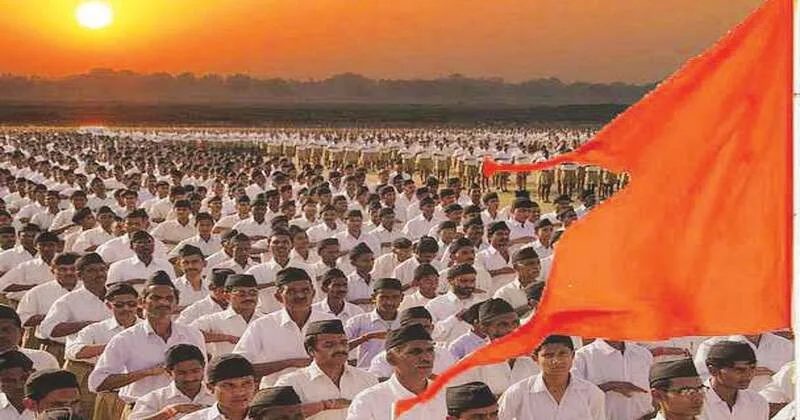
As the Rashtriya Swayamsevak Sangh (RSS) enters its centenary year this Vijay Dashami, on October 2, it is worth reflecting on a remarkable journey spanning a hundred years of resilience, struggle, and service to society. Since its inception in 1925, the RSS has remained steadfast in its vision of national reconstruction, rooted in cultural values and societal unity.
Marking its centenary, the Sangh has brought forward five key pillars for social transformation: samajik samrasta (social harmony), kutumb prabodhan (family awakening), paryavaran (environmental awareness), the emphasis on swa (selfhood), and the duties of citizens. Together, these five directions, known as ‘Pancha Parivartan’, embody the RSS’s renewed commitment to national and social upliftment. At the heart of this vision lies the principle of ‘samajik samarasata’. The Sangh has consistently worked to eradicate social discrimination and promote equality.
The discourse around caste in India has long been shaped not just by social realities but also by colonial interventions, Western misinterpretations, and ideological agendas. To understand casteism today, one must distinguish between the ancient ‘varna’ system of Hindu society and the rigid caste structures imposed and reinforced during colonial rule. Breaking India forces, both external and internal have consistently weaponised the narrative of caste to delegitimise Hindu civilisation and blame Hindus for systemic discrimination, while ignoring the historical distortions introduced by foreign powers. The current rigid caste system, where caste is determined by birth, finds no support in the Vedic tradition. Ancient Indian social organisation was based on varna and ashrama, determined by guna (qualities) and karma (actions). The Bhagavad-gita (4.13) makes this distinction clear, which says,
“chātur-varṇyaṁ mayā sṛiṣhṭaṁ guṇa-karma-vibhāgaśhaḥ
tasya kartāram api māṁ viddhyakartāram avyayam”
It means the four categories of occupations were created by me according to people’s qualities and activities. Although I am the Creator of this system, know Me to be the Non-doer and Eternal. In practice, Vedic society displayed significant mobility. Historical records mention sages like Vishwamitra, born a Kshatriya but revered as a Brahmarshi; and Valmiki, traditionally considered of low birth, becoming the composer of the Ramayana. Similarly, several dynasties in Indian history saw rulers and ministers rising from diverse backgrounds, reflecting the meritocratic flexibility of the system.
Borrowing from the Portuguese term ‘casta’ (race/lineage), they rigidified India’s social groups through censuses and codification. Communities that had once enjoyed mobility became locked into hereditary “castes.” The first all-India census of 1871 and subsequent classifications under H.H. Risley froze social identities into fixed categories, often racialised.
Policies such as the “martial races” theory further deepened divisions. The British portrayed caste as an immutable Hindu flaw, using this narrative to justify their “civilising mission” and to divide Hindus, while Muslims were spared comparable social engineering. This colonial construction still fuels modern propaganda. Breaking India forces Western academics, leftist intellectuals, and missionary lobbies project caste as Hinduism’s “original sin.” They ignore reformist traditions within Hinduism and overlook hierarchies in other societies. Marxist historians exaggerate the rigidity of caste. From the Hindu perspective, casteism today is not a dharmic inevitability but a colonial distortion. The task is twofold: to eliminate genuine caste discrimination within society, and to counter misleading narratives that demonise Hinduism. Returning to the dharmic principle of guna and karma over birth offers both social harmony and cultural resurgence.
This historical backdrop matters because it frames the RSS’s project of social harmony not as a negation of tradition, but as a restoration of its original spirit. From its inception in 1925, Dr. K.B. Hedgewar, the founder of the RSS, envisioned an organisation that would erase divisions within Hindu society. For him, national strength could not be built on a fractured social base. Every Swayamsevak was to consider himself first and foremost a Hindu, bound by a shared civilisational identity rather than caste or sect. M S Golwalkar, the second Sarsanghchalak, defended the Varna system but criticised its degeneration into a rigid, birth-based caste hierarchy that fostered inequality. He condemned untouchability as a deviation from true Hindu principles, arguing it arose from historical disruptions rather than the original Varna framework, and called for its elimination while preserving Varna’s core structure. As Sangh chief, he framed the movement as a cultural effort to revive fraternity, a vision later reinforced by Balasaheb Deoras, the third Sarsanghchalak of the RSS who made social equality central to the Sangh’s outreach, famously stating in 1974, “If untouchability is not wrong, then nothing is wrong in the world.”
The RSS believes that social equality is not only a moral necessity but also a national imperative. Without unity, there can be no national strength; without dignity for all, there can be no cultural resurgence. The real test of commitment lies not in slogans but in action. Over the decades, the Sangh and its affiliated organisations have engaged in a range of initiatives aimed at dismantling caste discrimination and fostering harmony.
In many regions, Swayamsevaks have organised temple entry programs for Dalits, breaking age-old taboos. More strikingly, the Vishwa Hindu Parishad (VHP), an RSS affiliate, has trained over 5,000 Dalits as priests. This not only democratises religious spaces but symbolically dismantles the monopoly of hereditary privilege in spiritual domains. Reports suggest that thousands of temples today are served by priests from marginalised backgrounds, an unthinkable transformation a few decades ago. Through initiatives like Ekal Vidyalayas and Saraswati Shishu Mandirs, the RSS network has reached tribal and rural children who often fall outside the mainstream education system. These schools not only provide literacy but also cultivate cultural pride, helping marginalised communities shed the stigma of inferiority. The Vanvasi Kalyan Ashram, another affiliate, has worked extensively among tribal populations, offering healthcare, education, and livelihood support. Importantly, it has done so without attempting cultural homogenisation, affirming local traditions while integrating them into the broader Hindu fold. During natural calamities, earthquakes, floods, cyclones, the RSS swayamsevaks have been among the first responders. Relief efforts are carried out without regard to caste or religion, embodying the principle of universal service. Such moments create bonds of solidarity that transcend inherited divisions.
While practical initiatives matter, the battle for social harmony is also ideological. Today, global and domestic “Breaking India” forces, Western academics, Marxist historians, and missionary lobbies consistently weaponise the caste narrative to delegitimise Hindu society. They portray Hinduism as uniquely oppressive, ignoring comparable hierarchies in other civilisations and overlooking reformist movements within India itself. For the RSS, therefore, ‘samajik samarasata’ is not only about reforming society but also about reclaiming civilisational dignity. It insists that casteism as practiced today is a distortion, not a dharmic inevitability. Returning to the principle of guna and karma over birth offers a way to both correct social injustices and counter hostile propaganda.
Social harmony is not about denying differences but about ensuring that differences do not divide. The RSS, with its century of grassroots work, offers one model of how civil society can confront entrenched divisions, not with coercion, but with persuasion, service, and cultural renewal. Its message resonates with the constitutional promise of fraternity, and with the civilisational ethos of ‘Vasudhaiva Kutumbakam’, the world as one family. In the words often echoed in Sangh gatherings: “Desh gathan tabhi sambhav hai jab samaj ek ho”, nation-building is possible only when society stands united. As the RSS marks its centenary, its commitment to samajik samrasta is not just an organisational priority; it is a national necessity.