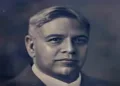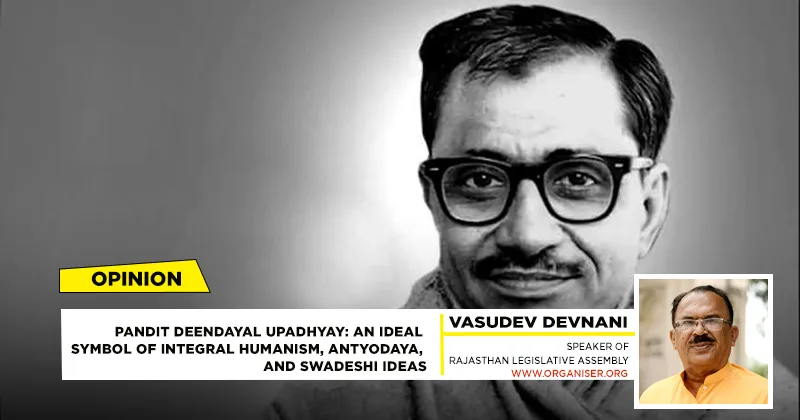
Pandit Deendayal Upadhyay’s name is engraved in golden letters among the great figures in India’s political and ideological history who gave a new direction to society through their lives, thoughts, and actions. He was an eternal guide to Indian politics and thought. He was born on September 25, 1916, in a small village called Nagla Chandrabhan (now Pandit Deendayal Dham) in the Mathura district of Uttar Pradesh. Pandit Deendayal Upadhyay’s father, Bhagwati Prasad Upadhyay, was a railway station master, and his mother, Rampyari, was a religious-minded homemaker. After his parents’ death, he was raised by his grandparents and later by his uncle and aunt. Despite difficult circumstances, he continued his studies. He received his early education at the village school, then at the Government High School, Sikar (Rajasthan), and further education at the universities of Pilani (Rajasthan), Kanpur, and Agra. He was a brilliant student and a gold medalist, and also excelled in morality, discipline, and organisational skills. Despite being born into a humble farming family, he developed an extraordinary personality and remarkable intellectual abilities. He dedicated his entire life to the reconstruction of society and the nation. His birth anniversary is not merely a memorial day, but an opportunity to embrace his ideals.
The carrier of cultural nationalism
Indian culture and tradition were deeply ingrained in Pandit Deendayal Upadhyaya’s life and ideology. He believed that India was not only a political but also a cultural nation, whose soul was rooted in the values of Sanatan Dharma. Instead of blindly emulating Western ideologies, he emphasised finding solutions to India’s problems from an Indian perspective. His life was always simple and ascetic. He owned no personal property and never desired luxury. His life was an epitome of sacrifice and dedication. He remained unmarried throughout his life and dedicated his entire life to serving the nation. These ideals of life made him a great personality and an inspiration.
Beginning of political journey
Pandit Deendayal Upadhyaya joined the Rashtriya Swayamsevak Sangh (RSS) during his student days. As an RSS pracharak, he travelled from village to village, serving the nation and organising. Recognising his organisational abilities, he was given important responsibilities at the founding of the Bharatiya Jana Sangh (1951). From 1951 to 1968, he built the party organisation down to the village level. He prioritised organisation and ideology over personal ambition.
Integral Humanism – Pandit Deendayal Upadhyaya’s original thought
Pandit Deendayal Upadhyaya’s greatest intellectual contribution is the principle of “Integral Humanism.” This fundamental thought is the political and economic aspect of Indian philosophy. His principles of Integral Humanism include not just treating humans as mere creatures but taking a comprehensive view of their complete personality, extending development and prosperity (Antyodaya) to the lowest in society, creating an Indian model of development distinct from Western capitalism or communism, and developing indigenous consciousness in education, art, language, and culture. This idea remains relevant in Indian politics and policymaking even today.
Organisational skills
Pandit Deendayal Upadhyaya’s organisational skills were remarkable. He instilled discipline, dedication, and a spirit of service among the JanSangh workers. He himself was an exemplary embodiment of simplicity and morality. He always travelled in the general class of trains and lived like an ordinary worker. Under his leadership, the Bharatiya Jan Sangh established a remarkable presence across the country. Through his hard work, dedication, and perseverance, he expanded the party organisation to the villages.
The mantra of Antyodaya
Pandit Deendayal Upadhyaya gave the country the concept of “Antyodaya,” the primary objective of which was to bring service and development to the last person in society. This was not merely an economic slogan, but a true, dedicated sense of responsibility for the weak, deprived, and exploited sections of society. Today, the term and spirit of “Antyodaya” in the schemes of the Government of India and state governments are a direct result of his thinking.
Death under mysterious circumstances
Pandit Deendayal Upadhyaya passed away under mysterious circumstances on February 11, 1968, at Mughalsarai station (now Pandit Deendayal Upadhyaya Junction) in Uttar Pradesh. This incident was an irreparable loss for Indian politics, and especially for the Jan Sangh. This divine man passed away at the age of 52, but his ideas remain alive and relevant. Today, when India’s illustrious Prime Minister, Shri Narendra Modi, speaks of a “self-reliant India,” the slogans of “Swadeshi” and “self-reliance” resonate with Pandit Deendayal Upadhyaya’s vision of Swadeshi. His policy of Antyodaya is proving effective, and current schemes for the welfare of the poor, including the Jan Dhan Account, the Ujjwala Yojana, and Ayushman Bharat, etc., embody Panditji’s spirit of Antyodaya. Today, pride in Indian languages, traditions, and values is inspired by his work. Pandit Deendayal Upadhyaya’s life, thoughts, and work have emerged as a role model and a source of inspiration in Indian politics. He taught us that politics is not merely a means to power, but a path to social service and nation-building.
Pandit Deendayal Upadhyay and Rajasthan
Pandit Deendayal Upadhyay had a deep connection with Rajasthan. This connection is not limited to his childhood and student days, his visits to Rajasthan, or his memorials. His ideology has become the foundation for Rajasthan’s political, social, and developmental policies. The vision he articulated for bringing Rajasthan’s marginalised, rural, and backward classes into the mainstream of development remains equally relevant today. When the Bharatiya Jana Sangh was founded in 1951 under the leadership of Dr. Shyama Prasad Mukherjee, Pandit Deendayal Upadhyaya was given the responsibility of the organisation at the all-India level. At that time, the Jana Sangh’s hold in Rajasthan, like in other states, was very weak. Deendayal Upadhyaya considered Rajasthan an important area for organisational expansion. He established Jana Sangh units in major cities such as Jaipur, Ajmer, Kota, and Udaipur. By connecting RSS volunteers with the Jan Sangh organisation, he played an unprecedented role in strengthening the party’s foundation. Pandit Deendayal Upadhyaya visited Rajasthan several times and held numerous organisational meetings in Jaipur, Ajmer, Bikaner, and Jodhpur. He inspired volunteers to reach rural areas. During that period, he launched special campaigns to connect Rajasthan’s farmers, businessmen, and the general public with the Jan Sangh. In his speeches, Deendayal Upadhyaya stated that Rajasthan is geographically inaccessible, and therefore, the concept of “Antyodaya” is the most appropriate path for the development of the state’s desert areas, border areas, tribal areas, and backward regions. These ideas were later realised in the “Antyodaya” scheme, first implemented in the country in 1977 during the Janata Party government led by Shri Bhairon Singh Shekhawat in Rajasthan. These ideas were later implemented by other central and state governments, and reflected in various government policies such as tribal welfare, water conservation, and border development schemes. The concept of “Antyodaya” was particularly meaningful for the tribal and backward areas of Rajasthan (Backward Tribal Sub-Plan Areas like Udaipur, Banswara, Dungarpur, Baran, Sirohi etc.).
Deendayal Upadhyay memorial site
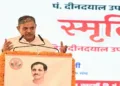
The “Pandit Deendayal Upadhyay Memorial” is located in Dhankya village in Jaipur, the capital of Rajasthan, showcasing his life and thoughts. Several state governments in the country have named various schemes, institutions, and roads after him, such as “Pandit Deendayal Upadhyay Marg,” “Pandit Deendayal Upadhyay College,” and “Pandit Deendayal Upadhyay Hospital.” Not only are numerous schemes running in his name, but numerous projects are also being implemented in the fields of education, skills, and rural development, such as the “Pandit Deendayal Upadhyay Gram Jyoti Yojana,” the “Pandit Deendayal Upadhyay Skill Development Center,” the “Pandit Deendayal Upadhyay Rural Skills Scheme,” and the “Pandit Deendayal Upadhyay National Urban Livelihood Mission.” All of these advance his vision of Antyodaya and self-reliance.
While serving as Education Minister, I added new chapters to the Rajasthan government’s school curriculum, focusing on the lives and works of nearly 200 historical figures and great men of the state, including Pandit Deendayal Upadhyaya. The aim was to inspire the new generation of young people to draw inspiration from the lives of these great men. Furthermore, in my public speeches, I always highlight Pandit Deendayal Upadhyaya’s philosophy as inspiring for youth, social workers, and politicians.
On Pandit Deendayal Upadhyaya’s birth anniversary, we should pledge to adopt his ideals of Integral Humanism, Antyodaya, and Swadeshi in our individual and collective lives. This will be a true tribute to him.